Crude Oil Trading Alert: The Strait of Hormuz is showing signs of easing tensions; oil prices continue to fluctuate and adjust.
2026-08-27 09:53:00
International oil prices were under pressure in Asian trading on Thursday, with WTI crude oil weakening again after a slight rebound in the previous session, trading around $81.80 per barrel at one point. The most crucial pricing factor in the market remains the potential for a gradual resumption of shipping through the Strait of Hormuz. Recent intensive communications between Iran and Oman regarding arrangements for navigation through the strait, and progress made on rights in certain waters and the distribution of related revenues, have somewhat alleviated investor concerns about a prolonged disruption to oil supply.  However, diplomatic progress does not mean the supply risk has been eliminated. Subsequent information from Iran indicates that there is still room for further negotiations on the arrangements, and the full resumption of navigation in the Strait depends on more conditions. Oman, on the other hand, is pushing for the establishment of a temporary shipping lane and discussing specific arrangements for clearing potential obstacles within the channel. Therefore, the market is currently trading more on the expectation of a "reduced supply disruption risk" than on the fact that global crude oil transportation has fully recovered. The importance of the Strait of Hormuz to the global energy market means that any improvement in navigation will be quickly reflected in the oil price risk premium. In peacetime, this channel carries about one-fifth of global oil and gas transportation, but since the conflict, related oil transportation volumes have declined significantly. Recent heated discussions surrounding a temporary lane and the restoration of safe shipping have led the market to reassess the previously excessively high supply disruption premium. Policy signals from the United States also influence oil price trends. The market previously worried that new economic sanctions would further compress Iranian crude oil exports, but the actual measures have been relatively mild, with no more severe comprehensive restrictions imposed on relevant partners for the time being. This means that market concerns about a further significant decline in Iranian supply have eased, prompting some previously established long positions in crude oil to be closed out for profit. The current weakness in oil prices is not merely a technical correction, but also reflects a decline in the geopolitical supply risk premium. US inventory data presents a different signal. The latest data from the US Energy Information Administration shows that for the week ending August 21, US commercial crude oil inventories increased by approximately 95,000 barrels to 428.9 million barrels, marking the fourth consecutive week of increases, but the increase was far lower than the market's previous expectation of approximately 597,000 barrels. Judging from the market reaction, this data is not sufficient to create a significant bearish impact. Although inventories continue to increase, the actual increase is small, meaning that there is no significant supply-demand imbalance in the US crude oil market. Meanwhile, refinery activity, refined product demand, and international supply disruptions could still alter inventory trends. Therefore, inventory data currently seems more like a factor limiting the upside potential of oil prices than a decisive factor driving a rapid decline. It is worth noting that new disruptions have emerged on the Russian energy supply side. The NORSI refinery, Russia's fourth-largest refinery and one of the country's important gasoline production bases, suspended crude oil processing after being attacked by a drone. Public information shows that the refinery has an annual crude oil processing capacity of approximately 15 million tons and a significant gasoline and diesel production capacity. This means that while the easing of tensions in the Hormuz is depressing the geopolitical premium in crude oil prices, disruptions to Russian refinery supply are increasing uncertainty in the energy market. For crude oil, refinery shutdowns do not necessarily mean a reduction in global crude oil supply; some crude oil demand may even decrease due to refinery shutdowns. However, if refined product supply tightens, it could push up gasoline and diesel crack spreads, indirectly affecting subsequent refinery purchases and regional crude oil pricing. Therefore, investors need to distinguish between "crude oil supply risk" and "refined product supply risk," as their price transmission mechanisms are not entirely the same. Meanwhile, the European energy market still faces high uncertainty. The possibility of further damage to Russian energy facilities will maintain a certain risk premium in the market regarding regional energy supply. If the scope of subsequent refinery shutdowns expands, or if Russian crude oil production and export facilities are directly affected, oil prices may regain fundamental support. Conversely, if shipping in the Hormuz continues to recover, and the disruption to Russian energy facilities does not escalate further, the current risk premium in oil prices may continue to shrink. The US dollar's performance is also a crucial variable for short-term oil prices. Crude oil is priced in US dollars, and a stronger dollar typically increases purchasing costs for non-dollar investors, thus suppressing commodity demand and price performance. Currently, the market is reassessing the path of US monetary policy while continuing to focus on US economic data and subsequent policy signals from the Federal Reserve. If the dollar remains strong, it may further limit the upside potential of WTI crude oil; if the dollar weakens again, it could help oil prices gain some technical upward momentum. From a market sentiment perspective, the crude oil market has gradually shifted from "supply disruption trading" to "risk premium reversion trading." This means that investors are no longer simply chasing price increases driven by geopolitical conflicts, but are beginning to refocus on inventory, demand, refinery operations, and actual global shipping volumes. The recent continuous weakening of WTI also indicates a decline in the willingness of bulls to further expand their risk exposure. The most important issue at present is not whether oil prices will immediately enter a long-term decline, but whether the improved shipping conditions in the Hormuz can truly translate into a stable recovery in physical flows. From a daily chart perspective, WTI has recently experienced a significant pullback after its surge, with prices approaching the $81 level again, and the short-term upward structure is being tested. Previous technical analysis indicated that the $81.0-$81.5 area was a key support zone, while the area around $80 represented a stronger medium-term defense zone. If $81 holds effectively, oil prices may retest the resistance around $84 amid recurring geopolitical risks. Previously, the market technical structure considered $84.3 a key dividing line, with the $86.5-$87 area as a further resistance level. If the daily chart breaks below $81 and further falls below $80, it signifies a significant weakening of the recent rebound structure, and the market may seek new support around $79 or even $78. Conversely, if oil prices can regain the $82.5-$84 area with improved trading momentum, it suggests that this pullback may be more of a technical adjustment following a contraction in risk premium, rather than a trend reversal. Current daily momentum has cooled significantly compared to the previous period, and investors should not judge the trend solely based on single-day geopolitical news. Looking at the 4-hour chart, WTI is currently in a short-term weak structure, with the area around $81 being a crucial battleground between bulls and bears. If the price finds support around $81 and forms a series of higher highs and lower lows, it may correct towards $82.5 and $84 in the short term. If it breaks below $81 and the rebound fails to recover that level, the bears may further test $80 or even the $79 area. From a previous technical perspective, the $80.99-$81.17 area was considered an important defensive zone for the short-term trend, so the current price fluctuations will be key to determining the next direction.
 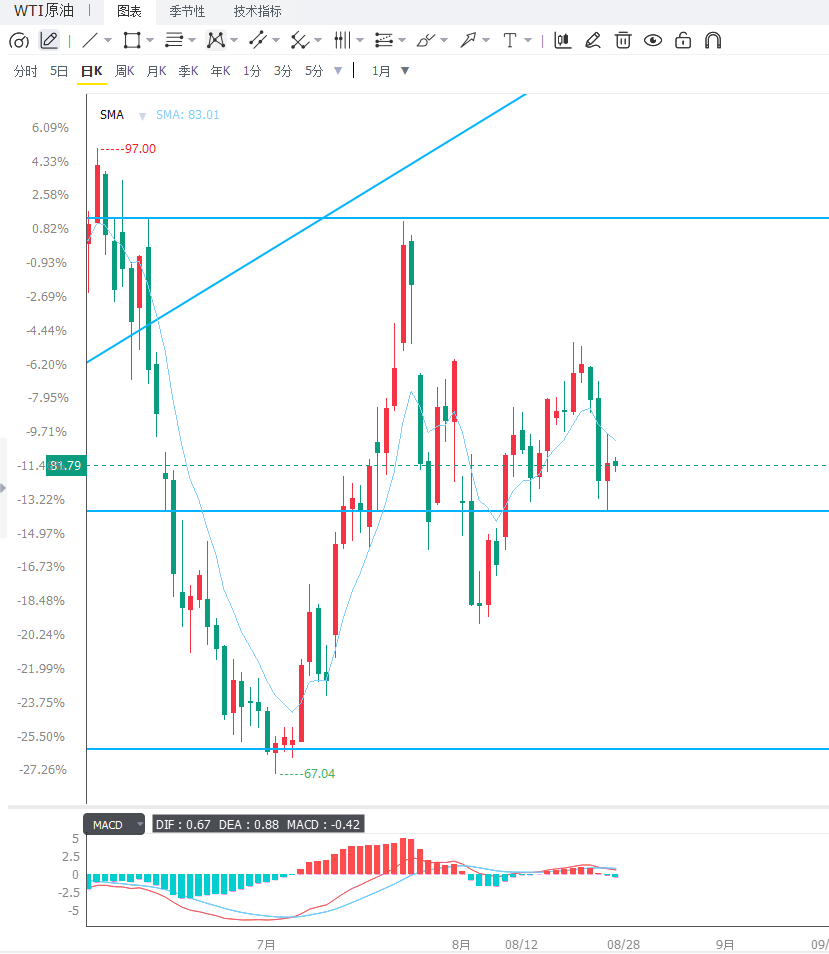 The core contradiction surrounding WTI crude oil has shifted: easing tensions in the Strait of Hormuz are reducing supply risk premiums, but disruptions to Russian energy facilities are limiting downside potential. US crude oil inventories increased by only 95,000 barrels, far below market expectations, indicating that the US inventory fundamentals have not yet formed a strong bearish signal. In the short term, $81 is a crucial level for judging the strength or weakness of WTI. If diplomatic progress continues to drive shipping recovery and US inventories continue to accumulate, oil prices may retreat further to the $80 or even $78 range; however, if the recovery of shipping through the Strait of Hormuz falls short of expectations, coupled with increased supply risks from Russian refineries and other energy facilities, oil prices may quickly re-incorporate geopolitical premiums.
However, diplomatic progress does not mean the supply risk has been eliminated. Subsequent information from Iran indicates that there is still room for further negotiations on the arrangements, and the full resumption of navigation in the Strait depends on more conditions. Oman, on the other hand, is pushing for the establishment of a temporary shipping lane and discussing specific arrangements for clearing potential obstacles within the channel. Therefore, the market is currently trading more on the expectation of a "reduced supply disruption risk" than on the fact that global crude oil transportation has fully recovered. The importance of the Strait of Hormuz to the global energy market means that any improvement in navigation will be quickly reflected in the oil price risk premium. In peacetime, this channel carries about one-fifth of global oil and gas transportation, but since the conflict, related oil transportation volumes have declined significantly. Recent heated discussions surrounding a temporary lane and the restoration of safe shipping have led the market to reassess the previously excessively high supply disruption premium. Policy signals from the United States also influence oil price trends. The market previously worried that new economic sanctions would further compress Iranian crude oil exports, but the actual measures have been relatively mild, with no more severe comprehensive restrictions imposed on relevant partners for the time being. This means that market concerns about a further significant decline in Iranian supply have eased, prompting some previously established long positions in crude oil to be closed out for profit. The current weakness in oil prices is not merely a technical correction, but also reflects a decline in the geopolitical supply risk premium. US inventory data presents a different signal. The latest data from the US Energy Information Administration shows that for the week ending August 21, US commercial crude oil inventories increased by approximately 95,000 barrels to 428.9 million barrels, marking the fourth consecutive week of increases, but the increase was far lower than the market's previous expectation of approximately 597,000 barrels. Judging from the market reaction, this data is not sufficient to create a significant bearish impact. Although inventories continue to increase, the actual increase is small, meaning that there is no significant supply-demand imbalance in the US crude oil market. Meanwhile, refinery activity, refined product demand, and international supply disruptions could still alter inventory trends. Therefore, inventory data currently seems more like a factor limiting the upside potential of oil prices than a decisive factor driving a rapid decline. It is worth noting that new disruptions have emerged on the Russian energy supply side. The NORSI refinery, Russia's fourth-largest refinery and one of the country's important gasoline production bases, suspended crude oil processing after being attacked by a drone. Public information shows that the refinery has an annual crude oil processing capacity of approximately 15 million tons and a significant gasoline and diesel production capacity. This means that while the easing of tensions in the Hormuz is depressing the geopolitical premium in crude oil prices, disruptions to Russian refinery supply are increasing uncertainty in the energy market. For crude oil, refinery shutdowns do not necessarily mean a reduction in global crude oil supply; some crude oil demand may even decrease due to refinery shutdowns. However, if refined product supply tightens, it could push up gasoline and diesel crack spreads, indirectly affecting subsequent refinery purchases and regional crude oil pricing. Therefore, investors need to distinguish between "crude oil supply risk" and "refined product supply risk," as their price transmission mechanisms are not entirely the same. Meanwhile, the European energy market still faces high uncertainty. The possibility of further damage to Russian energy facilities will maintain a certain risk premium in the market regarding regional energy supply. If the scope of subsequent refinery shutdowns expands, or if Russian crude oil production and export facilities are directly affected, oil prices may regain fundamental support. Conversely, if shipping in the Hormuz continues to recover, and the disruption to Russian energy facilities does not escalate further, the current risk premium in oil prices may continue to shrink. The US dollar's performance is also a crucial variable for short-term oil prices. Crude oil is priced in US dollars, and a stronger dollar typically increases purchasing costs for non-dollar investors, thus suppressing commodity demand and price performance. Currently, the market is reassessing the path of US monetary policy while continuing to focus on US economic data and subsequent policy signals from the Federal Reserve. If the dollar remains strong, it may further limit the upside potential of WTI crude oil; if the dollar weakens again, it could help oil prices gain some technical upward momentum. From a market sentiment perspective, the crude oil market has gradually shifted from "supply disruption trading" to "risk premium reversion trading." This means that investors are no longer simply chasing price increases driven by geopolitical conflicts, but are beginning to refocus on inventory, demand, refinery operations, and actual global shipping volumes. The recent continuous weakening of WTI also indicates a decline in the willingness of bulls to further expand their risk exposure. The most important issue at present is not whether oil prices will immediately enter a long-term decline, but whether the improved shipping conditions in the Hormuz can truly translate into a stable recovery in physical flows. From a daily chart perspective, WTI has recently experienced a significant pullback after its surge, with prices approaching the $81 level again, and the short-term upward structure is being tested. Previous technical analysis indicated that the $81.0-$81.5 area was a key support zone, while the area around $80 represented a stronger medium-term defense zone. If $81 holds effectively, oil prices may retest the resistance around $84 amid recurring geopolitical risks. Previously, the market technical structure considered $84.3 a key dividing line, with the $86.5-$87 area as a further resistance level. If the daily chart breaks below $81 and further falls below $80, it signifies a significant weakening of the recent rebound structure, and the market may seek new support around $79 or even $78. Conversely, if oil prices can regain the $82.5-$84 area with improved trading momentum, it suggests that this pullback may be more of a technical adjustment following a contraction in risk premium, rather than a trend reversal. Current daily momentum has cooled significantly compared to the previous period, and investors should not judge the trend solely based on single-day geopolitical news. Looking at the 4-hour chart, WTI is currently in a short-term weak structure, with the area around $81 being a crucial battleground between bulls and bears. If the price finds support around $81 and forms a series of higher highs and lower lows, it may correct towards $82.5 and $84 in the short term. If it breaks below $81 and the rebound fails to recover that level, the bears may further test $80 or even the $79 area. From a previous technical perspective, the $80.99-$81.17 area was considered an important defensive zone for the short-term trend, so the current price fluctuations will be key to determining the next direction. The core contradiction surrounding WTI crude oil has shifted: easing tensions in the Strait of Hormuz are reducing supply risk premiums, but disruptions to Russian energy facilities are limiting downside potential. US crude oil inventories increased by only 95,000 barrels, far below market expectations, indicating that the US inventory fundamentals have not yet formed a strong bearish signal. In the short term, $81 is a crucial level for judging the strength or weakness of WTI. If diplomatic progress continues to drive shipping recovery and US inventories continue to accumulate, oil prices may retreat further to the $80 or even $78 range; however, if the recovery of shipping through the Strait of Hormuz falls short of expectations, coupled with increased supply risks from Russian refineries and other energy facilities, oil prices may quickly re-incorporate geopolitical premiums.
- Risk Warning and Disclaimer
- The market involves risk, and trading may not be suitable for all investors. This article is for reference only and does not constitute personal investment advice, nor does it take into account certain users’ specific investment objectives, financial situation, or other needs. Any investment decisions made based on this information are at your own risk.