Institutions: Major Asian powers are advancing the gold corridor; gold has become a strategic mineral.
2026-08-27 13:29:00
A recent in-depth report by S&P Global points out that gold is a strategic mineral for major Asian governments, playing a central role not only in their long-term economic policies but also deeply embedded in their national security strategies. The Gold Road initiative is a key component of this strategic framework. The report provides a comprehensive analysis of the gold markets in major Asian countries, covering regulation, consumer demand, mining and production, and central bank reserves, revealing how these countries leverage international networks to place gold at the center of their economic and defense planning.
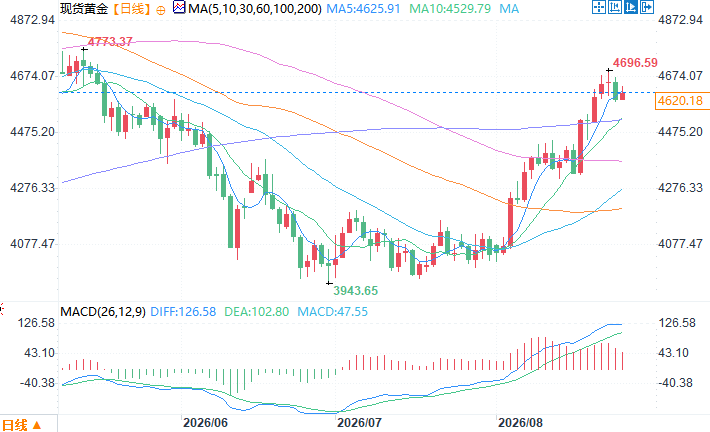 Spot gold daily chart source: FX678. As of 13:26 Beijing time on August 27, spot gold was trading at $4620.18 per ounce.
From pandemic disruptions to security-driven development: Gold's status rises across the board.
The report's authors explain that while the globalization strategies of major Asian powers were interrupted by the pandemic, they have since been reactivated and refocused on gold, potentially driving their efforts for years to come. They write: "Globalization slowed during the pandemic but restarted in 2022 with a greater sense of urgency. That year, Western sanctions frozen Russia's foreign exchange reserves due to the Russia-Ukraine conflict, raising concerns among Chinese policymakers and increasing the importance of gold as a potential means of mitigating such risks. Consequently, coupled with subsequent events, national security objectives such as enhancing economic resilience and reducing external dependence have been elevated to core organizing principles behind the policies of major Asian powers." The report also notes: "While some argue that the economic advantages of trading gold in a country's currency or holding gold reserves are still debatable, this means that such considerations are likely to be overridden by new security objectives."Central banks resume gold purchases, revealing a gold investment corridor.
The report notes that central banks in major Asian countries resumed their gold-buying spree at the end of 2022, and the country's gold exchange (SGE) reaffirmed its Gold Corridor initiative proposed in 2019. The report's authors state that driven by long-term goals such as currency internationalization, enhanced economic resilience, and reduced dependence on the US dollar, this initiative is expected to progress gradually, but with unwavering commitment. The Gold Corridor targets BRICS and Belt and Road Initiative member countries, echoing the country's trade and diplomatic efforts in the Global South. The report's authors write: "The latest Gold Corridor initiative aims to establish a global network of gold vaults to support the trading of the country's currency in gold and the exchange of the country's currency for gold stored in vaults. As more partner countries open such vaults, they will form a multilateral network for gold trading, exchange, and custody based on the country's currency, in addition to the US dollar."Hong Kong takes the lead: the first offshore gold vault and regional gold reserve hub
The first offshore gold vault is set to open in Hong Kong in 2025, accompanied by two gold contracts denominated in the country's currency. Transactions can be settled in the country's currency or settled with physical gold delivery, including delivery to the new vault. The report states that other potential locations reportedly include regional gold trading hubs such as Singapore, Kuala Lumpur, Dubai, Riyadh, and Moscow. The report's authors indicate that this network could connect to the world's largest physical gold market and could also attract countries seeking to diversify their gold storage, both onshore and nearshore, to enhance their control. While the future construction, operation, and implementation of the vault in partner countries remain unclear, Hong Kong's first vault is expected to serve as a model. The Hong Kong International Airport Precious Metals Storage Vault is the first offshore vault of the country's gold exchange. The report's authors write that the vault is owned and certified by the gold exchange and operated by the country's bank (Hong Kong) Limited, with an initial capacity of 150 tons. Hong Kong plans to expand its city's gold storage capacity tenfold to over 2,000 tons within three years to establish itself as a regional gold reserve hub. This size is close to the country's total gold reserves, equivalent to nearly one-third of the gold holdings in the New York Federal Reserve Bank's vaults, or 40% of the gold holdings in the Bank of England's vaults in London. The Hong Kong vault adopts the management system of the gold exchange and is supported by the centralized gold trading clearing system, which began trial operation on July 7, 2026.Conclusion: Certainty in an Uncertain World
In discussing several gold initiatives by major Asian powers, including the Gold Corridor strategy, S&P Global wrote: "As tensions and conflicts continue to arise around the world, we expect major Asian powers to advance these gold deployments and other related plans. These plans incorporate both past policy objectives and new security considerations." The report concludes: In an uncertain future, one thing may be certain: as these efforts progress, the country's role in the global gold market will be further strengthened. Spot gold daily chart source: FX678. As of 13:26 Beijing time on August 27, spot gold was trading at $4620.18 per ounce.
- Risk Warning and Disclaimer
- The market involves risk, and trading may not be suitable for all investors. This article is for reference only and does not constitute personal investment advice, nor does it take into account certain users’ specific investment objectives, financial situation, or other needs. Any investment decisions made based on this information are at your own risk.