The Federal Reserve's latest statement: Inflation stickiness is rising, and employment and independence are facing challenges.
2026-08-27 21:23:02
With the upcoming central bank interest rate meeting, market discussions surrounding inflation, employment, and central bank independence are heating up again. With only the August employment and inflation data remaining before the September FOMC meeting, and the Jackson Hole Economic Symposium approaching, internal divisions within the Federal Reserve are becoming increasingly apparent, significantly raising uncertainty about the policy path. 
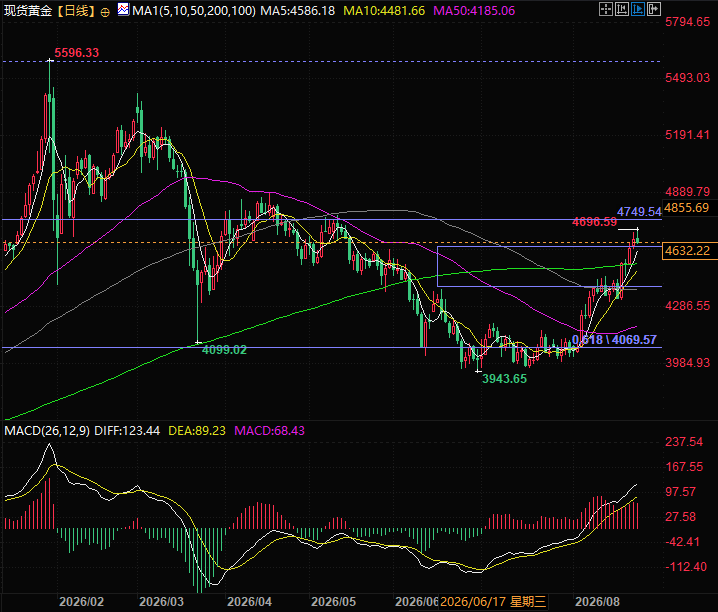 (Spot gold daily chart, source: EasyTrade) At 21:18 Beijing time, spot gold is currently trading at $4,588 per ounce.
Inflationary stickiness persists, and geopolitical risks to refined oil products become a new variable.
Federal Reserve officials Goolsby and Schmid have both released signals, outlining a contradictory picture of the current US macroeconomic environment. Regarding inflation, Goolsby pointed out that inflation data over the past three months has not shown a poor performance, but the biggest short-term risk remains the failure to effectively control inflation. Price disturbances caused by tariffs and war will pose real challenges to monetary policy. Schmid emphasized that inflation is stubbornly sticky, and the energy shock is penetrating the real economy; policymakers still need more data to make judgments. Meanwhile, external geopolitical risks are further amplifying inflation concerns. The Russia-Ukraine conflict continues to escalate, with Ukraine continuing to attack Russian refining and export infrastructure, and Russia restricting diesel and distillate exports, leading to a tightening of global refined oil supply. Compared to regular gasoline, refined oil price increases can be transmitted through multiple channels such as logistics, aviation, manufacturing, and agriculture, resulting in a wider impact and a longer duration. Institutions generally believe that the previous phase of declining inflation is nearing its end, and refined oil may become a major driver of the next round of inflation. Even if short-term inflation figures ease, external supply-side shocks remain a risk hanging over the Federal Reserve.The unique employment pattern of "low hiring + low layoffs" harbors a fragile equilibrium.
Regarding the job market, Goolsby argues that the current labor market pattern of low hiring and low layoffs is highly unusual. Data shows that while companies are maintaining low layoff levels and current employees have a strong sense of job security, their willingness to expand hiring has contracted significantly. Companies are subjectively stockpiling existing employees but lack confidence in future economic expansion. This unusual equilibrium is clearly fragile; net non-farm payrolls equal total hiring minus layoffs. Current hiring has already fallen to a low level, and if corporate profitability deteriorates and their mindset shifts, even a small increase in layoffs could cause a rapid collapse in net hiring, posing a risk of a soft landing and a downward spiral for the economy. The latest initial jobless claims data shows a moderate rise in the four-week moving average, but an unexpected decline in continuing jobless claims, with the insured unemployment rate remaining at 1.2%, indicating that the labor market remains in tight balance. This apparent resilience masks internal structural pressures and also interferes with the Federal Reserve's policy decisions. While the job market has not yet shown clear signs of deterioration, providing fundamental support for maintaining restrictive interest rates, the potential for contraction in lower-level jobs cannot be ignored.The clash between fiscal and monetary policies has brought the central bank's independence under intense scrutiny.
At the policy level, the tension between fiscal and monetary policies has become increasingly apparent. Treasury Secretary Bessant expanded the Treasury repurchase program, intending to suppress long-term Treasury yields. This action conflicts with Warsh's advocacy of allowing the market to price assets independently, further complicating the monetary policy environment. The market had previously held the logic that "rising long-term yields would replace interest rate hikes," but the Treasury's proactive intervention in long-term bond yields weakened the effectiveness of this mechanism. Meanwhile, the issue of central bank independence has been repeatedly raised. Goolsby explicitly expressed concern about political pressure on the Federal Reserve, arguing that political interference in central banks often fuels inflation risks. Schmid stated that the midterm elections would not interfere with the October policy meeting, and that Fed officials as a whole do not believe that central bank independence has been substantially undermined, but the market has begun to be wary of potential disruptions to monetary policy from fiscal and political factors. Hawkish forces within the FOMC are rising, with more than three members supporting the resumption of interest rate hikes. The view that interest rate hikes should be resumed as soon as possible if inflation does not show substantial improvement is gaining more acceptance among policymakers. In his Jackson Hole speech, Warsh needed to explain to the market whether current interest rates were sufficiently restrictive, explain how maintaining the current policy would bring inflation back to the 2% target, and also strive for consensus within the committee.A complex interplay of forces has brought gold prices into a critical observation window.
Amidst a confluence of conflicting factors, gold prices are caught in a tug-of-war between multiple forces. On one hand, disruptions to refined oil supply and geopolitical conflicts raising inflation risks could fuel expectations that the Federal Reserve will maintain high interest rates or even resume rate hikes, leading to rising real yields on US Treasury bonds and suppressing the valuation of non-interest-bearing gold. On the other hand, Treasury intervention in the bond market and a misalignment between fiscal and monetary policy objectives are accumulating market doubts about the credibility of the US dollar and US Treasury assets. Coupled with global safe-haven demand, this will provide a floor for gold prices. Future gold pricing will depend on the magnitude of the inflation rebound, the sustainability of the fragile labor market balance, and how the Federal Reserve balances its anti-inflationary goals with the risks of economic downturn. Until the stickiness of inflation, employment concerns, and policy maneuvering are resolved, gold is likely to maintain a wide range of fluctuations. Inflation and employment data around September will be key catalysts for gold prices to break through the current range. (Spot gold daily chart, source: EasyTrade) At 21:18 Beijing time, spot gold is currently trading at $4,588 per ounce.
- Risk Warning and Disclaimer
- The market involves risk, and trading may not be suitable for all investors. This article is for reference only and does not constitute personal investment advice, nor does it take into account certain users’ specific investment objectives, financial situation, or other needs. Any investment decisions made based on this information are at your own risk.