Gold Trading Alert: Bulls and bears battle at the 4600 level; the first appearance of the Wash-Jackson Hall conference could be a key indicator of future market direction.
2026-08-28 07:53:01
Spot gold fluctuated around the $4,600 mark on Thursday (August 28), rising as high as $4,643.18 before falling back to a low of around $4,565.67, closing at $4,600.78 per ounce, a gain of about 0.14%. The previous day, gold prices had fallen sharply by 1.4%, marking the largest single-day drop in a week. On the surface, this appears to be just routine high-level fluctuations, but behind it lies a complex interplay of factors: a rising and falling dollar, expectations of US Treasury repurchase agreements, sticky inflation, and uncertainty surrounding the Federal Reserve's policy path. Market attention is almost entirely focused on Federal Reserve Chairman Warsh's first major public speech at the Jackson Hole symposium on Friday. Investors hope to glean insights into the Fed's true assessment of inflation and potential shifts in future monetary policy. Gold, a traditional safe-haven and inflation-hedging asset, is awaiting a potentially decisive moment that could determine its short-term direction. In early Asian trading on Friday (August 28), spot gold traded in a narrow range, currently hovering around $4,596.72 per ounce. 
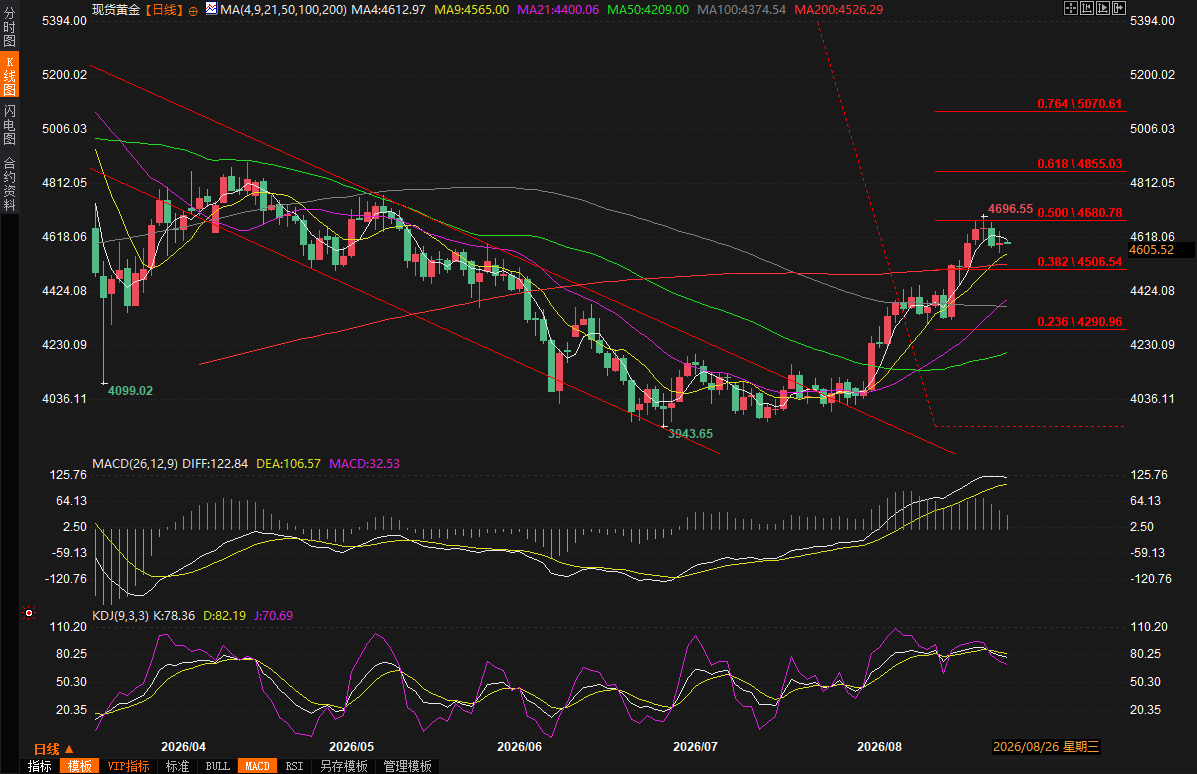 (Spot gold daily chart, source: EasyTrade) At 07:48 Beijing time, spot gold is currently trading at $4596.55 per ounce.
The direct drivers behind the high-level fluctuations: a decline in the US dollar and capital rebalancing.
Gold prices rebounded slightly on Thursday, directly benefiting from the pullback in the US dollar index. The dollar touched 99.26 intraday, a new high since August 19, before closing near 99.12. A weaker dollar makes dollar-denominated gold more attractive to investors holding other currencies, thus supporting buying. This trend is consistent with the logic behind gold's climb to its highest level since mid-May earlier this week. The core catalyst for that rally was the US Treasury's announcement last week of increased buybacks of older, long-term bonds. The market quickly interpreted this as a signal that the US government was attempting to directly intervene in rising borrowing costs, reigniting concerns about a long-term depreciation of the dollar. Looking at fund flows, gold's rise is not isolated. Bob Haberkorn, senior market strategist at StoneX, explicitly stated his bullish stance on gold prices, citing simple reasons: current demand includes continued inflows into ETFs and central banks' allocation needs for gold as an alternative asset to the dollar. Haberkorn also cautioned that the market will remain cautious in the short term as traders await key signals from the Jackson Hole symposium. In other words, although gold prices have risen above the $4,600 mark, upward momentum and downside risks coexist, and any policy statement could become a trigger to disrupt the balance.Jackson Hole: Walsh's Debut and the Market's Craving for a "Clear Roadmap"
The real focus of global financial markets this week is on the annual economic symposium in Jackson Hole, Wyoming. Federal Reserve Chairman Warsh will speak on Friday, his first public articulation of policy thinking at this high-profile event since taking office . Investors are particularly hoping he will use this opportunity to clearly outline the path to bringing inflation down to the 2% target and the role the bond market should play in this process. Warsh has previously emphasized that the Fed needs to "talk less" to allow for clearer price signals in the bond market. However, Treasury Secretary Bessenter's recent significant increase in long-term bond repurchase operations has been seen by some market participants as active intervention in price signals. Erik Bregar, Director of Foreign Exchange and Precious Metals Risk Management at Silver Gold Bull in Toronto, bluntly stated that this contradiction is perplexing: "Warsh wants to reduce intervention to make market signals clearer, but the Treasury is distorting those signals. If Warsh doesn't clarify his position on Friday, the dollar could fall sharply." Geoff Yu, a strategist at BNY Mellon, cautioned based on historical patterns that in the past three years, regardless of specific policy signals, the dollar has often been under pressure around the end of the month after the Jackson Hole meeting, with the content of the speech determining the magnitude rather than the direction of capital flows. Market expectations for Warsh's speech were inherently restrained. The new chairman has consistently opposed providing overly explicit forward guidance and rarely elaborates on the rationale behind his decisions. Therefore, even if he discusses inflation and the policy framework, he is unlikely to offer a clear signal directly pointing to the September FOMC meeting. Currently, the CME FedWatch tool shows that the market's probability of a September rate hike has fallen to around 35%, but the likelihood of a December rate hike remains as high as 74%. This "cautious in the near term, hawkish in the long term" pricing is a key factor contributing to the high-level fluctuations in gold prices.Inflation stickiness and job stability: Divergence within the Federal Reserve is widening.
What worries gold bulls is the persistent stubbornness of US inflation. Data released Wednesday showed that the Federal Reserve's closely watched Personal Consumption Expenditures (PCE) price index rose 3.7% year-on-year in July, unchanged from June, marking the 65th consecutive month well above the 2% target. While this data wasn't significantly different from expectations, it was enough to prompt several Fed officials to publicly express their concerns during Jackson Hole. Kansas City Fed President Schmid pointed out that inflation "remains stubborn and sticky," and the current policy rate of 3.50% to 3.75% does not seem to have a sufficient restraining effect on the economy. He bluntly stated, "I don't know what we're actually restraining with the current interest rate policy," and hinted that he still favors raising interest rates to help inflation fall. Cleveland Fed President Hamack similarly stated that inflation has been above target for more than five years, and monetary policy has not effectively curbed price pressures; she "believes it's time to take action." Chicago Fed President Goolsby emphasized that the biggest concern in the short term remains that inflation may not be under control, and the public may gradually form the expectation that "above-target inflation will not disappear," a risk that deserves vigilance. In contrast, Boston Fed President Collins viewed the latest inflation data as "mixed," slightly above expectations overall, but with some encouraging signs when broken down, including market-driven inflation in goods and services roughly around the 2% target. Collins' baseline scenario remains a gradual slowdown in inflation, with the current policy environment somewhat restrictive. She is also willing to raise interest rates if inflation fails to decline. This internal divergence makes the market more eager for a unified framework statement from Warsh. Employment data provides another layer of buffer. Initial jobless claims in the US fell for the second consecutive week to 203,000, below expectations; continuing claims also fell to a one-month low. The labor market remains generally stable, and the unemployment rate remains at historically low levels. This means that the Fed does not need to be overly concerned about a collapse in employment, at least in the short term, and can continue to focus on inflation. Meanwhile, the goods trade deficit widened to $118.8 billion in July, the largest in 16 months, with capital goods imports surging due to the artificial intelligence construction boom, further highlighting the complex tensions in the US economic structure.The Link Between Bond Market and the US Dollar: The Pricing Logic of Gold Amid a Slight Rise in Yields
The US Treasury market also entered a wait-and-see mode on Thursday. The two-year Treasury yield rose slightly to around 4.23%, while the ten-year yield rose to 4.672%, with the yield curve steepening slightly. Traders generally expected Warsh's speech to provide only limited policy guidance for September. The Treasury successfully completed a $183 billion issuance of medium- and short-term bonds this week, with robust demand in the seven-year auction and winning bid rates close to secondary market levels. Notably, Warsh has established several working groups to review the Fed's operations and monetary policy framework, one of which will assess the data used in decision-making. He previously indicated a preference for referencing broader inflation measures, which might show price pressures lower than traditional PCE data. Lou Brien, a strategist at DRW Trading, believes this gives Warsh considerable leeway in his inflation assessment. Meanwhile, there is potential tension between the Treasury's increased long-term bond repurchases and Warsh's statement of "referring more to bond market movements." These details collectively form the macroeconomic backdrop for gold pricing: in an environment where the dollar may be under pressure, inflation stickiness persists, and the policy path is not yet fully clear, gold remains attractive as a hedging asset.Conclusion: Amidst the high-level speculation, the real test for gold has only just begun.
In summary, gold prices are fluctuating around $4,600, which is both a natural digestion of previous upward momentum and a direct reflection of market caution ahead of the Jackson Hole meeting. Short-term trends will heavily depend on Warsh's remarks on Friday—if he releases a hawkish signal on inflation or hints that the policy framework will focus more on actual data rather than excessive communication, gold may gain new support; if his remarks are too dovish or avoid key issues, it could trigger a dollar rebound and a gold price pullback. In the medium to long term, continued demand from ETFs and central banks, the subtle interaction between US fiscal and monetary policies, and the potential reassessment of the dollar's credibility globally still constitute structural benefits for gold. In the current phase of significantly increased macroeconomic uncertainty, gold is no longer just a simple "safe-haven asset," but has become an important window for observing the credibility of the Fed's policies, the sustainability of US fiscal policy, and the shift in global asset allocation. Warsh's Jackson Hole debut may not provide all the answers immediately, but it is likely to determine the pace of gold's fluctuations in the coming weeks or even months. The market is holding its breath. (Spot gold daily chart, source: EasyTrade) At 07:48 Beijing time, spot gold is currently trading at $4596.55 per ounce.
- Risk Warning and Disclaimer
- The market involves risk, and trading may not be suitable for all investors. This article is for reference only and does not constitute personal investment advice, nor does it take into account certain users’ specific investment objectives, financial situation, or other needs. Any investment decisions made based on this information are at your own risk.