Crude oil trading reminder: After rebounding, oil prices have fallen again and remain in a range-bound trading pattern in the short term. Continue to monitor changes on the supply side.
2026-08-28 09:43:03
International oil prices saw profit-taking after two consecutive days of rebound, with WTI crude trading around $83 per barrel in Asian trading on Friday. Looking at the overall performance this week, oil prices remain in a correction phase as the market rebalances two opposing supply factors: on the one hand, the potential reopening of the Strait of Hormuz has reduced the premium for Middle Eastern supply disruptions; on the other hand, renewed tensions between Russia and Ukraine, coupled with ongoing attacks on Russian refineries and ports, have brought renewed attention to the risks of global refined product and crude oil supply.  Recently, market focus has shifted somewhat from the Middle East situation to energy supplies in Eastern Europe. Russian President Vladimir Putin's comments regarding limited progress in negotiations have heightened market concerns about further escalation. Meanwhile, Ukraine has continued its attacks on Russian refineries, ports, and other energy infrastructure, impacting Russia's refining capacity. If these attacks continue, market concerns may extend beyond crude oil production capacity to include refining, refined product supply, and export logistics. Market surveys show that attacks on Russian refining facilities reached a high level in August, with some refineries experiencing significant capacity disruptions. This means the global energy market needs to reassess the stability of the Russian supply chain. While the risks to Russian energy facilities are rising, a different development has emerged in the Strait of Hormuz. Iran and Oman have recently held negotiations on shipping management in the strait, making progress on temporary shipping arrangements and some revenue sharing issues. Iran previously confirmed discussions with Oman regarding strait waters management and revenue sharing, but the arrangements announced by both foreign ministries are closer to establishing a temporary shipping framework and do not necessarily indicate that the waterway has returned to normal operation. From actual shipping data, shipping activity in the Strait of Hormuz has indeed recovered somewhat, but it remains significantly below normal levels. Market data shows that the number of observable commodity vessels passing through on August 26 rose to approximately 10, up from 8 the previous day, but still below the 10-day moving average of approximately 15. This indicates that market supply concerns have eased somewhat, but it is not enough to prove that global energy transportation has stabilized. Some vessels may have turned off their Automatic Identification Systems (AIS), so the actual number of passages may be higher than publicly reported, but the market cannot yet confirm that the strait has entered a full recovery phase. This is also a major reason for the recent fluctuations in oil prices. Previously, the market rapidly reduced the risk premium for crude oil due to the temporary shipping arrangements between Iran and Oman, with WTI briefly falling to around $80; subsequently, attacks on Russian energy facilities and renewed regional tensions drove funds back into the energy market. However, oil prices currently lack a single catalyst for sustained upward movement. If the Strait of Hormuz were to reopen further, it would mean that some previously blocked Middle Eastern crude oil could re-enter the international market, potentially alleviating global supply tensions. Conversely, if shipping recovery is slower than expected, or if the security situation deteriorates again, the crude oil market will quickly re-inflate the risk of supply disruptions. Therefore, current oil prices are essentially dynamically priced based on the speed of shipping recovery and the extent of damage to Russian supply. The U.S. Energy Information Administration previously projected that global crude oil supply in 2026 would remain significantly affected by declining Middle Eastern production, with the WTI average price for the year expected to be around $80.88 per barrel. Meanwhile, market institutions anticipate that some Middle Eastern crude oil production capacity may continue to be affected, meaning that even with the gradual resumption of shipping through the Strait of Hormuz, supply may not quickly return to pre-conflict levels. From a demand perspective, oil prices above $80 have increased pressure on consumers. If energy prices remain high, costs in aviation, transportation, chemicals, and manufacturing may rise further, re-influencing market assessments of global inflation. For the Federal Reserve, continued energy price increases could slow the pace of further inflation decline, indirectly affecting interest rate expectations and the dollar's trajectory. Conversely, if shipping through the Strait of Hormuz recovers significantly and crude oil prices fall back to around $80, the inflationary impact of energy prices may gradually weaken. Currently, market sentiment is exhibiting a clear two-way tug-of-war. On the one hand, the hope for a recovery in shipping through the Strait of Hormuz limits further upward movement by bulls; on the other hand, continued attacks on Russian energy infrastructure prevent bears from establishing a one-sided trend. MUFG believes that the recent strengthening of crude oil prices may indicate that the energy market is attempting to start a new round of rebound, but whether this trend can be sustained largely depends on how many ships can safely pass through the Strait of Hormuz. The agency points out that current oil price levels already reflect a possible increase in shipping traffic compared to before, but the actual transportation situation remains highly uncertain. Therefore, investors need to focus on three key changes in the coming trading days. First, the actual number of ships passing through the Strait of Hormuz; if this number continues to rise and approaches normal levels, the crude oil supply premium may further decline. Second, the situation regarding attacks on Russian refineries and ports; if the frequency of attacks continues to remain high, the risk of refined oil supply may further push up crude oil prices. Finally, changes in US inventories, gasoline, and distillate fuel demand. If US fuel inventories remain tight, even if crude oil inventories don't change significantly, it could provide additional support for oil prices. From a daily chart perspective, WTI crude oil has rebounded above $82 after a rapid pullback, showing signs of stabilizing at lower levels and attempting a rebound in the short term. The price's current position above $82 indicates that bulls are still vying for control of the medium-term trend, but the $83.50-$84.00 area has become the first significant resistance level. A successful break and hold above $84 could lead to further testing of the $85.50-$86.00 area; a break above $86 would suggest a potential shift in the short-term correction towards an upward trend. Conversely, if the price falls below $82 again, caution is warranted regarding a weakening of the previous rebound momentum. The next support level to watch is $80.00-$80.50, with further support at $78.50-$79.00. Overall, daily momentum is recovering, but a clear one-sided upward structure has not yet formed. Geopolitical supply news remains the core variable determining the validity of any breakout. From a 4-hour chart perspective, WTI crude oil experienced a rapid decline followed by a continuous rebound, with the short-term price structure improving. Currently, it's consolidating around the $82-$83 range. Short-term moving averages are gradually flattening out from their downward trend, and the MACD momentum is showing signs of recovery. However, the price still faces significant selling pressure around $83.50. If a breakout above $83.50-$84.00 occurs with significant volume, the short-term rebound could open up further, potentially leading to a retest of $85 or even $86. Conversely, if multiple attempts to break through this area fail, and the price falls back below $82, the current rebound is more likely a technical correction, and the price may retest the support around $80. Therefore, short-term trading should focus on observing the breakout direction around the $82 support and $84 resistance levels, rather than prematurely concluding that oil prices have entered a new round of one-sided upward movement.
 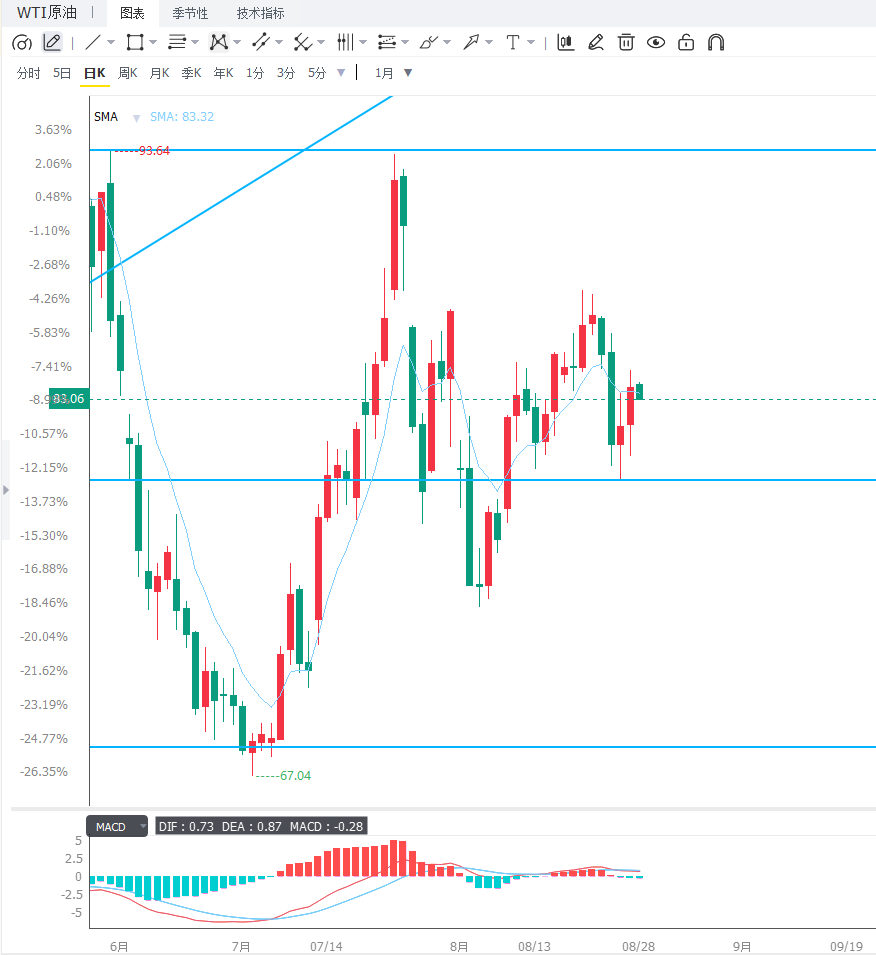 The editor summarizes that WTI is currently in a rebalancing phase between declining Middle Eastern supply risks and rising Russian energy supply risks. Signs of improvement in shipping through the Strait of Hormuz have lowered some risk premiums, but a full recovery is still far off, while continued disruptions to Russian energy infrastructure add new uncertainties to global crude oil and refined product supplies. If shipping through the Strait of Hormuz continues to recover while Russian energy exports remain stable, oil prices may return to around $80; conversely, if shipping recovery is hampered and damage to Russian energy facilities worsens, WTI could break through $84 and further approach $86 or even $90. Therefore, the biggest risk in the current crude oil market is not a single event, but rather the simultaneous changes at multiple key nodes in the supply chain. Close monitoring of actual shipping data, the extent of damage to Russian energy facilities, and changes in US fuel inventories is crucial, and assessments of oil prices should be dynamically adjusted between the two scenarios of supply recovery and supply disruption.
Recently, market focus has shifted somewhat from the Middle East situation to energy supplies in Eastern Europe. Russian President Vladimir Putin's comments regarding limited progress in negotiations have heightened market concerns about further escalation. Meanwhile, Ukraine has continued its attacks on Russian refineries, ports, and other energy infrastructure, impacting Russia's refining capacity. If these attacks continue, market concerns may extend beyond crude oil production capacity to include refining, refined product supply, and export logistics. Market surveys show that attacks on Russian refining facilities reached a high level in August, with some refineries experiencing significant capacity disruptions. This means the global energy market needs to reassess the stability of the Russian supply chain. While the risks to Russian energy facilities are rising, a different development has emerged in the Strait of Hormuz. Iran and Oman have recently held negotiations on shipping management in the strait, making progress on temporary shipping arrangements and some revenue sharing issues. Iran previously confirmed discussions with Oman regarding strait waters management and revenue sharing, but the arrangements announced by both foreign ministries are closer to establishing a temporary shipping framework and do not necessarily indicate that the waterway has returned to normal operation. From actual shipping data, shipping activity in the Strait of Hormuz has indeed recovered somewhat, but it remains significantly below normal levels. Market data shows that the number of observable commodity vessels passing through on August 26 rose to approximately 10, up from 8 the previous day, but still below the 10-day moving average of approximately 15. This indicates that market supply concerns have eased somewhat, but it is not enough to prove that global energy transportation has stabilized. Some vessels may have turned off their Automatic Identification Systems (AIS), so the actual number of passages may be higher than publicly reported, but the market cannot yet confirm that the strait has entered a full recovery phase. This is also a major reason for the recent fluctuations in oil prices. Previously, the market rapidly reduced the risk premium for crude oil due to the temporary shipping arrangements between Iran and Oman, with WTI briefly falling to around $80; subsequently, attacks on Russian energy facilities and renewed regional tensions drove funds back into the energy market. However, oil prices currently lack a single catalyst for sustained upward movement. If the Strait of Hormuz were to reopen further, it would mean that some previously blocked Middle Eastern crude oil could re-enter the international market, potentially alleviating global supply tensions. Conversely, if shipping recovery is slower than expected, or if the security situation deteriorates again, the crude oil market will quickly re-inflate the risk of supply disruptions. Therefore, current oil prices are essentially dynamically priced based on the speed of shipping recovery and the extent of damage to Russian supply. The U.S. Energy Information Administration previously projected that global crude oil supply in 2026 would remain significantly affected by declining Middle Eastern production, with the WTI average price for the year expected to be around $80.88 per barrel. Meanwhile, market institutions anticipate that some Middle Eastern crude oil production capacity may continue to be affected, meaning that even with the gradual resumption of shipping through the Strait of Hormuz, supply may not quickly return to pre-conflict levels. From a demand perspective, oil prices above $80 have increased pressure on consumers. If energy prices remain high, costs in aviation, transportation, chemicals, and manufacturing may rise further, re-influencing market assessments of global inflation. For the Federal Reserve, continued energy price increases could slow the pace of further inflation decline, indirectly affecting interest rate expectations and the dollar's trajectory. Conversely, if shipping through the Strait of Hormuz recovers significantly and crude oil prices fall back to around $80, the inflationary impact of energy prices may gradually weaken. Currently, market sentiment is exhibiting a clear two-way tug-of-war. On the one hand, the hope for a recovery in shipping through the Strait of Hormuz limits further upward movement by bulls; on the other hand, continued attacks on Russian energy infrastructure prevent bears from establishing a one-sided trend. MUFG believes that the recent strengthening of crude oil prices may indicate that the energy market is attempting to start a new round of rebound, but whether this trend can be sustained largely depends on how many ships can safely pass through the Strait of Hormuz. The agency points out that current oil price levels already reflect a possible increase in shipping traffic compared to before, but the actual transportation situation remains highly uncertain. Therefore, investors need to focus on three key changes in the coming trading days. First, the actual number of ships passing through the Strait of Hormuz; if this number continues to rise and approaches normal levels, the crude oil supply premium may further decline. Second, the situation regarding attacks on Russian refineries and ports; if the frequency of attacks continues to remain high, the risk of refined oil supply may further push up crude oil prices. Finally, changes in US inventories, gasoline, and distillate fuel demand. If US fuel inventories remain tight, even if crude oil inventories don't change significantly, it could provide additional support for oil prices. From a daily chart perspective, WTI crude oil has rebounded above $82 after a rapid pullback, showing signs of stabilizing at lower levels and attempting a rebound in the short term. The price's current position above $82 indicates that bulls are still vying for control of the medium-term trend, but the $83.50-$84.00 area has become the first significant resistance level. A successful break and hold above $84 could lead to further testing of the $85.50-$86.00 area; a break above $86 would suggest a potential shift in the short-term correction towards an upward trend. Conversely, if the price falls below $82 again, caution is warranted regarding a weakening of the previous rebound momentum. The next support level to watch is $80.00-$80.50, with further support at $78.50-$79.00. Overall, daily momentum is recovering, but a clear one-sided upward structure has not yet formed. Geopolitical supply news remains the core variable determining the validity of any breakout. From a 4-hour chart perspective, WTI crude oil experienced a rapid decline followed by a continuous rebound, with the short-term price structure improving. Currently, it's consolidating around the $82-$83 range. Short-term moving averages are gradually flattening out from their downward trend, and the MACD momentum is showing signs of recovery. However, the price still faces significant selling pressure around $83.50. If a breakout above $83.50-$84.00 occurs with significant volume, the short-term rebound could open up further, potentially leading to a retest of $85 or even $86. Conversely, if multiple attempts to break through this area fail, and the price falls back below $82, the current rebound is more likely a technical correction, and the price may retest the support around $80. Therefore, short-term trading should focus on observing the breakout direction around the $82 support and $84 resistance levels, rather than prematurely concluding that oil prices have entered a new round of one-sided upward movement. The editor summarizes that WTI is currently in a rebalancing phase between declining Middle Eastern supply risks and rising Russian energy supply risks. Signs of improvement in shipping through the Strait of Hormuz have lowered some risk premiums, but a full recovery is still far off, while continued disruptions to Russian energy infrastructure add new uncertainties to global crude oil and refined product supplies. If shipping through the Strait of Hormuz continues to recover while Russian energy exports remain stable, oil prices may return to around $80; conversely, if shipping recovery is hampered and damage to Russian energy facilities worsens, WTI could break through $84 and further approach $86 or even $90. Therefore, the biggest risk in the current crude oil market is not a single event, but rather the simultaneous changes at multiple key nodes in the supply chain. Close monitoring of actual shipping data, the extent of damage to Russian energy facilities, and changes in US fuel inventories is crucial, and assessments of oil prices should be dynamically adjusted between the two scenarios of supply recovery and supply disruption.
- Risk Warning and Disclaimer
- The market involves risk, and trading may not be suitable for all investors. This article is for reference only and does not constitute personal investment advice, nor does it take into account certain users’ specific investment objectives, financial situation, or other needs. Any investment decisions made based on this information are at your own risk.