The euro awaits a new catalyst; policy divergence between the European Central Bank and the Federal Reserve supports the exchange rate.
2026-08-28 08:27:01
On Friday (August 28) during Asian trading hours, the euro traded in a narrow range against the US dollar, currently hovering around 1.1650. Expectations of a September rate hike by the European Central Bank continue to support the euro – the market is pricing in a 96% probability of a rate hike. Executive Board member Schnabel stated that the Middle East conflict and the strong Eurozone economy pose upside risks to inflation. The Eurozone economy has shown resilience, with data released last Friday showing business activity expanding at its fastest pace this year. However, the market remains cautious ahead of Federal Reserve Chairman Warsh's Jackson Hole keynote speech on Friday. 
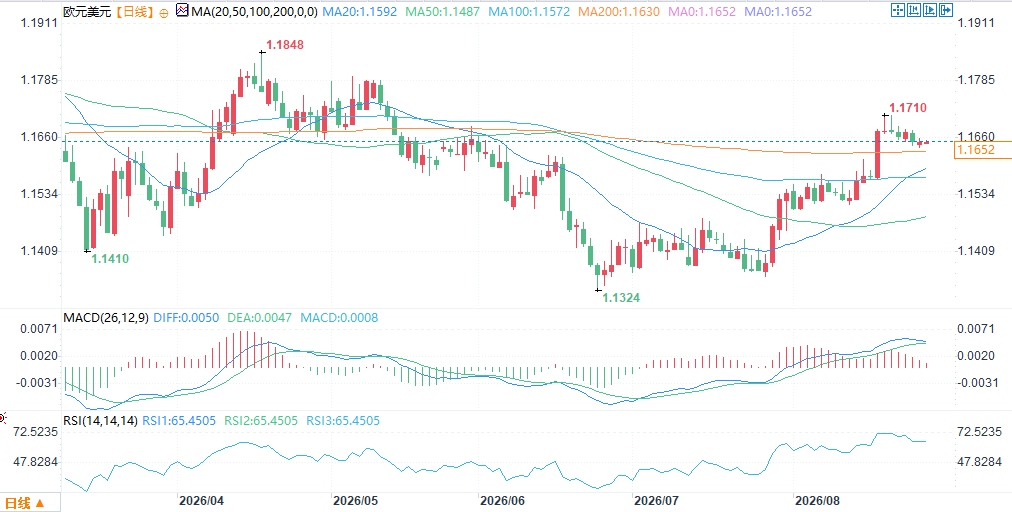 (Euro/USD daily chart, source: EasyForex) At 8:22 Beijing time, the euro/dollar exchange rate was 1.1650/51.
Hawkish expectations from the European Central Bank supported the euro, while the market awaited Jackson Hole.
The expectation of a September rate hike by the European Central Bank (ECB) has become a core supporting force, with the market pricing in a 96% probability of a rate hike, indicating that traders are almost certain that policy will tighten further. Executive Board member Schnabel recently stated explicitly that the Middle East conflict pushing up energy costs, coupled with the strong performance of the Eurozone economy, poses a significant upside risk to inflation, reinforcing the necessity for the ECB to maintain a hawkish stance. Meanwhile, the latest Eurozone business activity data shows significant economic resilience, with the fastest expansion this year, providing solid fundamental support for the euro. Scotiabank analysis points out that although the euro has temporarily lost some upward momentum due to yield curve fluctuations, in the medium term, policy divergence remains a clear positive – the ECB is expected to raise rates in September, while market pricing in further Fed rate hikes continues to subside. This narrowing interest rate differential expectation helps the euro maintain relative strength. Overall, ahead of the Jackson Hole meeting, the euro/dollar exchange rate is still supported by the ECB's hawkish expectations in the short term, but a directional breakout requires confirmation from the Fed.Jackson Hole's speech becomes a key variable
Markets remained highly cautious ahead of Federal Reserve Chairman Kevin Warsh's Jackson Hole keynote speech on Friday, with short-term volatility in the euro/dollar exchange rate narrowing significantly. As the new Fed chairman's first policy-related remarks at this important forum, Warsh's wording will be a key catalyst in determining the short-term direction of the dollar. The head of interest rate strategy at Bank of America pointed out that if Warsh explicitly hints that "the Fed is prepared to raise interest rates further if inflation fails to continue to cool," the market will quickly interpret this as a hawkish signal, potentially providing immediate support for the dollar and putting pressure on the euro/dollar exchange rate, causing it to retrace to the 1.1600 support area or even lower. Conversely, if Warsh focuses more on long-term structural themes such as productivity improvements and demographic changes, while avoiding specific statements on the interest rate path, it may be seen as dovish, weakening the dollar and helping the euro/dollar exchange rate test the 1.1700 resistance level. Traders generally believe that whether Warsh will provide clear triggers for interest rate adjustments is the biggest highlight of the speech. Jackson Hole has historically been an important window for the Fed to communicate policy shifts, and the market is extremely sensitive to any subtle changes in wording. If the speech reinforces expectations that US interest rates will remain high for a longer period, the support for the euro from policy divergence will be temporarily offset by a stronger dollar. If the speech is dovish, the contrast between the ECB's September rate hike expectations and the Fed's wait-and-see attitude will become more pronounced, and the euro is likely to continue its moderate upward trend. Trading in Europe and the US after the Asian session on Friday will be heavily priced in around this event.Institutional Views
ING expects the euro to rise to 1.17 against the dollar by the end of September, 1.18 by the end of 2026, and further to 1.20 12 months later. The core logic is that the Federal Reserve will not raise interest rates this year (requiring support from July-August inflation data and a market-priced-in probability of a rate hike falling below approximately 30%), while the European Central Bank will raise rates by 25 basis points in September, pushing interest rate differentials in favor of the euro. Eurozone economic data shows resilience (Q2 GDP and August PMI better than expected), and while energy prices are high, they have not completely eroded the growth outlook. ING believes the dollar will experience a moderate depreciation in an environment of rising risk appetite, with relatively light euro positions also providing support. In the short term, it may fluctuate in the 1.15-1.16 range due to the influence of natural gas prices and the Fed meeting minutes, but the medium-term trend is biased towards upward. JPMorgan Chase predicts the euro to reach 1.15 against the dollar in September, 1.14 in December, and 1.13 in March 2027, with a further decline to around 1.10 in the medium term (mid-2027). The main drivers were the widening growth divergence between the US and the Eurozone, the Fed's more hawkish repricing pushing up the real and nominal interest rate differentials, and the sharp deterioration in the Eurozone's terms of trade (export/import price ratio) and the collapse in relative stock market returns following the conflict with Iran.Summarize
The expectation of a September rate hike by the European Central Bank continues to support the euro—the market has priced in a 96% probability, reflecting the resilience of the Eurozone economy. The market awaits Warsh's speech at Jackson Hole on Friday. A Bank of America strategist noted that if Warsh emphasizes preparedness for a rate hike, the tone will be hawkish; if he focuses on structural themes, the tone will be dovish. Scotiabank points out that policy divergence remains a medium-term positive. The euro/dollar exchange rate may fluctuate between 1.1600 and 1.1700 in the short term, awaiting new directional guidance from Jackson Hole. (Euro/USD daily chart, source: EasyForex) At 8:22 Beijing time, the euro/dollar exchange rate was 1.1650/51.
- Risk Warning and Disclaimer
- The market involves risk, and trading may not be suitable for all investors. This article is for reference only and does not constitute personal investment advice, nor does it take into account certain users’ specific investment objectives, financial situation, or other needs. Any investment decisions made based on this information are at your own risk.