The pound has retreated from a six-month high, with funds being reshuffled at month-end?
2026-08-28 21:01:02
On Friday, August 28, the pound was trading around 1.3580 against the dollar, down from a six-month high of 1.3675 reached earlier this week. The pound has fallen approximately 0.4% this week and may be ending its four-week winning streak. The core market dynamic has shifted from simple interest rate differentials to a repricing of month-end rebalancing, UK fiscal constraints, inflation stickiness, and monetary policy expectations. 
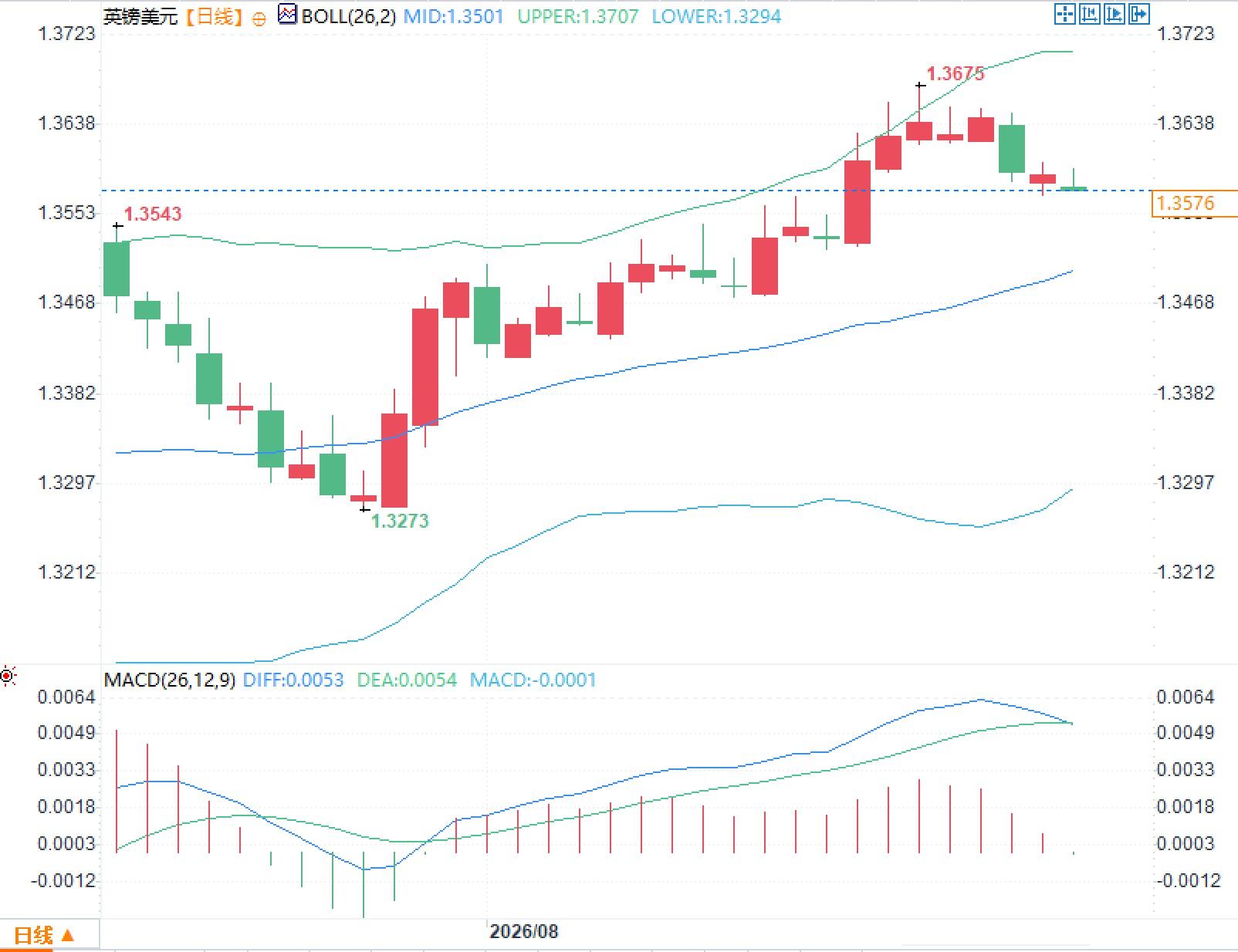 From the daily chart, the Bollinger Bands have the middle band at approximately 1.3501, the upper band at approximately 1.3707, and the lower band at approximately 1.3294. The price previously approached the upper band area before pulling back, and is currently back between the middle and upper bands. The MACD indicator shows the DIFF at approximately 0.0053, the DEA at approximately 0.0054, and the histogram at approximately -0.0001, indicating that the previously strong trend momentum has clearly subsided, but the indicators remain above the zero line.
Month-end rebalancing is changing the short-term pricing structure of the pound.
End-of-month fund flows are not essentially a vote on the direction of the UK economy, but rather a rebalancing of global asset portfolios following changes in stock, bond, and currency prices. When a particular currency and its related assets perform strongly for a period, international portfolios often experience a need for contrarian adjustments to restore their established risk exposure. The pound is currently in this sensitive range. Earlier in August, the pound remained relatively strong due to expectations of UK interest rates and resilient economic data, recently rising to around 1.3675 before gradually giving back its gains. This means that current exchange rate fluctuations cannot be simply attributed to a single macroeconomic data point. For institutional funds, month-end rebalancing, corporate foreign exchange hedging, and the translation effect of overseas income may all be present simultaneously. Especially after several weeks of continuous gains in the pound, the scale of passive adjustments at the balance sheet level is often significantly higher than during calm periods. Therefore, short-term fluctuations may become temporarily decoupled from medium-term macroeconomic fundamentals.The UK's fundamentals are not weak, but policy constraints are increasing.
The latest economic data presents a fairly typical combination: growth remains resilient, but inflation has not been fully resolved. UK real GDP grew 0.4% quarter-on-quarter in the second quarter, compared to 0.6% in the first quarter; June GDP grew 0.3% in June alone, with the services sector growing 0.4%, indicating that economic activity has not experienced a significant slowdown. Meanwhile, the Consumer Price Index (CPI) rose to 2.9% year-on-year in July, higher than June's 2.6%; the core CPI remained at 2.6%, and while the year-on-year increase in service prices fell from 3.6% to 3.4%, it remains at a level that policymakers need to continue monitoring. This data explains why UK interest rate expectations remain quite flexible. The Bank of England's current policy rate is 3.75%, and the next interest rate decision will be announced on September 17. Recently, the market's pricing in further interest rate hikes this year has decreased, currently reflecting roughly 25 basis points of tightening space, rather than the previously higher levels. Therefore, the pound is not facing a traditional problem of economic weakness, but rather a question of whether interest rate support has been adequately priced in. For a currency that has already benefited from high yields and macroeconomic resilience, new positive news needs to be strong enough to continue to change the existing valuation framework.While business confidence has improved, the real concern is the decline in price willingness.
The UK business confidence index rose 4 points to 53% in August, the highest level since March and significantly higher than the 12-month average of 47%. The business outlook index reached 58%, and economic optimism rose to 49%, an increase of 18 points from June. More noteworthy than the 53% figure is the third consecutive month of decline in business pricing intentions. This combination of business confidence and pricing intentions suggests that improved demand expectations do not necessarily translate into stronger price transmission. If this trend continues, it could reduce the risk of a new feedback loop between wages, service prices, and end-market prices. The implications for the interest rate market are complex. On the one hand, improved business confidence indicates that the economy remains resilient; on the other hand, declining pricing intentions weaken the need for continued monetary tightening. These two forces simultaneously reduce the pound's sensitivity to individual economic data points while increasing its sensitivity to changes in the overall yield curve.Fiscal discipline becomes a new link between the pound sterling and UK government bonds.
UK Chancellor of the Exchequer John Healy has confirmed that the first budget will be released on October 28th, and has clearly stated that the budget will be based on fiscal discipline while adhering to existing fiscal rules. John Healy became Chancellor on July 20th, while Andy Burnham became Prime Minister at the same time. The significance of this statement for the exchange rate market lies not in a single fiscal measure, but in how the risk premium for UK assets changes. Currently, the UK faces a structural dilemma: the government needs to balance public services, investment, and security spending, while simultaneously preventing fiscal deficits and long-term financing costs from reinforcing each other. If the market believes that fiscal rules remain binding, the term premium for UK government bonds is more likely to remain stable; if future budgets lead to a renewed increase in bond supply expectations, then changes in long-term yields may reflect fiscal risk more than monetary policy expectations. Therefore, the relationship between the pound and UK government bond yields cannot be mechanically interpreted as a rise in yields necessarily meaning support for the exchange rate. Only when the rise in yields mainly comes from economic growth or policy rate expectations is the interest rate differential logic relatively clear; if the rise in yields comes from term premiums and fiscal risk compensation, its meaning for the exchange rate is completely different. From the daily chart, the Bollinger Bands have the middle band at approximately 1.3501, the upper band at approximately 1.3707, and the lower band at approximately 1.3294. The price previously approached the upper band area before pulling back, and is currently back between the middle and upper bands. The MACD indicator shows the DIFF at approximately 0.0053, the DEA at approximately 0.0054, and the histogram at approximately -0.0001, indicating that the previously strong trend momentum has clearly subsided, but the indicators remain above the zero line.
- Risk Warning and Disclaimer
- The market involves risk, and trading may not be suitable for all investors. This article is for reference only and does not constitute personal investment advice, nor does it take into account certain users’ specific investment objectives, financial situation, or other needs. Any investment decisions made based on this information are at your own risk.