Diplomatic contacts have clearly intensified, but oil prices have failed to escape volatility. What is the market waiting for?
2026-08-28 20:31:03
On Friday, August 28, Brent crude oil was trading around $88 per barrel, down more than 5% this week. Meanwhile, oil shipments through the Strait of Hormuz have recovered significantly from previous lows, but have not yet returned to pre-conflict levels. The latest market estimates indicate that approximately 6 to 8 million barrels of crude oil are currently passing through this key shipping route daily; overall Persian Gulf oil exports, including land transport, have recovered to about two-thirds of their previous levels. Recent diplomatic activity has increased significantly, with Qatar, Oman, and Pakistan all participating in mediation efforts, while the United States maintains a strong stance of economic pressure. 
 Regarding the MACD, the DIFF line is approximately 0.89, the DEA line is approximately 1.22, and the histogram value is approximately -0.65. The DIFF line remains above the zero line but below the DEA line, reflecting a weakening of short-term momentum compared to the previous period. Considering the fundamentals, the easing of diplomatic tensions has compressed some risk premiums, but shipping has not yet normalized, and sanctions have not been lifted. Therefore, prices have not yet reached a stable state completely detached from event-driven factors. The determining factors for market volatility remain actual ship traffic volume, the degree of export recovery, and whether there are enforceable changes in diplomatic conditions.
The crude oil risk premium is being restructured.
In recent months, a significant component of Brent crude oil prices has not been the traditional demand cycle, but rather the supply risk premium resulting from the restricted passage through the Strait of Hormuz. This waterway normally handles approximately 20% of global oil trade, so the market's real focus is not on diplomatic statements themselves, but on whether those statements can translate into a stable, continuous, and verifiable recovery in physical traffic. Currently, it's noteworthy that the risk premium has begun to shift from a binary logic of "whether the strait is completely closed" to a continuous variable of "how many ships can safely pass through each day." The latest ship tracking data shows that only seven cargo ships passed through the Strait of Hormuz on Thursday, down from 17 the previous day and also below the 10-day average of approximately 15, indicating that shipping recovery is not a linear process. This means that even if the overall actual crude oil flow improves, uncertainties regarding ship insurance, detour costs, loading times, and port scheduling may still exist. For traders, current oil prices reflect not a single event, but a combined result of the constantly changing probability of supply disruptions and the degree of logistical recovery.Diplomatic signals have improved, but real-world constraints remain evident.
The latest development comes from Iranian Foreign Minister Araqchi. On August 28, he stated that resuming diplomatic contact with the United States was "not impossible," and described previous discussions with Qatar as creative, but emphasized that further progress depends on whether the United States adjusts its pressure tactics. Qatar has recently been conducting intensive contacts in Tehran, with topics including not only resuming diplomatic communication but also the conditions for resuming shipping in the Strait of Hormuz. Meanwhile, Oman and Iran are consulting on a temporary shipping lane and discussing information sharing, navigation services, and long-term management arrangements. However, increased diplomatic activity does not equate to the disappearance of core differences. The United States continues to intensify economic pressure, while Iran continues to link port restrictions, sanctions, and the Straits arrangement with subsequent negotiations. Therefore, the current market is facing a typical situation of "increased contact but still significant gaps in conditions." Its impact on oil prices is more likely to be reflected through repeated adjustments in risk premiums rather than a simple directional shift.What truly changes the market is physical flow, not declared quantity.
A key reason for the recent significant cooling in oil prices is that the supply chain is adapting to the new transportation environment. Currently, approximately 6 to 8 million barrels of crude oil per day are re-passing through the Strait of Hormuz, and total Persian Gulf oil exports have recovered to about two-thirds of pre-conflict levels. This data is crucial. The market had previously priced in a potential large-scale supply disruption, but now some supplies have re-entered the international market through restored sea and land transshipment, as well as alternative shipping methods. Iraq has even recently begun offering buyers the option of picking up goods from locations outside the Persian Gulf, further illustrating that oil-producing countries are proactively mitigating the impact of disruptions to single shipping routes. However, the recovery in the natural gas market is significantly slower than that of crude oil. Qatar's extension of the force majeure period for liquefied natural gas supplies for another month indicates that logistical constraints vary across different energy sources. Therefore, it is inaccurate to infer that the entire energy supply chain has returned to normal solely based on Brent crude oil price fluctuations.The technology structure is entering a rebalancing phase.
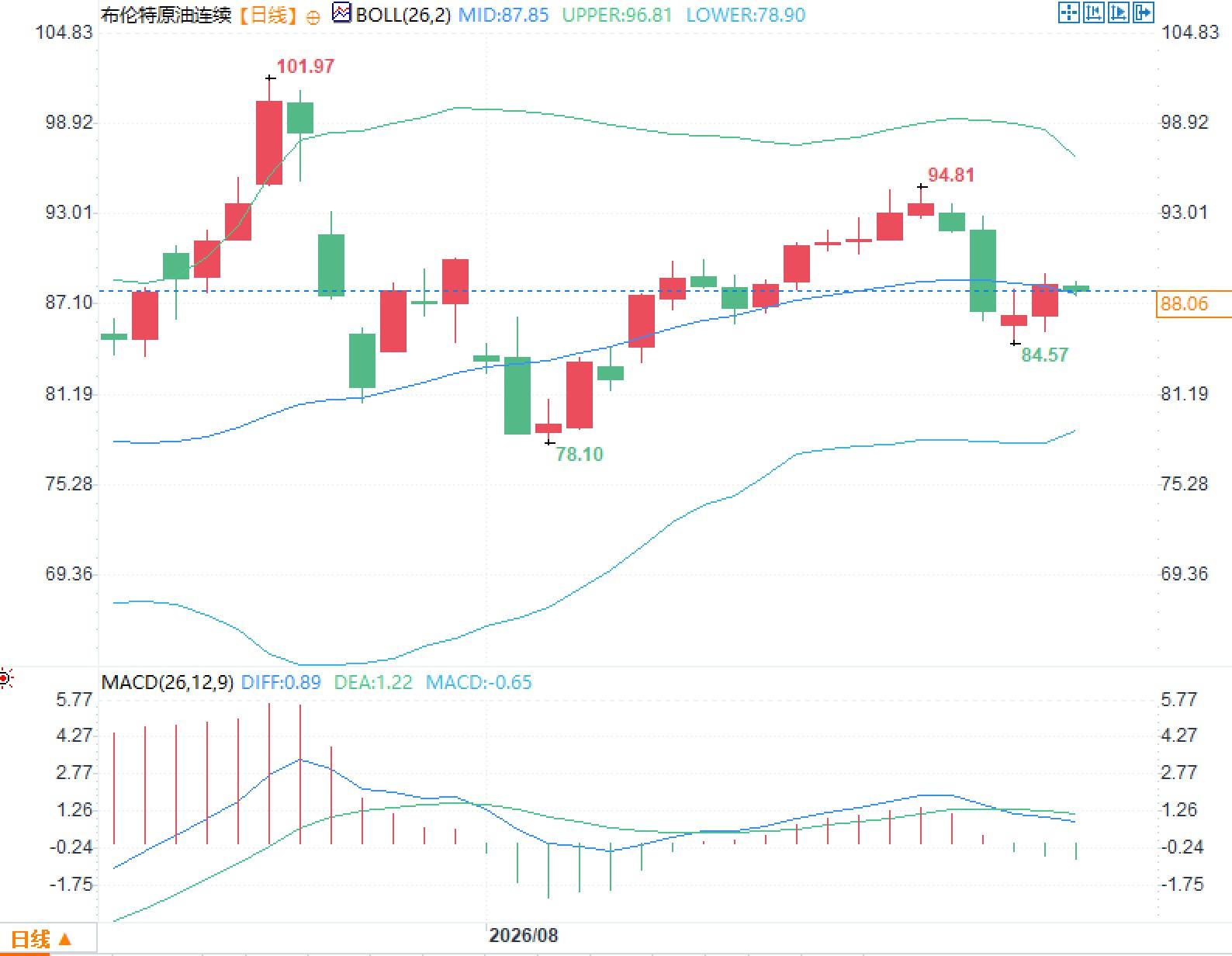
Looking at the daily chart for Brent crude oil, the latest price is near the middle Bollinger Band. The middle Bollinger Band is around 87.85, the upper band is around 96.81, and the lower band is around 78.90. After previously falling from around 94.81, the price briefly touched 84.57, and has now returned to the vicinity of the middle band. Regarding the MACD, the DIFF line is approximately 0.89, the DEA line is approximately 1.22, and the histogram value is approximately -0.65. The DIFF line remains above the zero line but below the DEA line, reflecting a weakening of short-term momentum compared to the previous period. Considering the fundamentals, the easing of diplomatic tensions has compressed some risk premiums, but shipping has not yet normalized, and sanctions have not been lifted. Therefore, prices have not yet reached a stable state completely detached from event-driven factors. The determining factors for market volatility remain actual ship traffic volume, the degree of export recovery, and whether there are enforceable changes in diplomatic conditions.
- Risk Warning and Disclaimer
- The market involves risk, and trading may not be suitable for all investors. This article is for reference only and does not constitute personal investment advice, nor does it take into account certain users’ specific investment objectives, financial situation, or other needs. Any investment decisions made based on this information are at your own risk.