













The rebound in the US dollar has led to another test of the 160 level resistance for the USD/JPY pair, awaiting a directional move.
2026-08-31 10:27:02
The USD/JPY pair strengthened in Asian trading on Monday, holding near the 160.00 level, not far from the one-month high reached last Friday. After a previous rapid rebound, USD/JPY is currently consolidating at higher levels, but fundamentally, the bulls still hold a certain advantage. The significant interest rate differential between the US and Japan, the continued existence of yen carry trades, and market concerns about Japan's fiscal situation are the main support for the exchange rate.  Japan is currently facing significant fiscal policy pressure. Market concerns about a deteriorating public finance situation and expansionary fiscal policy have intensified, weakening the yen's appeal as a low-yield funding currency. Meanwhile, US Treasury Secretary Scott Bessant recently stated that recent yen volatility remains largely manageable, reducing market expectations of renewed joint intervention in the foreign exchange market by Japan and the US. For USD/JPY bulls, the reduced risk of official intervention in the short term makes upward attempts near 160 easier to attract funding. Interest rate differentials remain one of the most important fundamental supports for USD/JPY. The Bank of Japan raised its short-term policy rate to 1.00% in June, reaching a multi-decade high, but the US benchmark interest rate remains in the 3.50%-3.75% range, leaving a gap of approximately 250-275 basis points between the two. Although the Bank of Japan has entered a policy normalization phase, as long as the US-Japan interest rate differential remains high, there will still be room for yen funding transactions in the market, which will continue to support USD/JPY. However, the market cannot ignore the potential changes brought about by the Bank of Japan's policy normalization. Currently, the market estimates an approximately 80% probability of the Bank of Japan raising interest rates by another 25 basis points in September. If domestic inflation, wages, and economic data continue to support policy normalization, the likelihood of the central bank further tightening monetary policy will gradually increase. At that time, the USD/JPY interest rate differential may begin to narrow, and the pressure on yen shorts will gradually increase. In other words, the fundamentals for USD/JPY remain bullish, but this advantage is not without time limitations. Another important development has occurred in the US. Federal Reserve Chairman Kevin Warsh released a hawkish signal at the Jackson Hole symposium, emphasizing that if policymakers cannot confirm that underlying inflation is falling towards the policy target at a sufficient pace, the Fed will still need to take further action. Following his speech, market expectations for a Fed rate hike in September have clearly increased. The renewed strengthening of US interest rate expectations makes it possible that the USD/JPY interest rate differential will remain high in the short term, thus continuing to provide interest rate support for USD/JPY. At the same time, the recent escalation of tensions in the Middle East has also re-strengthened the safe-haven appeal of the US dollar. After the US strikes Iranian military targets, Iran immediately launched a missile counterattack, increasing market concerns about further escalation of the regional situation. Because the US dollar still possesses strong safe-haven characteristics during global risk events, related capital flows can support the dollar and indirectly push USD/JPY to remain high. Meanwhile, the impact of risk events on energy prices may also influence the Federal Reserve's policy path through inflation expectations, thus forming a second layer of dollar support. However, the impact of safe-haven trading on USD/JPY is two-sided. The yen itself is also a traditional safe-haven currency; when global risk sentiment deteriorates significantly, some funds may flow back into the yen, thus limiting the exchange rate's rise. Therefore, current geopolitical risks are not simply a one-way positive for USD/JPY; the real determining factor is still the relative strength between the safe-haven demand for the dollar and the yen, as well as changes in the USD/JPY interest rate differential. From a market sentiment perspective, 160 yen has become a very sensitive psychological level. Previous rises in USD/JPY near 160 have easily triggered discussions about the risk of Japanese intervention; therefore, even if fundamentals support the bulls, investors should not simply chase the rally. If the exchange rate can stabilize above 160 and further break through 160.34 and 160.64, the market may consider the previous upward trend to have been reconfirmed. However, if it fails to break through 160 multiple times, profit-taking pressure at higher levels may increase rapidly. In the coming days, US economic data and expectations for the Bank of Japan's policy will continue to determine the short-term direction of USD/JPY. If US employment, inflation, and manufacturing data continue to be strong, the market may further increase its expectations that the Federal Reserve will maintain high interest rates or even tighten policy again. Conversely, if the US economy cools significantly, the dollar's previously accumulated interest rate advantage may narrow rapidly. Regarding Japan, attention needs to be paid to whether inflation and wage growth continue to support a September rate hike. If expectations for a Bank of Japan rate hike further intensify, it will become a significant factor limiting the upside potential of USD/JPY. From a daily chart perspective, USD/JPY is currently still maintaining a relatively complete rebound trend, with the price stabilizing above 159.00 and approaching the important psychological level of 160 again. After a rapid pullback from its previous highs, the exchange rate has rebounded and has now recovered the 50% Fibonacci retracement level of 159.50, indicating that the bulls are gradually regaining control. The first resistance level to watch is the 200-period simple moving average around 160.30, which is currently the most direct technical resistance. If the daily chart breaks and holds above 160.30, the next target will be the 61.8% Fibonacci retracement level around 160.70, and a further break above that could test the 78.6% retracement level around 162.10. On the downside, 159.50 is the first support level, and the 100-period moving average around 159.00 forms the second support. If it breaks below 159.00, the exchange rate may fall back towards the 38.2% retracement level around 158.50, and further down, the 23.6% retracement level around 157.30 will be the next support level to watch. Overall, the daily chart structure remains bullish, but a breakout of the 160.30-160.70 range will determine whether the rebound can extend further. Looking at the 4-hour chart, USD/JPY is currently consolidating near the $160 level. While the price remains above the 100-period moving average at $159.00 and the 50% Fibonacci retracement level at $159.50, the 200-period moving average at $160.30 continues to provide significant resistance. Short-term momentum is therefore characterized by a tug-of-war between bulls and bears. If the 4-hour candlestick chart can effectively break through $160.30 and further stabilize above $160.70, it would mean that the previous correction has been largely corrected, and the exchange rate could extend towards $161.00 and $162.10. Conversely, if the price is repeatedly resisted in the 160.30-160.70 area and falls below 159.50 again, the short-term downward pressure will increase significantly, and 159.00 will become a key defense level. Once it further breaks below 158.58, USD/JPY may re-enter a deeper correction. Currently, 159.50 is the short-term dividing line between bullish and bearish trends, while 160.70 is the key breakout level that will determine whether the upside potential can be unlocked.
 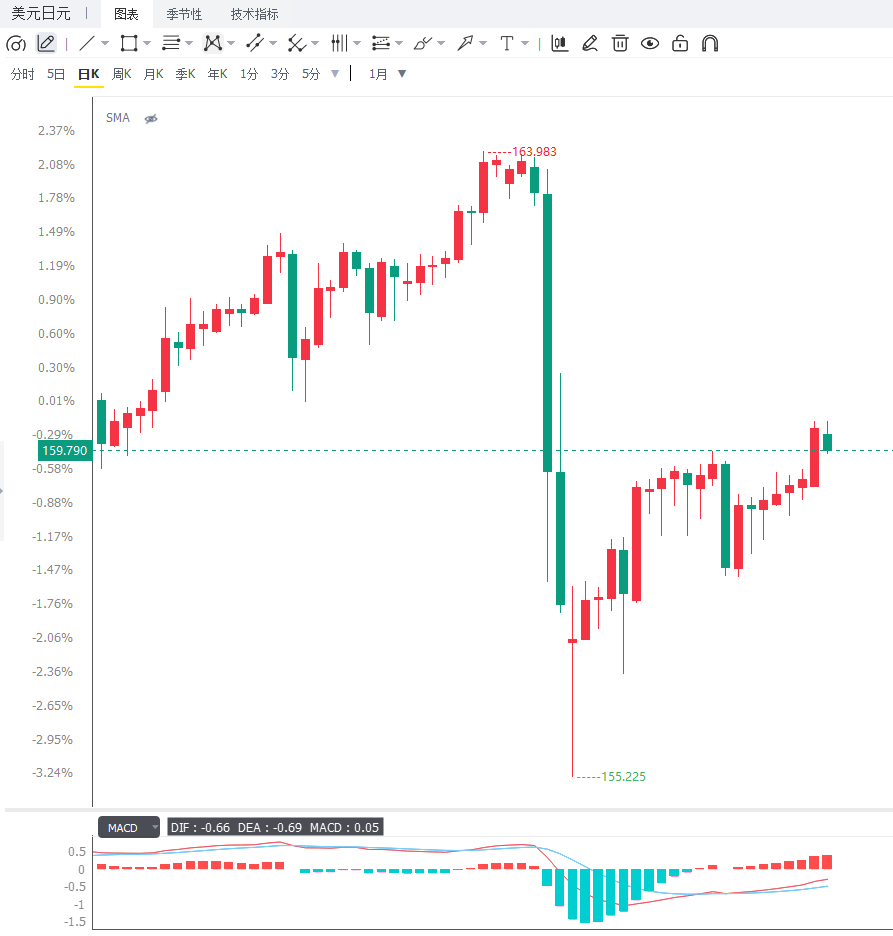 Editor's Summary: The USD/JPY pair is currently in a high-level area supported by interest rate advantages, carry trades, and concerns about Japanese fiscal policy, with short-term fundamentals still leaning towards a bullish trend. A hawkish shift in US policy expectations further strengthens the dollar's advantage, while escalating tensions in the Middle East have also created some safe-haven demand for the dollar. However, the 160 level is not a typical technical support level. With expectations of a September rate hike by the Bank of Japan rising to approximately 80%, the possibility of a further narrowing of the USD/JPY interest rate differential is increasing. Meanwhile, the risk of potential intervention by Japanese authorities remains a constraint that the exchange rate must overcome to rise.
Japan is currently facing significant fiscal policy pressure. Market concerns about a deteriorating public finance situation and expansionary fiscal policy have intensified, weakening the yen's appeal as a low-yield funding currency. Meanwhile, US Treasury Secretary Scott Bessant recently stated that recent yen volatility remains largely manageable, reducing market expectations of renewed joint intervention in the foreign exchange market by Japan and the US. For USD/JPY bulls, the reduced risk of official intervention in the short term makes upward attempts near 160 easier to attract funding. Interest rate differentials remain one of the most important fundamental supports for USD/JPY. The Bank of Japan raised its short-term policy rate to 1.00% in June, reaching a multi-decade high, but the US benchmark interest rate remains in the 3.50%-3.75% range, leaving a gap of approximately 250-275 basis points between the two. Although the Bank of Japan has entered a policy normalization phase, as long as the US-Japan interest rate differential remains high, there will still be room for yen funding transactions in the market, which will continue to support USD/JPY. However, the market cannot ignore the potential changes brought about by the Bank of Japan's policy normalization. Currently, the market estimates an approximately 80% probability of the Bank of Japan raising interest rates by another 25 basis points in September. If domestic inflation, wages, and economic data continue to support policy normalization, the likelihood of the central bank further tightening monetary policy will gradually increase. At that time, the USD/JPY interest rate differential may begin to narrow, and the pressure on yen shorts will gradually increase. In other words, the fundamentals for USD/JPY remain bullish, but this advantage is not without time limitations. Another important development has occurred in the US. Federal Reserve Chairman Kevin Warsh released a hawkish signal at the Jackson Hole symposium, emphasizing that if policymakers cannot confirm that underlying inflation is falling towards the policy target at a sufficient pace, the Fed will still need to take further action. Following his speech, market expectations for a Fed rate hike in September have clearly increased. The renewed strengthening of US interest rate expectations makes it possible that the USD/JPY interest rate differential will remain high in the short term, thus continuing to provide interest rate support for USD/JPY. At the same time, the recent escalation of tensions in the Middle East has also re-strengthened the safe-haven appeal of the US dollar. After the US strikes Iranian military targets, Iran immediately launched a missile counterattack, increasing market concerns about further escalation of the regional situation. Because the US dollar still possesses strong safe-haven characteristics during global risk events, related capital flows can support the dollar and indirectly push USD/JPY to remain high. Meanwhile, the impact of risk events on energy prices may also influence the Federal Reserve's policy path through inflation expectations, thus forming a second layer of dollar support. However, the impact of safe-haven trading on USD/JPY is two-sided. The yen itself is also a traditional safe-haven currency; when global risk sentiment deteriorates significantly, some funds may flow back into the yen, thus limiting the exchange rate's rise. Therefore, current geopolitical risks are not simply a one-way positive for USD/JPY; the real determining factor is still the relative strength between the safe-haven demand for the dollar and the yen, as well as changes in the USD/JPY interest rate differential. From a market sentiment perspective, 160 yen has become a very sensitive psychological level. Previous rises in USD/JPY near 160 have easily triggered discussions about the risk of Japanese intervention; therefore, even if fundamentals support the bulls, investors should not simply chase the rally. If the exchange rate can stabilize above 160 and further break through 160.34 and 160.64, the market may consider the previous upward trend to have been reconfirmed. However, if it fails to break through 160 multiple times, profit-taking pressure at higher levels may increase rapidly. In the coming days, US economic data and expectations for the Bank of Japan's policy will continue to determine the short-term direction of USD/JPY. If US employment, inflation, and manufacturing data continue to be strong, the market may further increase its expectations that the Federal Reserve will maintain high interest rates or even tighten policy again. Conversely, if the US economy cools significantly, the dollar's previously accumulated interest rate advantage may narrow rapidly. Regarding Japan, attention needs to be paid to whether inflation and wage growth continue to support a September rate hike. If expectations for a Bank of Japan rate hike further intensify, it will become a significant factor limiting the upside potential of USD/JPY. From a daily chart perspective, USD/JPY is currently still maintaining a relatively complete rebound trend, with the price stabilizing above 159.00 and approaching the important psychological level of 160 again. After a rapid pullback from its previous highs, the exchange rate has rebounded and has now recovered the 50% Fibonacci retracement level of 159.50, indicating that the bulls are gradually regaining control. The first resistance level to watch is the 200-period simple moving average around 160.30, which is currently the most direct technical resistance. If the daily chart breaks and holds above 160.30, the next target will be the 61.8% Fibonacci retracement level around 160.70, and a further break above that could test the 78.6% retracement level around 162.10. On the downside, 159.50 is the first support level, and the 100-period moving average around 159.00 forms the second support. If it breaks below 159.00, the exchange rate may fall back towards the 38.2% retracement level around 158.50, and further down, the 23.6% retracement level around 157.30 will be the next support level to watch. Overall, the daily chart structure remains bullish, but a breakout of the 160.30-160.70 range will determine whether the rebound can extend further. Looking at the 4-hour chart, USD/JPY is currently consolidating near the $160 level. While the price remains above the 100-period moving average at $159.00 and the 50% Fibonacci retracement level at $159.50, the 200-period moving average at $160.30 continues to provide significant resistance. Short-term momentum is therefore characterized by a tug-of-war between bulls and bears. If the 4-hour candlestick chart can effectively break through $160.30 and further stabilize above $160.70, it would mean that the previous correction has been largely corrected, and the exchange rate could extend towards $161.00 and $162.10. Conversely, if the price is repeatedly resisted in the 160.30-160.70 area and falls below 159.50 again, the short-term downward pressure will increase significantly, and 159.00 will become a key defense level. Once it further breaks below 158.58, USD/JPY may re-enter a deeper correction. Currently, 159.50 is the short-term dividing line between bullish and bearish trends, while 160.70 is the key breakout level that will determine whether the upside potential can be unlocked. Editor's Summary: The USD/JPY pair is currently in a high-level area supported by interest rate advantages, carry trades, and concerns about Japanese fiscal policy, with short-term fundamentals still leaning towards a bullish trend. A hawkish shift in US policy expectations further strengthens the dollar's advantage, while escalating tensions in the Middle East have also created some safe-haven demand for the dollar. However, the 160 level is not a typical technical support level. With expectations of a September rate hike by the Bank of Japan rising to approximately 80%, the possibility of a further narrowing of the USD/JPY interest rate differential is increasing. Meanwhile, the risk of potential intervention by Japanese authorities remains a constraint that the exchange rate must overcome to rise.
- Risk Warning and Disclaimer
- The market involves risk, and trading may not be suitable for all investors. This article is for reference only and does not constitute personal investment advice, nor does it take into account certain users’ specific investment objectives, financial situation, or other needs. Any investment decisions made based on this information are at your own risk.

