













Warsh's hawkish remarks boosted expectations of an interest rate hike, causing gold to fall to a new low since August 20. Is this a buying opportunity?
2026-08-31 11:13:06
On Monday (August 31) during Asian trading hours, spot gold fell by more than 1% at one point, hitting a new low since August 20 at $4396.39 per ounce, and is currently trading around $4425 per ounce. Federal Reserve Chairman Warsh warned in his Jackson Hole speech that inflation has not slowed significantly and that the Fed still has "work to do." Market expectations for a September rate hike rose from 39.9% to 56.9%, and the probability of a December rate hike rose to 88.7%. The high-interest-rate environment has weakened the appeal of gold as a non-interest-bearing asset. Over the weekend, the US military launched an airstrike on Iran's Larak Island, and Iran responded by firing missiles into the Strait of Hormuz. Escalating geopolitical risks may fuel concerns about oil-price-driven inflation, further suppressing gold prices. 
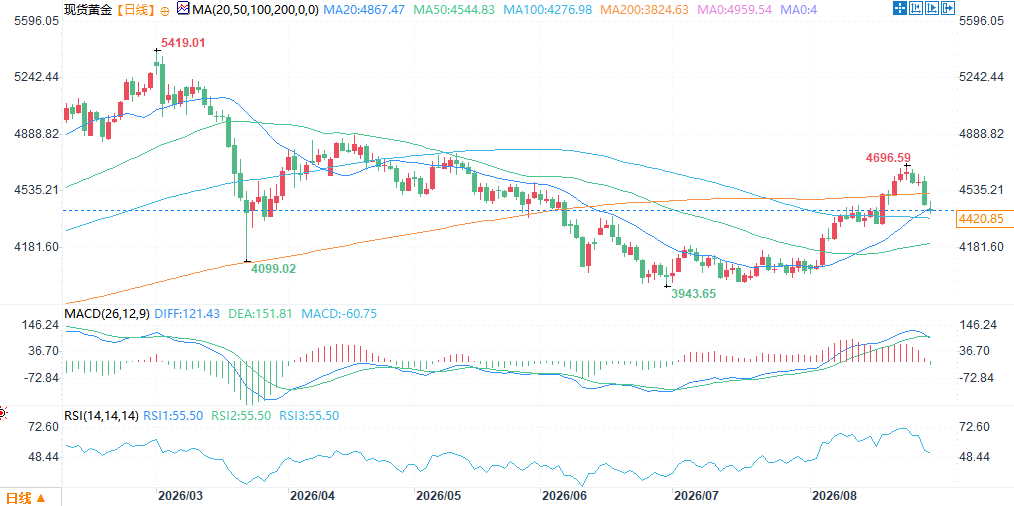 (Spot gold daily chart, source: EasyTrade) At 11:09 Beijing time, spot gold was trading at $4425.12 per ounce.
Warsh's hawkish remarks increase the probability of a rate hike
Spot gold fell to around $4,400 per ounce, reflecting the direct impact of Federal Reserve Chairman Warsh's hawkish remarks at Jackson Hole on non-interest-bearing assets. Warsh explicitly warned that recent relatively good inflation data has not yet shown a meaningful shift in the underlying inflation trend, and the Fed still has "work to do" if it cannot be confident that inflation is returning to its 2% target at a sufficient pace. The market quickly adjusted its expectations, with the probability of a September rate hike rising from approximately 39.9% to 56.9%, and the probability of a December hike further climbing to 88.7%. Independent analysts bluntly stated that gold was "severely hit." The high-interest-rate environment significantly weakens gold's relative attractiveness as a non-interest-bearing asset, with funds more inclined to flow into high-yield dollar assets. Warsh also emphasized the robust fundamentals of the US economy, including healthy consumer spending, a stable labor market, and rapid business investment, further reinforcing the narrative that "interest rates may be higher and longer." In the short term, if subsequent inflation data continues to support a hawkish stance, gold may face further downward pressure; conversely, if the data softens, a technical rebound may occur. Overall, monetary policy expectations remain the core variable driving gold's price movement.Escalating US-Iran conflict adds geopolitical uncertainty to gold prices.
Geopolitical risks escalated significantly over the weekend, adding further uncertainty to gold. Following the US airstrike on Iran's Larak Island, Iran responded by launching ballistic missiles and anti-ship cruise missiles into the Strait of Hormuz, escalating the conflict and raising market concerns about the disruption of Middle Eastern energy routes. This could push up oil prices, thereby increasing global inflation expectations and reinforcing the Federal Reserve's rationale for maintaining high interest rates, indirectly putting downward pressure on gold. However, the rising geopolitical uncertainty may also stimulate safe-haven demand, providing temporary support for gold. TD Securities points out that Warsh's hawkish tone may test recent optimism in precious metals, but it is unlikely to completely reverse the supporting role of current positions and underlying narratives. Investors need to closely monitor the subsequent developments of the conflict: if tensions ease quickly and safe-haven buying subsides, gold may continue to be under pressure; if the conflict expands, its safe-haven attributes will become prominent again. In the short term, gold's price action will fluctuate between hawkish monetary policy pressures and geopolitical safe-haven support, potentially leading to increased volatility.Institutional Views
In a research report at the end of August, Goldman Sachs analysts Lina Thomas and Daan Struyven pointed out that central banks' continued diversification of foreign exchange reserves and structural buying to hedge geopolitical and financial risks are the core supporting factors. They predict that central banks will purchase an average of about 50 tons of gold per month in 2026 (far higher than the level before 2022), accelerating to around 100 tons in June. Meanwhile, investors are increasingly using gold derivatives to hedge policy uncertainty, which may exacerbate volatility but also provide upside potential. Although Warsh's hawkish remarks have increased expectations of interest rate hikes, putting pressure on non-interest-bearing gold in the short term, Goldman Sachs still believes that central bank buying and potential revisions to Fed policy expectations will drive gold prices back up by the end of the year. The bank emphasizes significant upside risks; if real interest rates decline or geopolitical risks escalate, the target may be exceeded, but volatility will also increase.Summarize
Spot gold fell to around $4,400 per ounce after Warsh's hawkish remarks boosted the probability of a September rate hike to 56.9%, with the high-interest-rate environment diminishing gold's appeal. Escalating US-Iran conflict adds geopolitical uncertainty and could fuel concerns about oil-driven inflation. TD Securities believes the hawkish tone may test recent optimism in precious metals but is unlikely to completely reverse it. (Spot gold daily chart, source: EasyTrade) At 11:09 Beijing time, spot gold was trading at $4425.12 per ounce.
- Risk Warning and Disclaimer
- The market involves risk, and trading may not be suitable for all investors. This article is for reference only and does not constitute personal investment advice, nor does it take into account certain users’ specific investment objectives, financial situation, or other needs. Any investment decisions made based on this information are at your own risk.

