Gold fell below $4,400 as oil prices rose and hawkish expectations from the Federal Reserve were put on the rise.
2026-09-01 16:34:05
Gold prices have cooled significantly recently, with spot gold prices falling back below $4,400 per ounce. Some of the funds that previously drove gold prices higher are now taking profits, and the market is reassessing the Federal Reserve's future interest rate path. Compared to simple safe-haven demand, the main pressures currently facing gold come from rising bond yields, a relatively strong dollar, and improved expectations for real interest rates.  Global bond markets have recently experienced a sell-off, with long-term government bond yields rising significantly. The yield on the 10-year US Treasury note rose to approximately 4.78%, and the 30-year yield approached 5.27%. This high-interest-rate environment has increased the attractiveness of interest-bearing assets like bonds to funds, while also increasing the opportunity cost of holding gold. Rising oil prices have further amplified this impact. Escalating tensions in the Middle East have pushed oil prices higher again, and inflation expectations stemming from energy supply risks have resurfaced. The current market trading logic has shifted from "geopolitical risks benefiting gold" to "geopolitical risks pushing up oil prices, oil prices pushing up inflation, and inflation reinforcing expectations of interest rate hikes." This change prevents gold from fully benefiting from traditional safe-haven demand. Federal Reserve Chairman Kevin Warsh's hawkish remarks at the Jackson Hole symposium were a significant catalyst for the recent gold price correction. He emphasized that if policymakers cannot confirm that underlying inflation is falling towards the 2% target at a sufficient pace, the Fed will still need to take further action. The market subsequently significantly increased its bets on a September rate hike, with the probability now rising to approximately 66%. From a funding perspective, changes in interest rate expectations are weakening the short-term appeal of gold. ANZ Bank analysts believe the market is adapting to changes in the monetary policy environment, making gold more vulnerable to selling pressure. Meanwhile, the world's largest gold ETF has maintained holdings at approximately 1042 tons recently, with no significant increase, indicating that investment funds remain cautious about chasing short-term highs. However, long-term support for gold has not completely disappeared. Geopolitical risks, global fiscal pressure, and continued gold allocations by some central banks still constitute medium- to long-term value support. Therefore, this round of adjustment is more appropriately understood as a phased shift in macro pricing logic, rather than a complete reversal of the long-term trend for gold. Going forward, US economic data will be a key variable determining whether gold can stabilize. This week, the market will focus on JOLTS job openings, ADP employment data, and the August non-farm payroll report. If the job market performs strongly, expectations of a Fed rate hike may further intensify, and US Treasury yields and the dollar may continue to rise, putting greater pressure on gold. Conversely, if US employment data weakens significantly, the market will lower its expectations for further Fed tightening, US Treasury yields may fall, and gold may regain favor. Therefore, the true directional choice of gold prices in the future largely depends on the transmission chain of "employment data - interest rate expectations - US dollar and US Treasury yields". From a daily chart perspective, gold has clearly retreated from its previous highs, and the market focus is currently on the support area around $4350. If this area can be effectively stabilized, gold prices are expected to rebound towards $4500-$4550; if it regains $4550, then further attention should be paid to the resistance around $4600. Conversely, if $4350 is breached, it may further test the $4300 and $4200 areas. Overall, the short-term trend has shifted from a strong high to a consolidation structure. From a 4-hour chart perspective, gold is still in a weak consolidation phase in the short term, and the rebound momentum has not yet fully recovered. $4500 has turned from support into a significant resistance area; regaining this position will help alleviate short-term downward pressure; if the rebound continues to be blocked and falls below $4350 again, the bears may further test $4300. Currently, the technical outlook leans towards waiting for a data-driven directional breakout.
 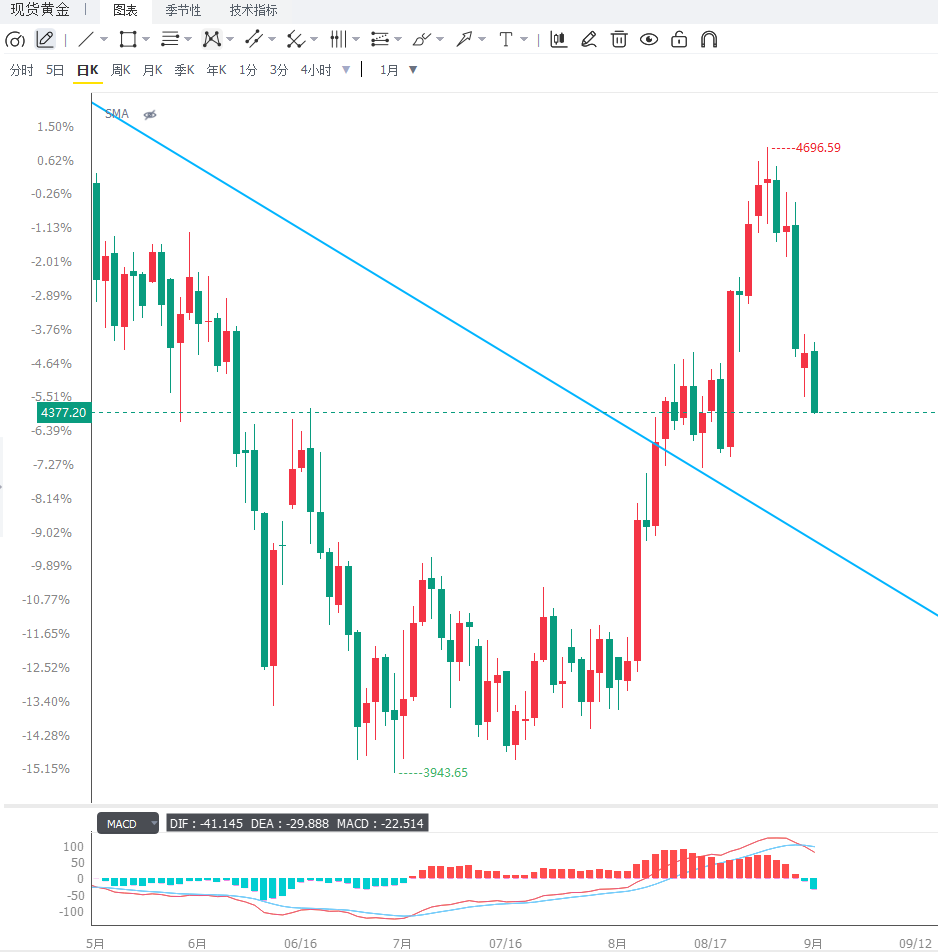 Editor's Summary: The core contradiction currently facing gold is the interplay between geopolitical safe-haven demand and rising interest rate pressures. Escalating tensions in the Middle East are theoretically beneficial to gold, but rising oil prices and resulting inflationary pressures reinforce expectations of a Federal Reserve rate hike. This, in turn, exerts more direct downward pressure on gold by pushing up the dollar and US Treasury yields. $4500 has become a crucial level for short-term bulls and bears to re-enter. If US employment data remains strong, gold may maintain its consolidation pattern; if the job market cools significantly and pushes yields down, gold may experience a technical correction. Key factors to watch include US employment data, the dollar index, US Treasury real yields, and changes in oil prices. As long as rate hike expectations do not cool significantly, gold still faces the risk of further short-term pullbacks, but its medium- to long-term fundamental support remains intact.
Global bond markets have recently experienced a sell-off, with long-term government bond yields rising significantly. The yield on the 10-year US Treasury note rose to approximately 4.78%, and the 30-year yield approached 5.27%. This high-interest-rate environment has increased the attractiveness of interest-bearing assets like bonds to funds, while also increasing the opportunity cost of holding gold. Rising oil prices have further amplified this impact. Escalating tensions in the Middle East have pushed oil prices higher again, and inflation expectations stemming from energy supply risks have resurfaced. The current market trading logic has shifted from "geopolitical risks benefiting gold" to "geopolitical risks pushing up oil prices, oil prices pushing up inflation, and inflation reinforcing expectations of interest rate hikes." This change prevents gold from fully benefiting from traditional safe-haven demand. Federal Reserve Chairman Kevin Warsh's hawkish remarks at the Jackson Hole symposium were a significant catalyst for the recent gold price correction. He emphasized that if policymakers cannot confirm that underlying inflation is falling towards the 2% target at a sufficient pace, the Fed will still need to take further action. The market subsequently significantly increased its bets on a September rate hike, with the probability now rising to approximately 66%. From a funding perspective, changes in interest rate expectations are weakening the short-term appeal of gold. ANZ Bank analysts believe the market is adapting to changes in the monetary policy environment, making gold more vulnerable to selling pressure. Meanwhile, the world's largest gold ETF has maintained holdings at approximately 1042 tons recently, with no significant increase, indicating that investment funds remain cautious about chasing short-term highs. However, long-term support for gold has not completely disappeared. Geopolitical risks, global fiscal pressure, and continued gold allocations by some central banks still constitute medium- to long-term value support. Therefore, this round of adjustment is more appropriately understood as a phased shift in macro pricing logic, rather than a complete reversal of the long-term trend for gold. Going forward, US economic data will be a key variable determining whether gold can stabilize. This week, the market will focus on JOLTS job openings, ADP employment data, and the August non-farm payroll report. If the job market performs strongly, expectations of a Fed rate hike may further intensify, and US Treasury yields and the dollar may continue to rise, putting greater pressure on gold. Conversely, if US employment data weakens significantly, the market will lower its expectations for further Fed tightening, US Treasury yields may fall, and gold may regain favor. Therefore, the true directional choice of gold prices in the future largely depends on the transmission chain of "employment data - interest rate expectations - US dollar and US Treasury yields". From a daily chart perspective, gold has clearly retreated from its previous highs, and the market focus is currently on the support area around $4350. If this area can be effectively stabilized, gold prices are expected to rebound towards $4500-$4550; if it regains $4550, then further attention should be paid to the resistance around $4600. Conversely, if $4350 is breached, it may further test the $4300 and $4200 areas. Overall, the short-term trend has shifted from a strong high to a consolidation structure. From a 4-hour chart perspective, gold is still in a weak consolidation phase in the short term, and the rebound momentum has not yet fully recovered. $4500 has turned from support into a significant resistance area; regaining this position will help alleviate short-term downward pressure; if the rebound continues to be blocked and falls below $4350 again, the bears may further test $4300. Currently, the technical outlook leans towards waiting for a data-driven directional breakout. Editor's Summary: The core contradiction currently facing gold is the interplay between geopolitical safe-haven demand and rising interest rate pressures. Escalating tensions in the Middle East are theoretically beneficial to gold, but rising oil prices and resulting inflationary pressures reinforce expectations of a Federal Reserve rate hike. This, in turn, exerts more direct downward pressure on gold by pushing up the dollar and US Treasury yields. $4500 has become a crucial level for short-term bulls and bears to re-enter. If US employment data remains strong, gold may maintain its consolidation pattern; if the job market cools significantly and pushes yields down, gold may experience a technical correction. Key factors to watch include US employment data, the dollar index, US Treasury real yields, and changes in oil prices. As long as rate hike expectations do not cool significantly, gold still faces the risk of further short-term pullbacks, but its medium- to long-term fundamental support remains intact.
- Risk Warning and Disclaimer
- The market involves risk, and trading may not be suitable for all investors. This article is for reference only and does not constitute personal investment advice, nor does it take into account certain users’ specific investment objectives, financial situation, or other needs. Any investment decisions made based on this information are at your own risk.