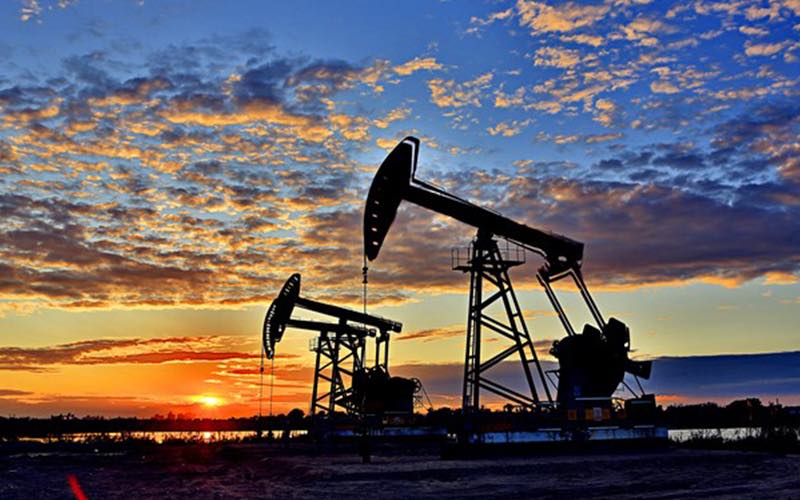
Minesweeping and escalating island standoffs keep crude oil prices volatile amid US-Iran tensions.
2026-09-01 16:04:02
On Tuesday (September 1st) during the Asian and European sessions, international oil prices continued to rise after Monday's 3% surge, with WTI crude currently up 1.5% to around $87. The geopolitical rivalry between the US and Iran in the Strait of Hormuz has escalated again, focusing on Larak Island. This island is strategically located and contains various military assets, allowing Iran to control the Strait of Hormuz. Reports indicate that Iran has deployed multiple military assets on Larak Island, including rocket and missile launchers, satellite communication jamming systems, air defense systems, and speedboats. Iran is using all these military assets to establish control over merchant ships entering and leaving the Strait of Hormuz. Furthermore, this round of military clashes, with mine warfare as a new front, is not a full-blown hot war. Essentially, it is a deep confrontation between the US to stabilize oil prices and pressure Iran into negotiations, and Iran to maintain its bargaining chips and break through the sanctions impasse. This strategic structure directly impacts oil prices, and the market is expected to maintain a wide range of fluctuations in the short term. In this round of conflict, the US military conducted precision airstrikes on Iranian mine-launching and rocket-propelled positions, disrupting Iran's core means of blockading the Strait of Hormuz. Iran retaliated by launching missiles at US bases in Jordan, all of which were intercepted, but the intensity of the confrontation significantly increased. The Trump administration clearly defined the boundaries, limiting strikes against Iran to limited precision operations, deliberately controlling the situation to prevent its escalation. The core objective was to avoid the geopolitical conflict spiraling out of control, leading to a surge in oil prices, a rebound in domestic inflation, volatility in the US stock market, and pressure on the midterm elections. 
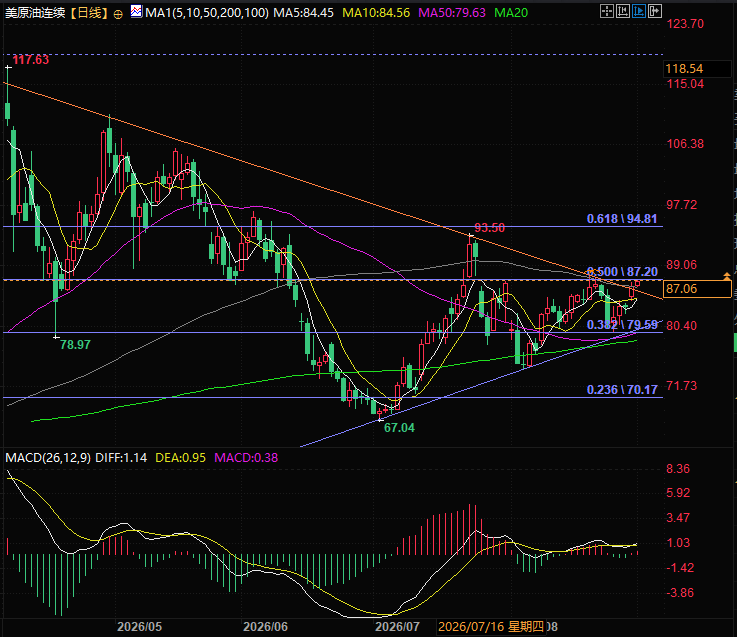 (WTI crude oil futures daily chart, source: EasyTrade) At 16:01 Beijing time, WTI crude oil futures were trading at $86.90 per barrel.
US core strategy: Global supply control, oil price stabilization, and pressure on Iran to negotiate.
Stabilizing crude oil prices is a core strategic objective for the United States at present. To lock in the upward potential of oil prices and hedge against multiple domestic risks, the US has established a comprehensive supply and pressure system. On the supply side, the US has secured majority control over Venezuela's proven oil reserves of over 65 billion barrels, adding a stable source of crude oil supply, hedging against Middle East geopolitical risks, and suppressing domestic fuel prices. On the Strait of Hormuz control side, the US military, relying on divers, Navy SEALs, and air power, has completed mine-clearing operations in the main channel of the Strait of Hormuz, using various equipment to simulate ship magnetic fields and noise-induced mine detonation to continuously ensure navigational safety. At the same time, the US has adopted a differentiated shipping strategy, openly escorting large VLCC tankers to stabilize market expectations, while tacitly allowing smaller vessels to secretly transfer crude oil to ensure actual supply and prevent supply gaps. In addition, the US restarted its maritime blockade against Iran in July, using "Operation Exile" to comprehensively compress Iran's economic space, and using multiple means such as military pressure, supply control, and economic sanctions to force Iran to compromise and return to the negotiating table.Iran's asymmetric countermeasures: Low-cost tactics to control the lifeline of US oil prices
Iran has accurately grasped the core pain points of the United States, namely its fear of soaring oil prices and an out-of-control situation. Leveraging the geographical advantage of the narrow Strait of Hormuz and its concentration of merchant shipping, Iran is employing asymmetric tactics that are low-cost, highly concealed, and difficult to eradicate, to continuously counter these threats. Mines are inexpensive to build and flexible to deploy; without sinking merchant ships, continuous mine laying can deter shipowners and insurance companies from navigational risks, weakening commercial shipping activity and creating market panic premiums. Even after the US military clears the waterway, Iran can quickly lay mines again using stealthy speedboats along its coast and the Fajr-5 long-range rocket system, without exposing its combat forces. Furthermore, Iran has upgraded its countermeasures, possessing the ability to detect and disrupt covert ship-to-ship transfers by the US in the Strait of Hormuz, precisely disrupting the US's "overt stability, covert communication" supply control model, continuously raising the cost of US stabilization efforts, thereby forcing the US to ease sanctions and increasing Iran's bargaining power.Iran is divided: peacemakers seek de-escalation, while hardliners strive for greater strategic influence.
The core issue driving the current stalemate in US-Iran negotiations lies in the severe factional divisions within Iran, resulting in a two-pronged external strategy of "diplomatic overtures and military hardline stances," which amplifies market uncertainty. The Iranian presidential palace, representing the moderate negotiating faction, has sent clear signals of de-escalation. The Iranian president told the Pakistani prime minister that Iran is willing to fully implement the Islamabad Memorandum of Understanding, return to the framework of diplomatic negotiations, and peacefully alleviate sanctions and resolve disputes, provided the US honors its commitments. However, the hardline military faction, led by the Iranian Revolutionary Guard, is completely opposed, refusing passive compromise. Their core demand is to gain more bargaining chips through military deterrence, and even to secure complete control over the Strait of Hormuz, thus continuing aggressive actions such as mine laying, missile retaliation, and disruption of shipping. Addressing the fragmented decision-making system in Iran, Trump bluntly stated that Iran itself lacks a clear supreme authority, accurately pointing out its core weakness: factional infighting and lack of unified decision-making. Coupled with continued strong pressure from the US and calls for diplomatic mediation from third parties, this multi-faceted game has caused the negotiation prospects to fluctuate repeatedly, continuously disrupting sentiment in the oil market.Oil prices are limited in both directions amid the US-Iran rivalry.
The upside potential for crude oil prices is effectively locked down by the US, making a one-sided surge unlikely. Global crude oil supply stability is significantly enhanced by three core guarantees: Venezuela's increased crude oil reserves, the regular safe navigation of the Strait of Hormuz, and the US military's continued mine-clearing and escort operations. If geopolitical tensions drive oil prices sharply higher, the US will immediately use military control, stable navigation, supply releases, and media guidance to cool things down, preventing a surge in oil prices from triggering domestic inflation, capital market volatility, and political risks, thus suppressing the upward potential of oil prices at its source. The downside potential for crude oil prices is also firmly capped, with no basis for a one-sided sharp decline. Iran's routine mine-laying tactics, maritime shipping disruption capabilities, and continuous military deterrence mean that the supply risk in the Strait of Hormuz cannot be completely eliminated, and the geopolitical risk premium will persist in the long term. As long as the US does not fully lift sanctions against Iran and the US and Iran do not reach a substantial reconciliation agreement, Iran will continue to export geopolitical uncertainty, creating shipping risks to support oil prices, safeguard its bargaining power, and ensure that oil prices always have rigid support.Market Outlook: Crude oil's wide-range fluctuation pattern is expected to continue in the long term.
In summary, the current crude oil market exhibits a firmly established pattern of wide-range fluctuations with both a ceiling and a floor, making a sustained trend in the short term unlikely. The core operating rules are clear and stable: when oil prices rise sharply, the US activates supply and risk control mechanisms to suppress the increase; when oil prices fall sharply, Iran activates geopolitical risk measures to support prices. Until the US and Iran completely resolve their differences and the geopolitical tensions in the Strait of Hormuz subside, geopolitical confrontation will continue to dominate oil price fluctuations, and crude oil will maintain a wide-range, fluctuating trend in the long term. Technically, WTI crude oil futures prices have slightly broken through the resistance line of the triangle consolidation pattern, but only slightly. Currently, they are facing resistance at the 0.500 Fibonacci retracement level. However, if oil prices can hold above this level, they are likely to continue rising. Whether US intervention will occur remains to be seen. (WTI crude oil futures daily chart, source: EasyTrade) At 16:01 Beijing time, WTI crude oil futures were trading at $86.90 per barrel.
- Risk Warning and Disclaimer
- The market involves risk, and trading may not be suitable for all investors. This article is for reference only and does not constitute personal investment advice, nor does it take into account certain users’ specific investment objectives, financial situation, or other needs. Any investment decisions made based on this information are at your own risk.