One chart: The index shows significant divergence in performance, highlighting the structural market trend in the Baltic Dry Shipping Market.
2026-09-02 01:56:03
The latest data shows that the Baltic Dry Index (BDI) was 3157 points on September 1, 2026, a decrease of 0.91% compared to the previous month, marking the largest drop since August 19, 2026. Looking at the short-term charts, the BDI has seen positive growth 8 times, negative growth 3 times, and zero growth 0 times in the last 11 BDI data points. Specifically, the Panamax Freight Index (BPI) was 2360 points, up 1.94% from the previous month; the Capesize Freight Index (BCI) was 5221 points, down 2.16%; and the Supramax Freight Index (BSI) was 1650 points, up 0.18%. For detailed charts of the latest 720-day and 10-year trends of the Baltic Dry Index and its three main sub-indices, please refer to the charts specially created by FX678. 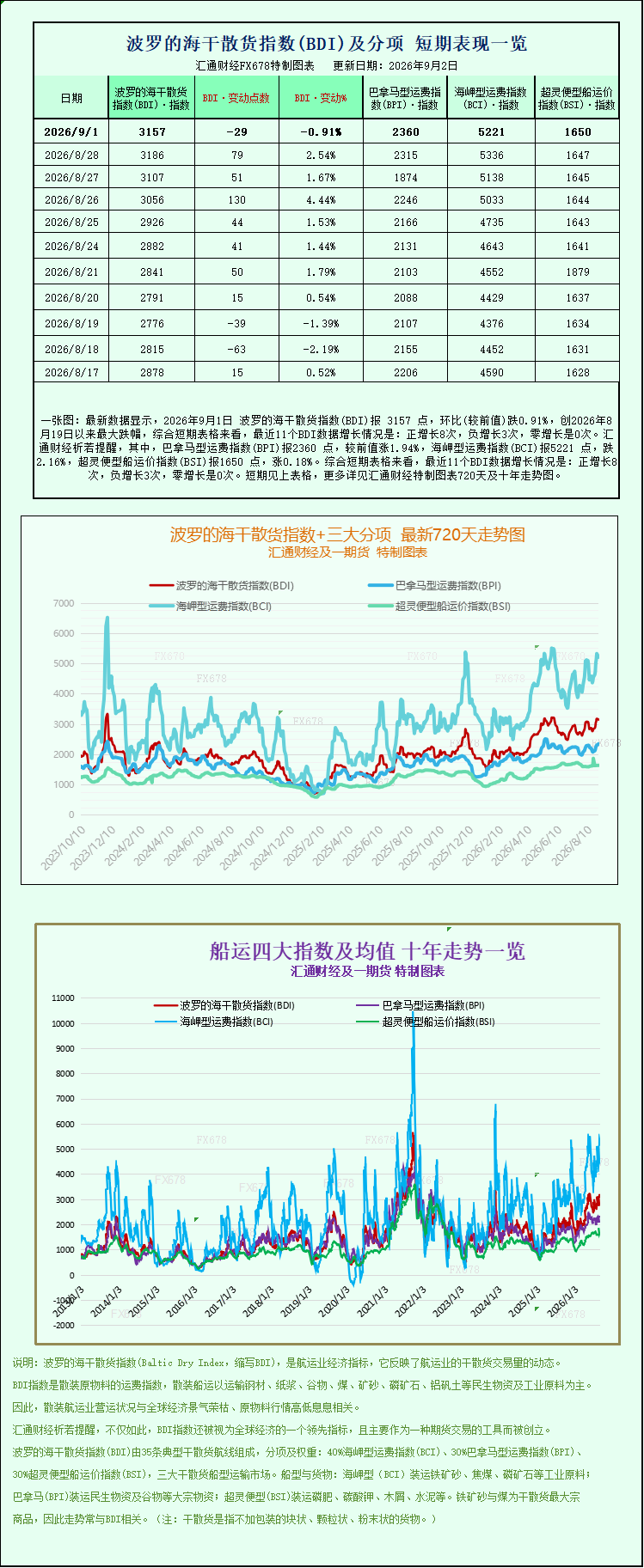 The international shipping market has recently shown a structural divergence, with the crude oil and dry bulk shipping markets experiencing contrasting trends. Affected by the continued weakness in international Capesize crude oil prices, the Baltic Dry Index (BADI) has slightly declined, putting pressure on the overall crude oil shipping market. Meanwhile, the Baltic Dry Index (BADI) saw an overall downward trend on Tuesday, primarily dragged down by a significant drop in freight rates for Capesize vessels. Conversely, Panamax and Supramax vessels saw slight increases, demonstrating a significant divergence between different vessel types and reflecting structural differences in global demand for bulk commodity transportation. As a core indicator of the global dry bulk shipping market, the Baltic Dry Index (BADI) comprehensively covers freight rate changes across the three major vessel types—Capesize, Panamax, and Supramax—accurately reflecting the global shipping climate for bulk commodities such as ore, coal, and grain. Data shows that the Baltic Dry Index (BDI) fell sharply by 29 points on Tuesday, a 0.9% overall decline, closing at 3157 points, ending its previous slight upward trend. The core drag on the index stemmed from the Capesize large vessel market, where cooling demand for large dry bulk carriers directly dragged down the overall dry bulk market sentiment. Capesize vessels, as the mainstay of the dry bulk market, primarily handle the ocean transport of ultra-large industrial raw materials such as iron ore and thermal coal. Their freight rate fluctuations have the greatest impact on the dry bulk index, making them the primary source of pressure in this market downturn. Data also shows that the Capesize index fell sharply by 115 points on the same day, a 2.1% drop, closing at 5221 points, far exceeding the market average. Looking at shipyard revenues, the average daily revenue of core Capesize vessels carrying 150,000 tons of bulk commodities such as iron ore and coal declined sharply by $1049, with daily earnings falling to $43,847, indicating a significant contraction in profit margins. Industry analysts say the weakening of Capesize freight rates is mainly due to cautious sentiment in the global iron ore shipping market. Currently, iron ore futures prices are generally fluctuating moderately, lacking a clear upward or downward trend, and trading is characterized by strong speculative activity. On the one hand, shipments from major global iron ore exporting countries are steadily increasing, and overseas port supplies remain ample. The market expects a phased rebound in iron ore arrivals at domestic ports, and this ample supply expectation is suppressing premiums in ocean shipping. On the other hand, recent private sector surveys show that Chinese factory production is steadily accelerating, and industrial activity is marginally recovering, theoretically benefiting iron ore demand. These conflicting factors have resulted in a lack of upward momentum in the iron ore trade and transportation market, making it difficult for demand for large Capesize vessels to sustain a recovery, ultimately leading to continued downward pressure on freight rates. In stark contrast to the sluggish performance of large Capesize vessels, the medium-sized Panamax vessel market performed strongly, becoming the core supporting force in the dry bulk market that day. Data shows that the Panamax index rose 45 points, or 1.9%, to close at 2360 points, bucking the trend and leading the gains across all vessel types. Revenue also improved, with Panamax vessels, primarily transporting 60,000 to 70,000-ton coal and grain cargo, seeing an average daily revenue increase of $403 to $21,237, indicating a steady recovery in profitability. The rebound in the Panamax market is mainly attributed to the robust demand for global energy and food transportation. Entering a phase of consumption cycle, many countries have increased their energy restocking needs, leading to a steady increase in cross-border orders for thermal coal. Simultaneously, global food trade remains active, with continued release of grain export orders from South and North America, providing stable cargo support for medium-sized Panamax vessels. Compared to large ore carriers, Panamax vessels transport a wider variety of cargoes, are less affected by fluctuations in the iron ore market, and have stronger market resilience, thus enabling them to maintain an independent upward trend even when the large vessel market is declining. The small Supramax vessel market, on the other hand, maintained a stable and slightly increasing trend, showing overall steady growth. The Supramax vessel index rose slightly by 3 points, a mere 0.18%, closing at 1650 points, with relatively limited fluctuations. These smaller vessels offer greater flexibility and cover a wider range of routes, primarily handling short-haul, small-volume dry bulk cargo orders. Cargo types include building materials, minor minerals, and grains. Market demand is relatively dispersed and stable, with very few sharp price fluctuations. Against the backdrop of overall market differentiation, the slight increase reflects the solid fundamentals of demand for small and medium-sized dry bulk cargo, effectively offsetting the downward pressure on the large vessel market. In summary, the recent decline in the Baltic Dry Index (BDI) is not a sign of overall market weakness, but rather a typical structural market trend. The core issue lies in the temporary weakness in demand across the iron ore industry chain, leading to a decline in freight rates for large dry bulk vessels, while stable demand for energy and food commodities supports upward pressure on freight rates for small and medium-sized vessels. Simultaneously, weak crude oil prices have driven down the crude oil shipping index, further exacerbating the differentiation in the shipping market. Looking ahead, shipping trends will continue to depend on changes in the global supply and demand dynamics of commodities. In the short term, the pace of China's manufacturing recovery, the increase in global iron ore arrivals, and the strength of energy restocking will continue to influence freight rates for various vessel types. If domestic industrial activity continues to recover and pent-up demand for iron ore is steadily released, it is expected to drive a recovery in Capesize vessel freight rates; meanwhile, continued activity in global food and energy trade will continue to support the market for small and medium-sized vessels. Overall, the dry bulk market is likely to continue its structural differentiation trend, and a full recovery in overall market sentiment still requires a concentrated release of demand for the transportation of bulk industrial raw materials.
The international shipping market has recently shown a structural divergence, with the crude oil and dry bulk shipping markets experiencing contrasting trends. Affected by the continued weakness in international Capesize crude oil prices, the Baltic Dry Index (BADI) has slightly declined, putting pressure on the overall crude oil shipping market. Meanwhile, the Baltic Dry Index (BADI) saw an overall downward trend on Tuesday, primarily dragged down by a significant drop in freight rates for Capesize vessels. Conversely, Panamax and Supramax vessels saw slight increases, demonstrating a significant divergence between different vessel types and reflecting structural differences in global demand for bulk commodity transportation. As a core indicator of the global dry bulk shipping market, the Baltic Dry Index (BADI) comprehensively covers freight rate changes across the three major vessel types—Capesize, Panamax, and Supramax—accurately reflecting the global shipping climate for bulk commodities such as ore, coal, and grain. Data shows that the Baltic Dry Index (BDI) fell sharply by 29 points on Tuesday, a 0.9% overall decline, closing at 3157 points, ending its previous slight upward trend. The core drag on the index stemmed from the Capesize large vessel market, where cooling demand for large dry bulk carriers directly dragged down the overall dry bulk market sentiment. Capesize vessels, as the mainstay of the dry bulk market, primarily handle the ocean transport of ultra-large industrial raw materials such as iron ore and thermal coal. Their freight rate fluctuations have the greatest impact on the dry bulk index, making them the primary source of pressure in this market downturn. Data also shows that the Capesize index fell sharply by 115 points on the same day, a 2.1% drop, closing at 5221 points, far exceeding the market average. Looking at shipyard revenues, the average daily revenue of core Capesize vessels carrying 150,000 tons of bulk commodities such as iron ore and coal declined sharply by $1049, with daily earnings falling to $43,847, indicating a significant contraction in profit margins. Industry analysts say the weakening of Capesize freight rates is mainly due to cautious sentiment in the global iron ore shipping market. Currently, iron ore futures prices are generally fluctuating moderately, lacking a clear upward or downward trend, and trading is characterized by strong speculative activity. On the one hand, shipments from major global iron ore exporting countries are steadily increasing, and overseas port supplies remain ample. The market expects a phased rebound in iron ore arrivals at domestic ports, and this ample supply expectation is suppressing premiums in ocean shipping. On the other hand, recent private sector surveys show that Chinese factory production is steadily accelerating, and industrial activity is marginally recovering, theoretically benefiting iron ore demand. These conflicting factors have resulted in a lack of upward momentum in the iron ore trade and transportation market, making it difficult for demand for large Capesize vessels to sustain a recovery, ultimately leading to continued downward pressure on freight rates. In stark contrast to the sluggish performance of large Capesize vessels, the medium-sized Panamax vessel market performed strongly, becoming the core supporting force in the dry bulk market that day. Data shows that the Panamax index rose 45 points, or 1.9%, to close at 2360 points, bucking the trend and leading the gains across all vessel types. Revenue also improved, with Panamax vessels, primarily transporting 60,000 to 70,000-ton coal and grain cargo, seeing an average daily revenue increase of $403 to $21,237, indicating a steady recovery in profitability. The rebound in the Panamax market is mainly attributed to the robust demand for global energy and food transportation. Entering a phase of consumption cycle, many countries have increased their energy restocking needs, leading to a steady increase in cross-border orders for thermal coal. Simultaneously, global food trade remains active, with continued release of grain export orders from South and North America, providing stable cargo support for medium-sized Panamax vessels. Compared to large ore carriers, Panamax vessels transport a wider variety of cargoes, are less affected by fluctuations in the iron ore market, and have stronger market resilience, thus enabling them to maintain an independent upward trend even when the large vessel market is declining. The small Supramax vessel market, on the other hand, maintained a stable and slightly increasing trend, showing overall steady growth. The Supramax vessel index rose slightly by 3 points, a mere 0.18%, closing at 1650 points, with relatively limited fluctuations. These smaller vessels offer greater flexibility and cover a wider range of routes, primarily handling short-haul, small-volume dry bulk cargo orders. Cargo types include building materials, minor minerals, and grains. Market demand is relatively dispersed and stable, with very few sharp price fluctuations. Against the backdrop of overall market differentiation, the slight increase reflects the solid fundamentals of demand for small and medium-sized dry bulk cargo, effectively offsetting the downward pressure on the large vessel market. In summary, the recent decline in the Baltic Dry Index (BDI) is not a sign of overall market weakness, but rather a typical structural market trend. The core issue lies in the temporary weakness in demand across the iron ore industry chain, leading to a decline in freight rates for large dry bulk vessels, while stable demand for energy and food commodities supports upward pressure on freight rates for small and medium-sized vessels. Simultaneously, weak crude oil prices have driven down the crude oil shipping index, further exacerbating the differentiation in the shipping market. Looking ahead, shipping trends will continue to depend on changes in the global supply and demand dynamics of commodities. In the short term, the pace of China's manufacturing recovery, the increase in global iron ore arrivals, and the strength of energy restocking will continue to influence freight rates for various vessel types. If domestic industrial activity continues to recover and pent-up demand for iron ore is steadily released, it is expected to drive a recovery in Capesize vessel freight rates; meanwhile, continued activity in global food and energy trade will continue to support the market for small and medium-sized vessels. Overall, the dry bulk market is likely to continue its structural differentiation trend, and a full recovery in overall market sentiment still requires a concentrated release of demand for the transportation of bulk industrial raw materials.
- Risk Warning and Disclaimer
- The market involves risk, and trading may not be suitable for all investors. This article is for reference only and does not constitute personal investment advice, nor does it take into account certain users’ specific investment objectives, financial situation, or other needs. Any investment decisions made based on this information are at your own risk.