Crude oil trading alert: Supply concerns drive oil prices higher – is this a bullish rebound or a reversal?
2026-09-02 09:58:03
WTI crude oil extended its strong performance in Asian trading on Wednesday, rising for the third consecutive session and closing higher for the fifth time in the past six trading days. Oil prices rose to their highest level since July 24th during the session, currently trading around $91.80, with a daily gain of approximately 1.2%. Looking at the week's performance, oil bulls are regaining control of the market, pushing prices gradually out of their previous trading range.  The core driver of this round of price increases remains the risk to energy supplies in the Middle East. Recent developments indicate that US military action against targets associated with the Iranian Islamic Revolutionary Guard Corps is occurring against the backdrop of commercial shipping in the Strait of Hormuz and the risk of attacks on US personnel. Simultaneously, Iran launched missile and drone attacks on US-linked targets in Jordan and the UAE. These events suggest significant uncertainty regarding shipping security in the Middle East, and the stability of the Strait of Hormuz, a crucial global energy transport route, directly impacts international crude oil supply expectations. The market's real focus is not on the current amount of lost crude oil production, but rather on the scale and duration of potential supply disruptions. If commercial vessel passage is affected, tanker insurance, shipping times, and freight rates could all rise simultaneously, ultimately increasing the cost of spot crude oil supply. Therefore, even if actual global production has not yet declined significantly, the market may already be reflecting potential supply gaps through risk premiums. Some institutions believe that recent developments once again demonstrate the high vulnerability of any temporary arrangements surrounding key energy transport routes. Even if some crude oil shipments have been diverted to alternative routes, investors will remain highly vigilant about whether major shipping lanes can maintain stability. This means that the current rise in oil prices is not only a reaction to changes in actual supply, but also includes a significant geopolitical risk premium. Changes in the refined oil market are also noteworthy. Russia recently decided to extend diesel export restrictions until September 30th, meaning the international market may continue to face tightening diesel supply pressure in the short term. Due to the strong correlation between crude oil and refined oil, tighter diesel supply may improve refinery profits and crude oil processing demand, thus indirectly supporting WTI crude oil. Especially against the backdrop of rising shipping risks in the Middle East, the market's sensitivity to the security of refined oil supply has further increased. Meanwhile, the US's plans regarding its strategic petroleum reserve have also become a focus of market attention. US President Donald Trump stated that Venezuelan crude oil acquired under the latest arrangements will be used to replenish the strategic petroleum reserve. Theoretically, increased Venezuelan crude oil supply may improve global crude oil supply in the future, but from the perspective of actual market impact, there is still uncertainty as to whether the new supply can quickly enter the international market. Therefore, before the supply actually materializes, this factor's suppressive effect on oil prices is relatively limited. From a global market perspective, oil prices are currently re-entering a trading phase dominated by "supply risk." Previously, the market focused more on global economic growth, crude oil demand, and inventory changes. However, with renewed geopolitical tensions, investors are beginning to increase the weight given to supply-side risks in their pricing. If shipping through the Strait of Hormuz continues to be disrupted, crude oil and refined product supply costs in parts of Asia and Europe could rise further, and this could be transmitted to global inflation expectations through transportation costs, energy prices, and business costs. This also introduces new variables to the monetary policies of major central banks. Continued increases in energy prices will make it more difficult to reduce inflation, especially given the relative resilience of the US economy. Rising oil prices may lead the market to reassess future interest rate paths. For the US dollar, higher energy prices could reinforce inflation concerns and postpone expectations of easing; for gold, if geopolitical risks and inflation expectations rise simultaneously, safe-haven funds may gain new investment momentum. However, after WTI crude oil prices quickly rose to around $92, the market also needs to be wary of short-term profit-taking. Current oil price increases are highly dependent on whether geopolitical risks escalate further. If the situation eases, major shipping routes return to normal, or the risk of supply disruptions decreases, the risk premium could contract rapidly. Therefore, the core contradiction in oil prices is not simply "supply shortage," but rather the repricing between the potential risk of supply disruptions and the actual supply and demand fundamentals of crude oil. If geopolitical risks continue to escalate, WTI may continue to challenge the psychological barrier of $100; however, if tensions do not escalate further, the risk premium accumulated during the previous rapid rise may also see a phased release. Investors need to focus on the commercial shipping situation in the Strait of Hormuz, changes in exports from major oil-producing countries, US crude oil inventories, and refined product inventories, while also paying attention to whether the US dollar and global inflation expectations change in tandem. From a daily chart perspective, WTI is currently maintaining a clear oscillating but slightly bullish pattern. Oil prices have regained the 100-day simple moving average of $85.12 and the 50% Fibonacci retracement level of $87.20, indicating that the previous adjustment pressure has been significantly alleviated, and the current pullback is more likely to find support from the bulls. The most important short-term resistance level is at the 61.8% Fibonacci retracement level of $91.88, but since the current price has already reached around $91.50, the market needs to observe whether this breakout can form a valid daily confirmation. If the bulls can hold above $91.88, the next target will be the 78.6% Fibonacci retracement level at $98.55, followed by the previous high of $107.04. On the downside, the key level to watch is whether $90 can become new support. If it breaks below this level, $87.20 will become the first important line of defense. A further break below the 100-day moving average at $85.12 would indicate a significant weakening of the current upward structure, with potential tests of the $82.51, $76.72, and $67.36 areas below. Looking at the 4-hour chart, WTI's short-term bullish momentum remains dominant, with prices rising for several consecutive trading days and pushing towards previous highs, maintaining a complete short-term upward structure. The current area around $92 is a psychological level and a previous area of high trading volume. If oil prices can stabilize above this area and break through effectively, they are expected to move further towards $98.55 in the short term. If they cannot sustain a hold above $92, profit-taking after the continuous rise may push prices back to $90. As long as the pullback holds above $90, the 4-hour chart can still be considered a technical consolidation after a strong upward move; if $90 is breached, we need to be wary of the price seeking support again at $87.20. Overall, the short-term technical structure is bullish, but the rapid rise in oil prices has accumulated some divergence, making a "high-level consolidation before choosing a direction" pattern more likely in the future.
 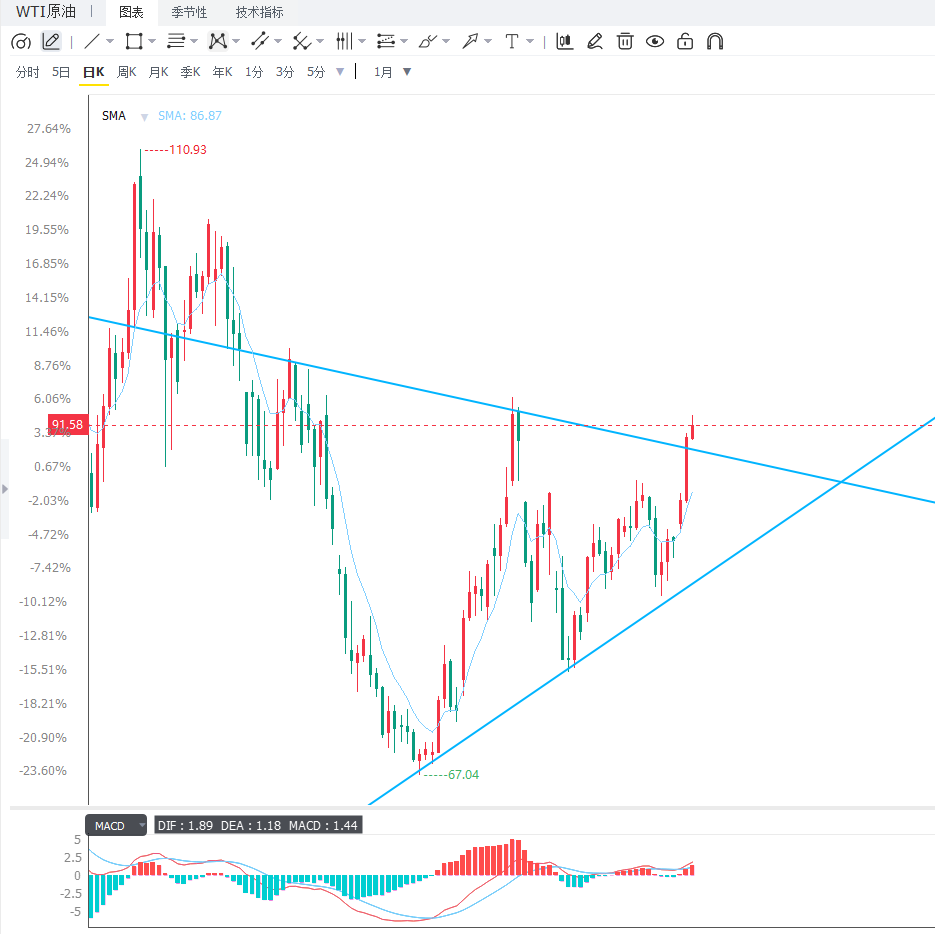 The recent rise in WTI crude oil prices is not primarily driven by supply and demand factors, but rather by a combination of factors: Middle East shipping risks, tightening refined product supply, and expectations of strategic reserve replenishment, all contributing to a higher risk premium. With oil prices near $92, the market has entered a new critical zone. If geopolitical tensions continue to deteriorate and impact actual transportation, the probability of WTI breaking through $98.55 and testing $100 will significantly increase; conversely, if supply risks ease, the previously accumulated risk premium may be quickly reversed. The short-term focus is on the direction of the breakout from the $90-$98 range, while the medium-term focus requires a reassessment of actual supply, inventory levels, and changes in global demand. Given the current significant widening of geopolitical premiums, the risk of chasing higher prices also increases.
The core driver of this round of price increases remains the risk to energy supplies in the Middle East. Recent developments indicate that US military action against targets associated with the Iranian Islamic Revolutionary Guard Corps is occurring against the backdrop of commercial shipping in the Strait of Hormuz and the risk of attacks on US personnel. Simultaneously, Iran launched missile and drone attacks on US-linked targets in Jordan and the UAE. These events suggest significant uncertainty regarding shipping security in the Middle East, and the stability of the Strait of Hormuz, a crucial global energy transport route, directly impacts international crude oil supply expectations. The market's real focus is not on the current amount of lost crude oil production, but rather on the scale and duration of potential supply disruptions. If commercial vessel passage is affected, tanker insurance, shipping times, and freight rates could all rise simultaneously, ultimately increasing the cost of spot crude oil supply. Therefore, even if actual global production has not yet declined significantly, the market may already be reflecting potential supply gaps through risk premiums. Some institutions believe that recent developments once again demonstrate the high vulnerability of any temporary arrangements surrounding key energy transport routes. Even if some crude oil shipments have been diverted to alternative routes, investors will remain highly vigilant about whether major shipping lanes can maintain stability. This means that the current rise in oil prices is not only a reaction to changes in actual supply, but also includes a significant geopolitical risk premium. Changes in the refined oil market are also noteworthy. Russia recently decided to extend diesel export restrictions until September 30th, meaning the international market may continue to face tightening diesel supply pressure in the short term. Due to the strong correlation between crude oil and refined oil, tighter diesel supply may improve refinery profits and crude oil processing demand, thus indirectly supporting WTI crude oil. Especially against the backdrop of rising shipping risks in the Middle East, the market's sensitivity to the security of refined oil supply has further increased. Meanwhile, the US's plans regarding its strategic petroleum reserve have also become a focus of market attention. US President Donald Trump stated that Venezuelan crude oil acquired under the latest arrangements will be used to replenish the strategic petroleum reserve. Theoretically, increased Venezuelan crude oil supply may improve global crude oil supply in the future, but from the perspective of actual market impact, there is still uncertainty as to whether the new supply can quickly enter the international market. Therefore, before the supply actually materializes, this factor's suppressive effect on oil prices is relatively limited. From a global market perspective, oil prices are currently re-entering a trading phase dominated by "supply risk." Previously, the market focused more on global economic growth, crude oil demand, and inventory changes. However, with renewed geopolitical tensions, investors are beginning to increase the weight given to supply-side risks in their pricing. If shipping through the Strait of Hormuz continues to be disrupted, crude oil and refined product supply costs in parts of Asia and Europe could rise further, and this could be transmitted to global inflation expectations through transportation costs, energy prices, and business costs. This also introduces new variables to the monetary policies of major central banks. Continued increases in energy prices will make it more difficult to reduce inflation, especially given the relative resilience of the US economy. Rising oil prices may lead the market to reassess future interest rate paths. For the US dollar, higher energy prices could reinforce inflation concerns and postpone expectations of easing; for gold, if geopolitical risks and inflation expectations rise simultaneously, safe-haven funds may gain new investment momentum. However, after WTI crude oil prices quickly rose to around $92, the market also needs to be wary of short-term profit-taking. Current oil price increases are highly dependent on whether geopolitical risks escalate further. If the situation eases, major shipping routes return to normal, or the risk of supply disruptions decreases, the risk premium could contract rapidly. Therefore, the core contradiction in oil prices is not simply "supply shortage," but rather the repricing between the potential risk of supply disruptions and the actual supply and demand fundamentals of crude oil. If geopolitical risks continue to escalate, WTI may continue to challenge the psychological barrier of $100; however, if tensions do not escalate further, the risk premium accumulated during the previous rapid rise may also see a phased release. Investors need to focus on the commercial shipping situation in the Strait of Hormuz, changes in exports from major oil-producing countries, US crude oil inventories, and refined product inventories, while also paying attention to whether the US dollar and global inflation expectations change in tandem. From a daily chart perspective, WTI is currently maintaining a clear oscillating but slightly bullish pattern. Oil prices have regained the 100-day simple moving average of $85.12 and the 50% Fibonacci retracement level of $87.20, indicating that the previous adjustment pressure has been significantly alleviated, and the current pullback is more likely to find support from the bulls. The most important short-term resistance level is at the 61.8% Fibonacci retracement level of $91.88, but since the current price has already reached around $91.50, the market needs to observe whether this breakout can form a valid daily confirmation. If the bulls can hold above $91.88, the next target will be the 78.6% Fibonacci retracement level at $98.55, followed by the previous high of $107.04. On the downside, the key level to watch is whether $90 can become new support. If it breaks below this level, $87.20 will become the first important line of defense. A further break below the 100-day moving average at $85.12 would indicate a significant weakening of the current upward structure, with potential tests of the $82.51, $76.72, and $67.36 areas below. Looking at the 4-hour chart, WTI's short-term bullish momentum remains dominant, with prices rising for several consecutive trading days and pushing towards previous highs, maintaining a complete short-term upward structure. The current area around $92 is a psychological level and a previous area of high trading volume. If oil prices can stabilize above this area and break through effectively, they are expected to move further towards $98.55 in the short term. If they cannot sustain a hold above $92, profit-taking after the continuous rise may push prices back to $90. As long as the pullback holds above $90, the 4-hour chart can still be considered a technical consolidation after a strong upward move; if $90 is breached, we need to be wary of the price seeking support again at $87.20. Overall, the short-term technical structure is bullish, but the rapid rise in oil prices has accumulated some divergence, making a "high-level consolidation before choosing a direction" pattern more likely in the future. The recent rise in WTI crude oil prices is not primarily driven by supply and demand factors, but rather by a combination of factors: Middle East shipping risks, tightening refined product supply, and expectations of strategic reserve replenishment, all contributing to a higher risk premium. With oil prices near $92, the market has entered a new critical zone. If geopolitical tensions continue to deteriorate and impact actual transportation, the probability of WTI breaking through $98.55 and testing $100 will significantly increase; conversely, if supply risks ease, the previously accumulated risk premium may be quickly reversed. The short-term focus is on the direction of the breakout from the $90-$98 range, while the medium-term focus requires a reassessment of actual supply, inventory levels, and changes in global demand. Given the current significant widening of geopolitical premiums, the risk of chasing higher prices also increases.
- Risk Warning and Disclaimer
- The market involves risk, and trading may not be suitable for all investors. This article is for reference only and does not constitute personal investment advice, nor does it take into account certain users’ specific investment objectives, financial situation, or other needs. Any investment decisions made based on this information are at your own risk.