













The yield on 10-year Japanese government bonds exceeding 3% failed to boost the yen, and the USD/JPY pair broke through the 160 level.
2026-09-02 10:16:03
The USD/JPY pair remained range-bound in Asian trading on Wednesday, briefly touching its highest level since July 31, and is currently trading mainly in the 160.25-160.30 range. Despite a significant rise in Japanese domestic interest rates, the yen has not gained sustained upward momentum, instead exhibiting a unique market pattern of "rising Japanese yields but a still relatively weak yen," reflecting market concerns about the sustainability of Japan's fiscal policy and the pace of monetary policy normalization.  The global bond market has recently experienced a significant sell-off, with Japanese government bonds also facing considerable pressure. The yield on 10-year Japanese government bonds briefly broke through the important psychological threshold of 3%, reaching its highest level since 1996. Theoretically, higher yields on Japanese government bonds should enhance the attractiveness of yen-denominated assets, but the market is currently more focused on the potential pressure that rapidly rising yields will place on Japan's fiscal system. Given the massive scale of Japanese government debt, the continued rise in financing costs means that future interest payment pressures may further increase, which to some extent offsets the support for the yen from rising Japanese interest rates. At the same time, the Japanese government continues to project a strong inclination towards investment and fiscal spending. The market is concerned that if fiscal expansion significantly outpaces potential economic growth and tax revenue growth, Japan's long-term fiscal situation may face even greater pressure. For the foreign exchange market, this means that rising Japanese government bond yields do not necessarily equate to a stronger yen. If the rise in yields stems more from fiscal risk premiums than from a strong market expectation of continued interest rate hikes by the Bank of Japan, then the yen may actually be suppressed. Therefore, the Bank of Japan's policy expectations have become a key variable in the USD/JPY exchange rate movement. U.S. Treasury Secretary Scott Bessant recently expressed concern about the yen's weakness and Japan's monetary policy adjustments, suggesting the Bank of Japan needs to take more explicit policy action. These statements have further strengthened market expectations that the Bank of Japan may raise interest rates this month. Previously, domestic inflation in Japan remained relatively high, increasing policy pressure on the Bank of Japan and raising market attention to subsequent policy normalization. However, mere expectations of interest rate hikes are currently insufficient to reverse the yen's weakness. Even if Japan's policy rate is further raised, a significant interest rate gap will remain between it and major economies like the U.S. As long as the real financing cost gap between the U.S. and Japan remains high, carry trades—where investors borrow yen at low cost and allocate to high-yield dollar assets—remain attractive. This is one of the key reasons why USD/JPY has found support around 160. Regarding the dollar, recent market demand for safe-haven assets and renewed focus on U.S. inflation have provided some support. Fluctuations in energy prices may be transmitted back to inflation through production and transportation costs, making investors cautious about the pace of decline in U.S. inflation. If the market lowers its expectations for rapid easing by the Federal Reserve, US interest rates may remain high for an extended period, further widening the yield advantage of dollar assets relative to yen assets. However, the USD/JPY pair also faces significant resistance above 160. After a prolonged period of high levels, the market's sensitivity to potential measures by Japanese authorities to stabilize the yen has increased considerably. Simultaneously, the rapid rise in Japanese government bond yields may ultimately prompt the Bank of Japan to adopt a more hawkish policy stance. Once the market confirms a significantly accelerated pace of interest rate hikes by the Bank of Japan, the US-Japan interest rate differential may reverse, increasing the risk of a pullback in USD/JPY from its highs. Therefore, the current market is not simply trading on "Japanese interest rate hikes" or "rising US interest rates," but rather reassessing the future interest rate paths, fiscal conditions, and capital flow directions of both countries. For USD/JPY, the 160 level is not only a technical psychological level but also a crucial watershed in the fundamental game. If the dollar can continue to hold above 160, it indicates that the market is still willing to pay a premium for the dollar's interest rate differential and safe-haven appeal; conversely, if expectations of further strengthening of Japanese policy strengthen, the area around 160 may become a high-level reversal zone. Currently, the market is particularly focused on the US non-farm payrolls report. The employment data will directly influence market expectations regarding the Fed's future policy path. If non-farm payrolls are strong and wage growth remains resilient, the market may further weaken expectations for rapid US interest rate cuts, and USD/JPY is likely to continue testing recent resistance levels. Conversely, if the job market cools significantly, and US yields and the dollar decline in tandem, USD/JPY may fall back below 160 and seek buying opportunities in lower technical support areas. From a broader market perspective, the Japanese government bond yield breaking through 3% cannot be simply interpreted as positive for the yen. The key factor determining the future direction of the exchange rate lies in whether the rise in Japanese yields stems from monetary policy normalization or fiscal risk premiums. If the former dominates, the yen is expected to gradually gain fundamental support; if the latter continues to strengthen, a situation may arise where rising Japanese bond yields coexist with continued pressure on the yen. From a daily chart perspective, USD/JPY currently maintains a strong medium-term bullish structure, and the bullish momentum has not clearly subsided after the exchange rate returned to the vicinity of the 160 level. The 160.00-160.20 area is a crucial dividing line between bullish and bearish sentiment. If the price can continue to trade above this area, the overall trend remains biased towards a volatile upward movement. The first resistance level to watch is the 61.8% Fibonacci retracement level around 160.64. A successful breakout and confirmation with a daily close could open up further upside potential. Subsequent resistance levels to watch are the 78.6% retracement level around 162.10, and further up is the previous high around 163.96. From a momentum perspective, while USD/JPY is at a high level, the upward slope is not steep, indicating that while bulls still hold the advantage, they lack sufficient breakout momentum. Therefore, whether 160.64 can be effectively broken will be a key signal for determining whether a new round of upward movement has begun. If 160.20 is breached, the market may first test the 50% retracement level around 159.62; a further break below this level would see the 38.2% retracement level around 158.59 become important support, with further downside targeting the area around 157.32. From a 4-hour chart perspective, USD/JPY remains in a generally bullish consolidation pattern, with the price hovering around the 200-period simple moving average near 160.20. This level is currently both a key technical support and a core area of contention between bulls and bears in the short term. If the price can stabilize above 160.20 and further break through 160.64, the bulls may regain the initiative in the short term, and the price could extend towards 162.10. Conversely, if 160.20 is effectively broken, it means that the recent upward structure has been damaged, and the market may accelerate its pullback towards 159.62; if 159.62 is also breached, the short-term correction could extend further to around 158.59. Overall, there are no clear trend reversal signals on the 4-hour chart, and the current position is more like a consolidation phase at higher levels. The US non-farm payroll data could be a significant catalyst for breaking this consolidation structure.
 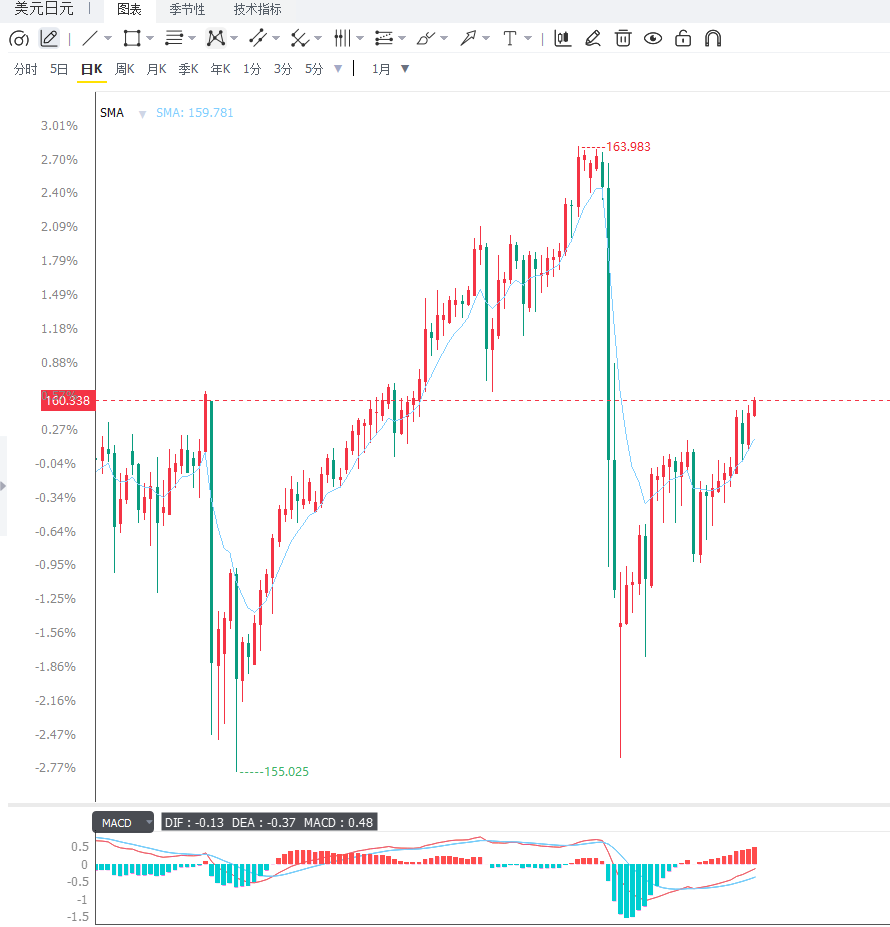 Editor's Summary: The USD/JPY pair is currently facing a typical situation of "intertwined interest rate and fiscal risks." The yield on Japanese 10-year government bonds breaking through 3% indicates both increased pressure for the normalization of Japanese monetary policy and the rapidly rising cost of fiscal financing; therefore, it has not immediately translated into an upward trend for the yen. In the short term, 160.20 and 160.64 constitute the most critical bullish/bearish zone for USD/JPY: a firm hold and break above 160.64 could see the pair further challenge 162.10 or even higher; a break below 160.20 would significantly increase the risk of a pullback from these highs. The medium-term trend will ultimately depend on a combination of changes in the USD/JPY interest rate differential, the strength of the Bank of Japan's policy, and US employment and inflation data.
The global bond market has recently experienced a significant sell-off, with Japanese government bonds also facing considerable pressure. The yield on 10-year Japanese government bonds briefly broke through the important psychological threshold of 3%, reaching its highest level since 1996. Theoretically, higher yields on Japanese government bonds should enhance the attractiveness of yen-denominated assets, but the market is currently more focused on the potential pressure that rapidly rising yields will place on Japan's fiscal system. Given the massive scale of Japanese government debt, the continued rise in financing costs means that future interest payment pressures may further increase, which to some extent offsets the support for the yen from rising Japanese interest rates. At the same time, the Japanese government continues to project a strong inclination towards investment and fiscal spending. The market is concerned that if fiscal expansion significantly outpaces potential economic growth and tax revenue growth, Japan's long-term fiscal situation may face even greater pressure. For the foreign exchange market, this means that rising Japanese government bond yields do not necessarily equate to a stronger yen. If the rise in yields stems more from fiscal risk premiums than from a strong market expectation of continued interest rate hikes by the Bank of Japan, then the yen may actually be suppressed. Therefore, the Bank of Japan's policy expectations have become a key variable in the USD/JPY exchange rate movement. U.S. Treasury Secretary Scott Bessant recently expressed concern about the yen's weakness and Japan's monetary policy adjustments, suggesting the Bank of Japan needs to take more explicit policy action. These statements have further strengthened market expectations that the Bank of Japan may raise interest rates this month. Previously, domestic inflation in Japan remained relatively high, increasing policy pressure on the Bank of Japan and raising market attention to subsequent policy normalization. However, mere expectations of interest rate hikes are currently insufficient to reverse the yen's weakness. Even if Japan's policy rate is further raised, a significant interest rate gap will remain between it and major economies like the U.S. As long as the real financing cost gap between the U.S. and Japan remains high, carry trades—where investors borrow yen at low cost and allocate to high-yield dollar assets—remain attractive. This is one of the key reasons why USD/JPY has found support around 160. Regarding the dollar, recent market demand for safe-haven assets and renewed focus on U.S. inflation have provided some support. Fluctuations in energy prices may be transmitted back to inflation through production and transportation costs, making investors cautious about the pace of decline in U.S. inflation. If the market lowers its expectations for rapid easing by the Federal Reserve, US interest rates may remain high for an extended period, further widening the yield advantage of dollar assets relative to yen assets. However, the USD/JPY pair also faces significant resistance above 160. After a prolonged period of high levels, the market's sensitivity to potential measures by Japanese authorities to stabilize the yen has increased considerably. Simultaneously, the rapid rise in Japanese government bond yields may ultimately prompt the Bank of Japan to adopt a more hawkish policy stance. Once the market confirms a significantly accelerated pace of interest rate hikes by the Bank of Japan, the US-Japan interest rate differential may reverse, increasing the risk of a pullback in USD/JPY from its highs. Therefore, the current market is not simply trading on "Japanese interest rate hikes" or "rising US interest rates," but rather reassessing the future interest rate paths, fiscal conditions, and capital flow directions of both countries. For USD/JPY, the 160 level is not only a technical psychological level but also a crucial watershed in the fundamental game. If the dollar can continue to hold above 160, it indicates that the market is still willing to pay a premium for the dollar's interest rate differential and safe-haven appeal; conversely, if expectations of further strengthening of Japanese policy strengthen, the area around 160 may become a high-level reversal zone. Currently, the market is particularly focused on the US non-farm payrolls report. The employment data will directly influence market expectations regarding the Fed's future policy path. If non-farm payrolls are strong and wage growth remains resilient, the market may further weaken expectations for rapid US interest rate cuts, and USD/JPY is likely to continue testing recent resistance levels. Conversely, if the job market cools significantly, and US yields and the dollar decline in tandem, USD/JPY may fall back below 160 and seek buying opportunities in lower technical support areas. From a broader market perspective, the Japanese government bond yield breaking through 3% cannot be simply interpreted as positive for the yen. The key factor determining the future direction of the exchange rate lies in whether the rise in Japanese yields stems from monetary policy normalization or fiscal risk premiums. If the former dominates, the yen is expected to gradually gain fundamental support; if the latter continues to strengthen, a situation may arise where rising Japanese bond yields coexist with continued pressure on the yen. From a daily chart perspective, USD/JPY currently maintains a strong medium-term bullish structure, and the bullish momentum has not clearly subsided after the exchange rate returned to the vicinity of the 160 level. The 160.00-160.20 area is a crucial dividing line between bullish and bearish sentiment. If the price can continue to trade above this area, the overall trend remains biased towards a volatile upward movement. The first resistance level to watch is the 61.8% Fibonacci retracement level around 160.64. A successful breakout and confirmation with a daily close could open up further upside potential. Subsequent resistance levels to watch are the 78.6% retracement level around 162.10, and further up is the previous high around 163.96. From a momentum perspective, while USD/JPY is at a high level, the upward slope is not steep, indicating that while bulls still hold the advantage, they lack sufficient breakout momentum. Therefore, whether 160.64 can be effectively broken will be a key signal for determining whether a new round of upward movement has begun. If 160.20 is breached, the market may first test the 50% retracement level around 159.62; a further break below this level would see the 38.2% retracement level around 158.59 become important support, with further downside targeting the area around 157.32. From a 4-hour chart perspective, USD/JPY remains in a generally bullish consolidation pattern, with the price hovering around the 200-period simple moving average near 160.20. This level is currently both a key technical support and a core area of contention between bulls and bears in the short term. If the price can stabilize above 160.20 and further break through 160.64, the bulls may regain the initiative in the short term, and the price could extend towards 162.10. Conversely, if 160.20 is effectively broken, it means that the recent upward structure has been damaged, and the market may accelerate its pullback towards 159.62; if 159.62 is also breached, the short-term correction could extend further to around 158.59. Overall, there are no clear trend reversal signals on the 4-hour chart, and the current position is more like a consolidation phase at higher levels. The US non-farm payroll data could be a significant catalyst for breaking this consolidation structure. Editor's Summary: The USD/JPY pair is currently facing a typical situation of "intertwined interest rate and fiscal risks." The yield on Japanese 10-year government bonds breaking through 3% indicates both increased pressure for the normalization of Japanese monetary policy and the rapidly rising cost of fiscal financing; therefore, it has not immediately translated into an upward trend for the yen. In the short term, 160.20 and 160.64 constitute the most critical bullish/bearish zone for USD/JPY: a firm hold and break above 160.64 could see the pair further challenge 162.10 or even higher; a break below 160.20 would significantly increase the risk of a pullback from these highs. The medium-term trend will ultimately depend on a combination of changes in the USD/JPY interest rate differential, the strength of the Bank of Japan's policy, and US employment and inflation data.
- Risk Warning and Disclaimer
- The market involves risk, and trading may not be suitable for all investors. This article is for reference only and does not constitute personal investment advice, nor does it take into account certain users’ specific investment objectives, financial situation, or other needs. Any investment decisions made based on this information are at your own risk.

