Gold Trading Alert: Gold Prices Rebound Over 1%! Dollar and Yields Fall Together, But a Bigger Storm Is Brewing?
2026-09-03 07:48:06
After several days of sharp sell-offs, the gold market finally saw a long-awaited rebound on Wednesday (September 2). Spot gold rose 1.36% to close at $4,387.56 per ounce, a strong recovery of over $100 from the intraday low of $4,282.48, the lowest since August 7. US gold futures for December delivery edged up 0.4% to close at $4,414.60. In early Asian trading on Thursday (September 3), spot gold traded in a narrow range, currently hovering around $4,385 per ounce. The direct driver of this rebound was the simultaneous decline in the US dollar and US Treasury yields from recent highs. The dollar index edged down 0.11% on Wednesday to 99.54, retreating from a near three-week high of 99.85 reached during the session. The yield on the 10-year U.S. Treasury also retreated after hitting a three-year high of 4.818%, falling 0.2 basis points to 4.794%, ending a five-day winning streak. David Meger, director of precious metals trading at HighRidgeFutures, commented, "One reason gold was able to rebound above the flat line is that we saw a slight pullback in yields during the day, which allowed gold to bounce from recent lows." However, how strong is this rebound? Beneath the surface price correction, gold is at a crossroads where multiple forces are fiercely intertwined—escalating geopolitical conflicts have strengthened expectations of interest rate hikes by pushing up energy prices, with the probability of a Fed rate hike in September climbing to 64%, putting continued pressure on gold, a non-interest-bearing asset; while the upcoming U.S. non-farm payroll data could be a key catalyst determining the short-term direction of gold prices. Is gold's rebound a signal of a trend reversal, or merely a technical respite during a sharp decline? 
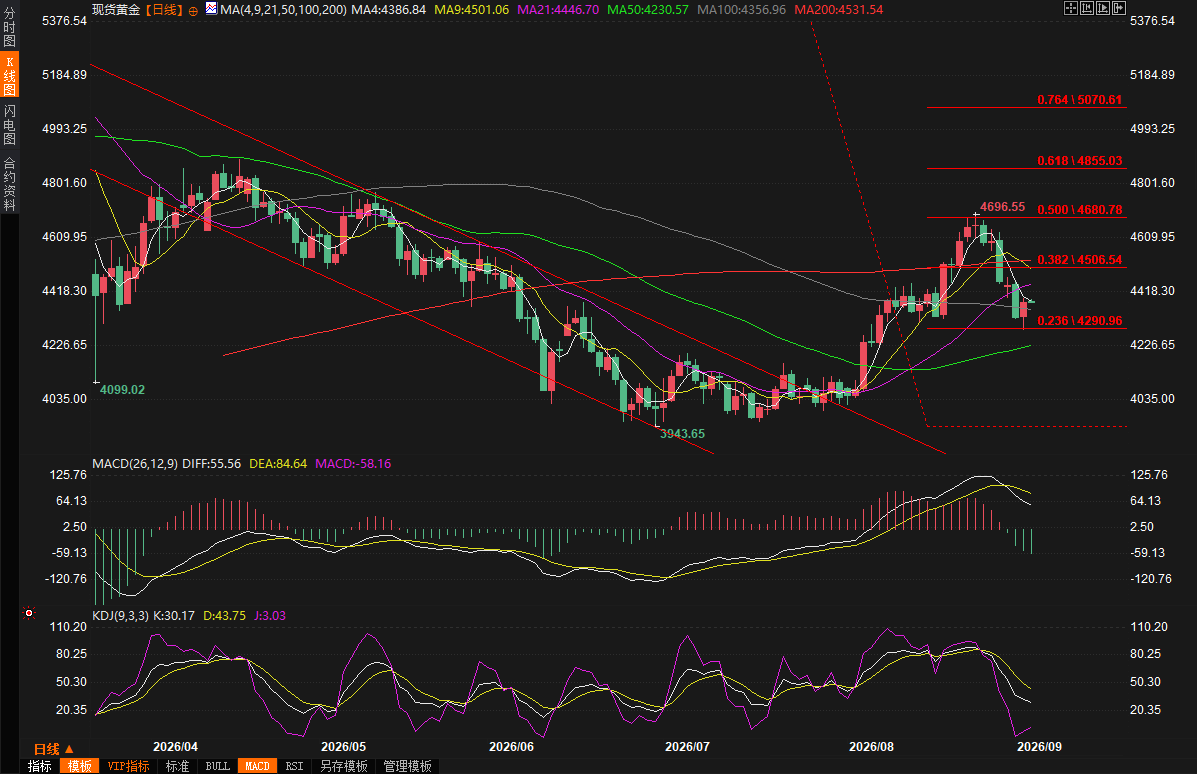 (Spot gold daily chart, source: FX678) At 07:44 Beijing time, spot gold is currently trading at $4386.58 per ounce.
The source of the rebound: the easing of the "double whammy" of a falling dollar and low yields.
To understand the logic behind this rebound in gold prices, we first need to clarify why gold prices fell to a near one-month low. Over the past week, gold has fallen from its recent high of $4,696 per ounce in late August, with a cumulative drop exceeding 7%. The root cause of this plunge lies in the simultaneous surge of the US dollar and US Treasury yields, creating a "double pressure" on gold. The strengthening of the US dollar began with hawkish remarks from Federal Reserve Chairman Warsh at the Jackson Hole Economic Symposium. Warsh emphasized that the slowdown in US inflation was not significant, and policymakers needed to ensure that the inflation rate returned to the 2% target level, a goal that remained unwavering. This statement caused market expectations for a Fed rate hike in September to jump rapidly from about 35% to over 66%. The US dollar index subsequently strengthened, rising 0.25% to 99.68 on September 1st, and even touching a near three-week high of 99.85 during trading on September 2nd. At the same time, US Treasury yields also experienced a sharp rise. The 10-year Treasury yield climbed about 17 basis points from 4.630% to 4.799% over five consecutive trading days, briefly touching a three-year high of 4.818%; the 30-year Treasury yield surged to a two-week high of 5.296%. The surge in yields was directly driven by inflation concerns triggered by soaring oil prices—the escalating conflict between the US and Iran pushed Brent crude above $95 per barrel and WTI crude above $91. The rapid rise in energy prices reignited market concerns about persistently high inflation, thus strengthening expectations of a Federal Reserve rate hike. However, on Wednesday, the situation subtly changed. As oil prices retreated and investors assessed the latest round of economic data, Treasury yields fell from multi-year highs. The ADP National Employment Report showed that private sector jobs increased by only 38,000 in August, lower than the expected 48,000. This lower-than-expected figure somewhat alleviated market concerns that an overheated labor market would force the Federal Reserve to aggressively raise interest rates, thus driving yields back from their highs. The dollar index also slipped from its near three-week high. This easing of the "double whammy" of a weak dollar and low yields opened up room for a gold rebound. Thomas Urano, co-chief investment officer at Sage Advisory, analyzed this: "Everyone likes to try to blame a problem on a single factor, but in reality, it's a series of problems coming one after another. We are currently in a very difficult situation for policymaking, and results like today's ADP data, which fell short of expectations, show that the pace of growth is quite slow. Suddenly, inflation and employment are no longer on the same page, and when inflation and employment no longer point in the same direction, monetary policy becomes very complicated."Geopolitical tensions fuel inflation fears, triggering a global wave of tightening.
Traditionally, escalating geopolitical tensions should boost safe-haven demand for gold, driving up prices. However, the reality is quite the opposite—gold prices have steadily declined amid escalating conflicts, even falling below the $4,300 mark at one point. The core logic behind this lies in the fundamental shift in how geopolitical conflicts affect gold. When conflict first pushes up energy prices, thereby strengthening inflation expectations, the pressure on the Federal Reserve to maintain high interest rates increases, leading to a simultaneous strengthening of the dollar and US Treasury yields, ultimately creating a net negative for gold. Analysts point out that "when geopolitical risks are primarily transmitted through inflation and interest rates, gold's safe-haven attributes often temporarily fail." The escalation path of the current US-Iran conflict clearly confirms this logic. On September 2, in response to Iranian attacks on merchant ships, the US military struck air defense facilities, radar systems, maritime assets, and communication sites off Iran's southern coast. Iran subsequently launched attacks on US facilities in Bahrain, Jordan, Kuwait, and Iraq. This was the largest exchange of fire between the two sides since July. The escalation of the conflict immediately triggered market concerns about the safety of passage through the Strait of Hormuz—a vital waterway through which approximately 20% of global oil and liquefied natural gas shipments pass. Preliminary shipping data released by Kpler showed that only four commodity carriers passed through the Strait of Hormuz that day, far below the average of about 13 ships over the past 10 days. The rise in oil prices quickly translated into inflation expectations, thereby increasing the probability of a Federal Reserve interest rate hike. This sharp shift in interest rate expectations completely negated the safe-haven appeal of gold, which was suppressed by the rising real interest rates. Furthermore, the conflict also exerted downward pressure on gold through another channel—rising oil prices increased energy costs, directly exacerbating inflationary pressures and forcing central banks worldwide to maintain or even tighten monetary policy. The Reserve Bank of New Zealand announced a 25 basis point rate hike to 2.75% on September 2nd; the market also widely expects the European Central Bank to raise rates on September 10th, and the Bank of Japan to have a 92% probability of raising rates on September 18th. This global wave of monetary tightening has put systemic pressure on non-interest-bearing assets like gold.The battle between bulls and bears intensifies
The gold market is currently in a fierce battle between bulls and bears, with multiple factors intertwined, making gold price movements highly uncertain. On the bearish side, the persistently high expectation of a Federal Reserve rate hike is the most significant pressure. Although lower-than-expected ADP data temporarily eased market concerns, the probability of a September rate hike remains as high as 64%. Recent statements from several Fed officials have also been generally hawkish. New York Fed President Williams stated that the rise in long-term bond yields is not driven by inflation concerns but rather reflects a robust economy; Governor Barr suggested that a rate hike should be decisive if inflation does not fall rapidly; and Chairman Warsh emphasized that there is still room for policy even when there is a lack of confidence in inflation returning to 2%. Chairman Warsh's speech at Jackson Hole last Friday directly triggered the recent sharp drop in gold prices. As long as rate hike expectations continue to exert downward pressure, the valuation center of gold will be difficult to rise effectively. The trend of US Treasury yields is also not optimistic. Although it fell somewhat on Wednesday, the 10-year US Treasury yield remains at a high of 4.794%, just a step away from the three-year high of 4.818%. The 30-year US Treasury yield also remained at 5.267%. The global bond sell-off continues to spread—the yield on Japanese 10-year government bonds rose to 3% for the first time since 1996, the yield on German 10-year government bonds rose to a 15-year high of 3.36%, and the yield on French 10-year government bonds rose to 4.21%, the highest since 2008. This synchronized rise in global yields means that gold faces systemic pressure from rising holding costs. The technical breakdown is also worrying. Last Friday, spot gold broke below the 200-day moving average, a level considered by most institutions as a watershed for the medium-term trend. After breaking down, gold failed to recover quickly and instead continued to decline under pressure. Breaking key levels has a self-reinforcing effect—short sellers accelerate their entry, long positions are forced to stop losses, creating a chain reaction. The World Gold Council warned that if gold prices fall further, $4215 will become a key support level. However, from a bullish perspective, gold is not entirely without support. A recent study by Deutsche Bank offers a noteworthy perspective: the systemic buying activity driving the current gold rally is nearing its end, while selling pressure is also waning. Daniel Ghali, Head of Metals Research at Deutsche Bank, noted in a report that the spot gold market experienced a massive sell-off over the past month, with selling activity reaching the 86th percentile in the past five years. However, Deutsche Bank clearly quantified the trigger threshold for algorithmic trading: CTAs need the price of gold to fall below $4,315 per ounce to trigger the next round of systemic selling. Above this level, ordinary declines are insufficient to trigger a chain reaction of algorithmic liquidations; conversely, if prices rise, CTAs will be forced to re-establish previously closed long positions. This asymmetric structure suggests that further downside potential for gold may be limited, while rebounds could trigger forced buying by algorithmic traders. From a medium- to long-term perspective, the macroeconomic narrative for gold remains intact. The four major macroeconomic narratives—de-dollarization, asset diversification, currency devaluation, and fiscal dominance—continue to unfold. Data from the World Gold Council shows that global central banks and other official institutions added a net 289 tons of gold reserves in the second quarter, a year-on-year increase of 62%. The People's Bank of China has increased its gold reserves for 21 consecutive months. With US debt surpassing $40 trillion and market concerns about the sustainability of US fiscal policy deepening, the trend of central banks using gold to hedge against this credit risk is unlikely to be reversed by a single interest rate hike. TD Securities maintains its Q3 2027 gold price target of $5,350 per ounce.Market Outlook: Non-farm payroll data may become a key indicator
In the short term, gold's price movement will heavily depend on the US non-farm payroll report released this Friday. While the ADP data already provided a sample of lower-than-expected figures, the non-farm payroll data is the key indicator truly determining the Fed's policy direction. Urano of SageAdvisory points out that current policymaking faces an extremely difficult situation—"Monetary policy becomes very complex when inflation and employment no longer point in the same direction." If the non-farm payroll data is significantly lower than expected, it could further weaken the urgency of a September rate hike by the Fed, thus providing more room for a gold rebound. Conversely, if the non-farm payroll data is strong, it could strengthen expectations of a rate hike, putting renewed pressure on gold prices. Data from the Chicago Mercantile Exchange shows that market expectations for a September rate hike have risen from 36.6% a week ago to 64.2%—this expectation is already quite substantial, and any "surprise" in the data could trigger significant market volatility. From a broader perspective, gold is undergoing a struggle between "safe-haven logic" and "interest rate logic." Geopolitical risks, dollar credit erosion, and central bank gold purchases are among the safe-haven factors that provide long-term support for gold; while inflationary pressures, interest rate hike expectations, and rising yields exert downward pressure in the short term. As Xinhua Finance points out, "In the medium term, the core of the gold price trend reversal remains the real interest rate and the dollar's trajectory. Only when inflation concerns ease, interest rate hike expectations decline, or geopolitical conflicts escalate to the point of impacting global financial stability, will gold be expected to resume its upward trend." For investors, the complexity of the current gold market should not be underestimated. On the one hand, gold prices have retreated by about 7% from recent highs, and short-term technical oversold conditions may be creating opportunities for a rebound; on the other hand, the uncertainty of the Fed's interest rate hike cycle and the systemic rise in global yields mean that the gold correction may not be over yet. Simon-Peter Massabni, head of business development at multi-asset brokerage XS, points out that if Treasury yields stabilize or decline, US fiscal issues will once again become a focus, and gold investment demand may strengthen again. He further added that if gold can maintain its overall bullish structure and buyers re-enter at key support levels, then this pullback could represent an opportunity to rebuild long positions rather than the start of a new bearish trend. (Spot gold daily chart, source: FX678) At 07:44 Beijing time, spot gold is currently trading at $4386.58 per ounce.
- Risk Warning and Disclaimer
- The market involves risk, and trading may not be suitable for all investors. This article is for reference only and does not constitute personal investment advice, nor does it take into account certain users’ specific investment objectives, financial situation, or other needs. Any investment decisions made based on this information are at your own risk.