The Reserve Bank of New Zealand has already priced in an interest rate hike, but the rate path is too dovish. Can the New Zealand dollar hold above its 200-day moving average?
2026-09-03 08:08:05
On Thursday (September 3), the New Zealand dollar traded in a narrow range around 0.5850 against the US dollar during Asian trading hours. Overnight, the exchange rate plunged nearly 1.7% from above 0.5900 to the 0.5800 area before rebounding and stabilizing near the 200-day moving average of 0.5850. The Reserve Bank of New Zealand raised interest rates by 25 basis points to 2.75% as expected, but the market wasn't selling the rate hike itself, but rather the interest rate path – forecasts indicate only one more rate hike before the end of the year, far below the market's previous tightening expectation of around 95 basis points by mid-2027. Governor Brehman stated that after two consecutive rate hikes, "time can be taken to assess," confirming that a pause is on the agenda. The New Zealand dollar became the weakest major currency of the day. 
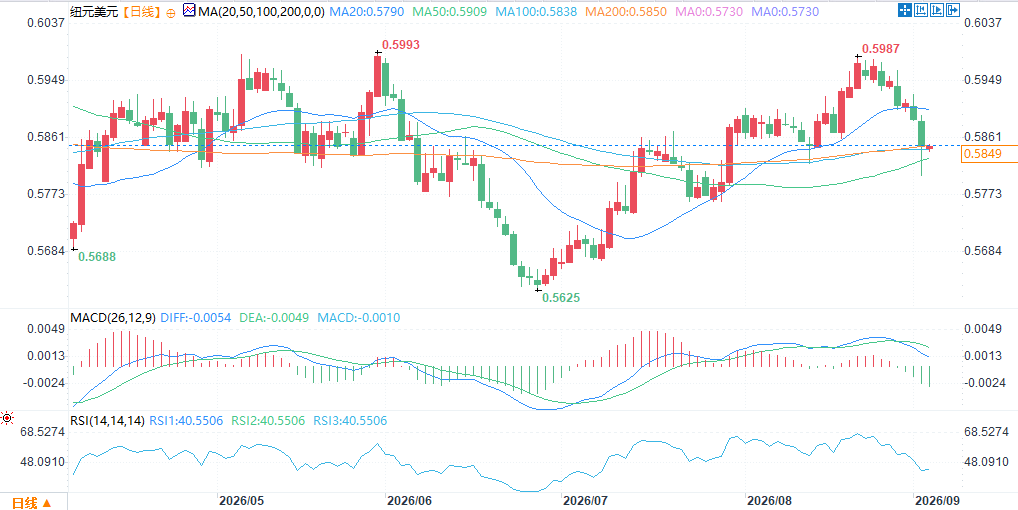 (NZD/USD daily chart, source: EasyForex) At 7:57 Beijing time, the NZD/USD exchange rate was 0.5849/50.
New Zealand dollar plunges: Interest rate hike is a foregone conclusion, but the interest rate path disappoints the market.
On Wednesday, the New Zealand dollar plunged nearly 1.7% against the US dollar from around 0.5900, briefly falling to the 0.5800 area before barely recovering to around 0.5850, just managing to hold above the 200-day moving average. The Reserve Bank of New Zealand raised interest rates by 25 basis points to 2.75%, as expected by the market. However, investors were not selling the rate hike itself, but rather the Fed's published guidance on the interest rate path. The latest forecasts indicate only one more rate hike is likely before the end of the year, with the cumulative tightening significantly lower than the market's previous expectation of around 95 basis points by mid-2027. Governor Brehman stated at the press conference that after two consecutive rate hikes, "time can be taken to assess economic data," which the market interpreted as a formal pause in rate hikes now on the agenda. As a result, the New Zealand dollar became the weakest performing major currency of the day. Meanwhile, the Australian dollar surged 1.07% against the New Zealand dollar, approaching the 1.2300 level, fully validating that the decline stemmed from adjustments in the New Zealand dollar's own fundamentals and policy expectations, rather than being driven solely by a stronger US dollar. Market sentiment quickly turned cautious, and traders began to reassess the medium-term outlook for the New Zealand dollar.Imported energy shock: Inflation not driven by domestic factors, and the rationale for raising interest rates is weak.
New Zealand's current overall inflation rate of 4.1% is almost entirely driven by imported energy price shocks. Excluding vehicle fuel costs, the annual rate is only 2.9%, with many core inflation indicators approaching or entering the central bank's target range. Tightening monetary policy to address purely imported price shocks is considered the least credible policy option, as the central bank cannot control external energy price fluctuations, and the timing of the shock's dissipation depends entirely on international oil market and geopolitical factors. The market has clearly realized that once oil prices decline, the necessity for further interest rate hikes will significantly diminish or even disappear. In the short term, investors will closely watch Thursday's release of China's services PMI and the US ISM services data to assess the latest developments in global demand and inflationary pressures. Friday's upcoming US non-farm payroll report is seen as a key catalyst, potentially further influencing risk sentiment and the US dollar's performance, thus providing either secondary shocks or support for the New Zealand dollar. Overall, the Reserve Bank of New Zealand's policy space is becoming increasingly limited due to the unique nature of its inflationary policies.Summarize
The New Zealand dollar's decline stemmed from market selling of the post-rate hike interest rate path rather than the hike itself. The impact of imported energy shocks weakened the tightening justification, and the New Zealand dollar is likely to trade in the 0.5800-0.5900 range in the short term. Attention should be paid to the impact of Friday's US non-farm payroll data and oil price movements on the New Zealand dollar's direction. The 200-day moving average at 0.5850 is a key support level; a break below this level could lead to a further decline towards 0.5750-0.5700. (NZD/USD daily chart, source: EasyForex) At 7:57 Beijing time, the NZD/USD exchange rate was 0.5849/50.
- Risk Warning and Disclaimer
- The market involves risk, and trading may not be suitable for all investors. This article is for reference only and does not constitute personal investment advice, nor does it take into account certain users’ specific investment objectives, financial situation, or other needs. Any investment decisions made based on this information are at your own risk.