Waller suddenly loosened a key condition, causing gold to fluctuate by $40 in an instant.
2026-09-03 21:22:04
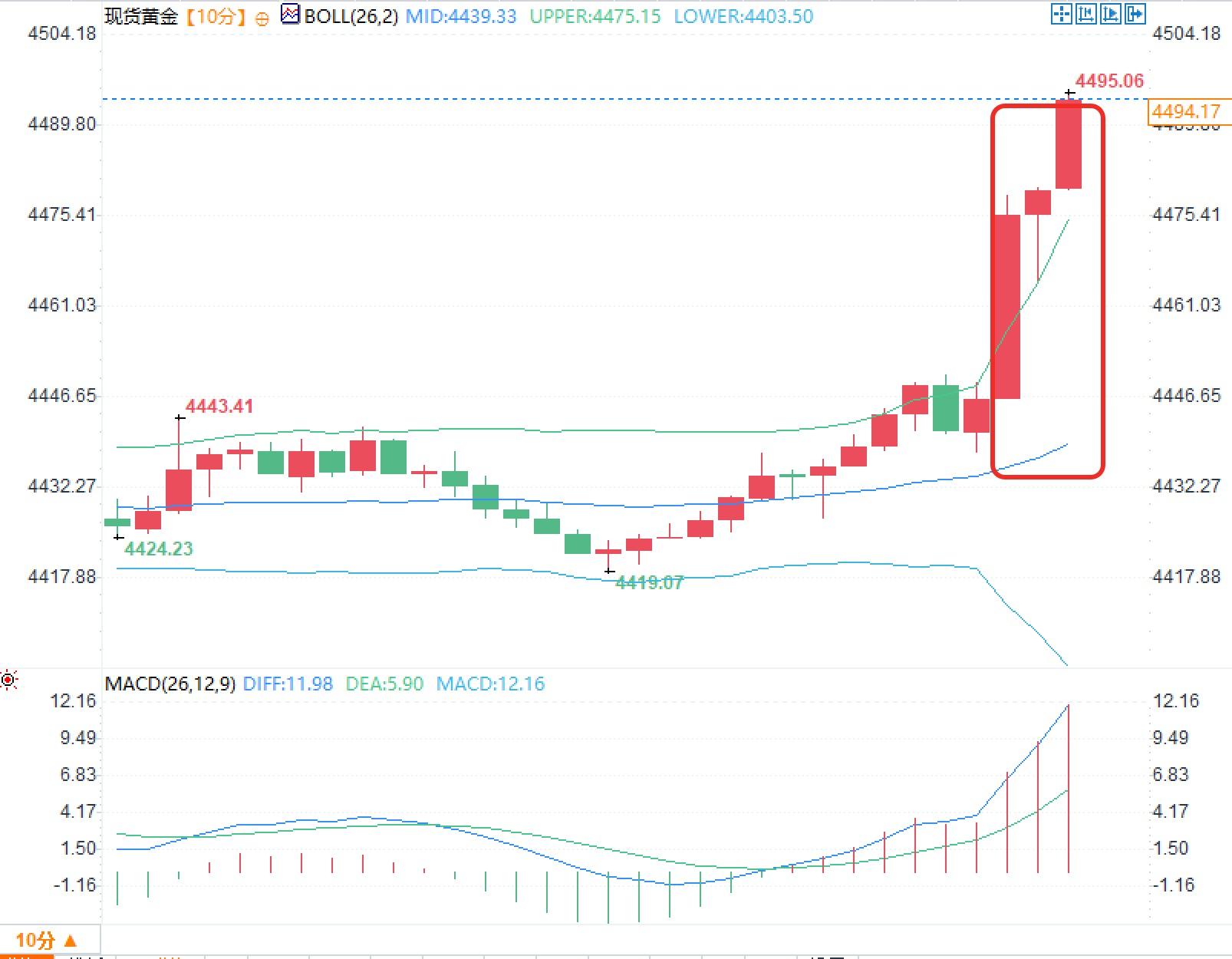
On Thursday, September 3, the core variable in the precious metals market shifted from simply the safe-haven premium back to the Federal Reserve's reaction function. Following speeches by Fed officials, spot gold rose rapidly by about $40, currently trading around $4490 per ounce, a daily increase of approximately 2.3%. 
Waller wasn't signaling easing, but rather a conditional pause.
Federal Reserve Governor Waller stated on September 3rd that recent data has finally shown some signs of cooling inflation. If the data continues to improve over the next two weeks, he is inclined to maintain the policy rate unchanged at the September 15-16 meeting; if inflation rebounds in August, he will consider a slight tightening of policy. He also believes that current monetary policy is only mildly restricting aggregate demand. The truly important factor is not "maintaining the rate" itself, but rather the significant asymmetry in policy conditions: rate cuts are not currently part of his policy agenda, and policy discussions remain focused on maintaining the status quo versus further tightening. The current target range for the federal funds rate is 3.50% to 3.75%. The July meeting saw a 9-3 vote to maintain the rate, with three members supporting a 25 basis point increase. Therefore, the core disagreement at the September meeting is not about shifting to easing, but whether the current level of restraint can continue to drive inflation down. For gold, an unchanged nominal policy rate does not automatically equate to easing financial conditions; the combination of real interest rates, the dollar, and inflation risk compensation is the more crucial pricing variable.The structure of inflation is more important than a single year-on-year figure.
The U.S. Personal Consumption Expenditures (PCE) price index rose 3.7% year-on-year in July, while the core index rose 3.3% year-on-year, both up 0.2% month-on-month. Waller specifically pointed out that about half of the core increase that month came from estimated prices of non-market services, suggesting that underlying inflation may be better than the core year-on-year figures suggest. He further cited the three-month annualized core inflation rate of 3.05%, a significant decrease from 4.76% in February. It's important to distinguish between statistical improvement and actual price improvement here. Waller mentioned that if the relevant non-market price estimation methods are adjusted, the 12-month PCE inflation could be revised downwards. This would change the market's measurement of inflation's distance from the 2% target, but would not simultaneously change the actual prices already faced by businesses and households. Therefore, what is more valuable for interest rate logic is the combination of marginal inflation, wages, and productivity over several consecutive months, rather than a single year-on-year change. As cross-validation, the July CPE rose 3.4% year-on-year, and the core index rose 2.5% year-on-year; there were approximately 7.3 million job openings and 5.1 million hires in July, with an unemployment rate of 4.1%. Labor demand has not shown any significant slowdown, which explains why Waller is currently placing the primary weight of his policy assessment on inflation rather than downside risks to employment.Why is gold unusually sensitive to this speech?
Gold is currently highly sensitive to policy information because both short-term policy expectations and long-term term premiums are at high levels. On September 2nd, the 10-year US Treasury yield was around 4.79%, having previously approached 4.82%. When long-term yields fall and the dollar weakens simultaneously, the opportunity cost of non-interest-bearing assets adjusts rapidly, making gold more susceptible to event-driven revaluation. However, this transmission mechanism itself doesn't provide a definitive conclusion on the subsequent direction, as energy prices, inflation expectations, and term premiums can all simultaneously alter real interest rates. More noteworthy is the data schedule. The US August jobs report will be released on September 4th, the producer price index on September 10th, and the consumer price index on September 11th, while the Federal Reserve meeting will be held from September 15th to 16th. The official August personal consumption expenditure price index won't be released until September 30th. In other words, before the meeting, the market can only estimate the Fed's preferred inflation indicator through employment, consumer prices, producer prices, and related sub-indices. This time misalignment—trading on proxy data before official indicators are confirmed—inherently increases the event volatility of the gold and interest rate markets. Observing the 10-minute chart, the price quickly deviated from the middle band in the news window and once ran to the outer side of the upper Bollinger Band, with the Bollinger Bands widening significantly in sync; the gap between the MACD fast and slow lines widened and the histogram bars increased significantly.Frequently Asked Questions
Question 1: Does Waller's inclination to keep interest rates unchanged equate to a policy shift towards easing? Answer: No. This is predicated on continued improvement in inflation in August, and a clear retention of the option to tighten slightly if inflation rises. The current statement is still a conditional pause, not a commitment to easing. Question 2: Why does gold tend to fluctuate sharply after speeches? Answer: Gold is simultaneously affected by real interest rates, the US dollar, inflation risk compensation, and safe-haven demand. Speeches change the market's weighting of policy distribution; when bond yields adjust in tandem with the US dollar, the opportunity cost of gold is quickly repriced.- Risk Warning and Disclaimer
- The market involves risk, and trading may not be suitable for all investors. This article is for reference only and does not constitute personal investment advice, nor does it take into account certain users’ specific investment objectives, financial situation, or other needs. Any investment decisions made based on this information are at your own risk.