The US revised its forecast upwards by 55,000, while Canada cut its forecast by 42,000, causing the Canadian dollar to be torn apart by two conflicting logics.
2026-09-04 21:56:07
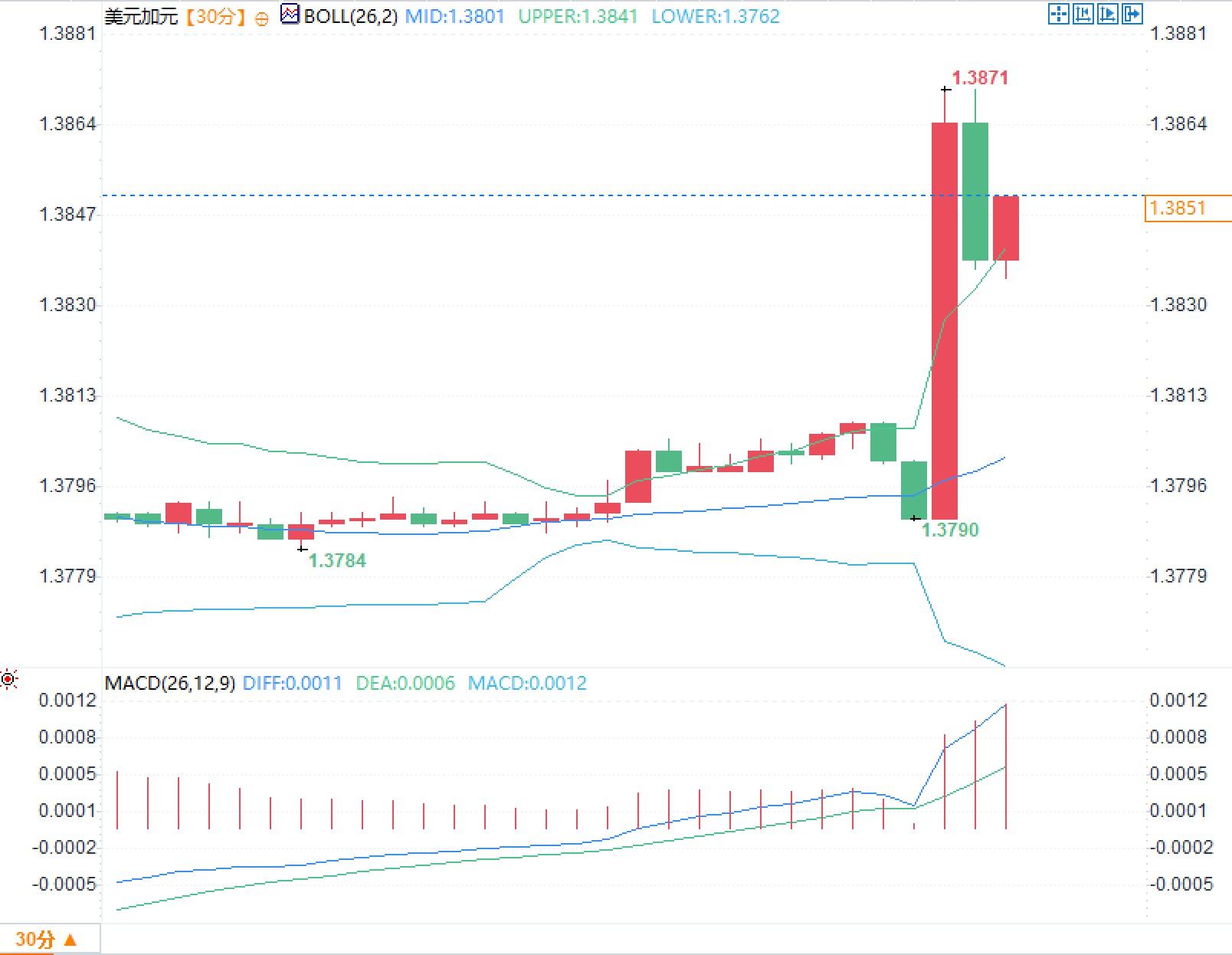
On Friday, September 4th, the North American foreign exchange market quickly entered a repricing phase after the simultaneous release of two employment reports. Canadian employment fell by approximately 42,000 in August, significantly deviating from the market's previous expectation of a modest increase, while the unemployment rate remained at 6.4%. Meanwhile, US non-farm payrolls increased by 162,000 in August, with the unemployment rate remaining at 4.1%, creating a stark contrast between the two labor market data. The Bank of Canada had just maintained its policy rate at 2.25% two days prior and increased its vigilance regarding upside risks to inflation. Therefore, this employment data was not simply "weak data," but rather reflected a shift in policy weighting among growth, wages, tariff costs, and inflation constraints. Market reactions reflected this complexity. Following the release of the employment data, Canadian short-term bonds initially saw a significant price correction, with the latest yield on the 2-year Canadian government bond at approximately 3.114%, having fluctuated between 3.058% and 3.136% during the day. The USD/CAD 30-minute chart shows a sharp increase in volatility immediately after the data release, followed by a period of high-volatility digestion, indicating that the trading logic has shifted from simply discussing the Bank of Canada's inflation stance to reassessing the relationship between growth resilience and policy constraints. 
 What truly warrants continued observation is the strength of the correlation between price volatility, Canadian short-term yields, and policy expectations in both countries. The US added 162,000 non-farm payroll jobs in August, with an unemployment rate of 4.1% and average hourly earnings increasing by 3.1% year-on-year. Meanwhile, the combined upward revision of June and July employment figures by 55,000 further amplified the discrepancy between the two countries' employment data on that day. Therefore, the short-term volatility of the USD/CAD exchange rate essentially incorporates two variables: the repricing of Canadian growth and adjustments to US interest rate expectations, rather than a single Canadian factor.
The key to the employment decline is not the 42,000 jobs lost, but rather the weakening of the job structure.
Canada's total employment fell by approximately 42,000 in August, a 0.2% decrease month-over-month, with the employment rate dropping to 60.8% and the labor force participation rate falling to 65.0%. The unemployment rate remained at 6.4%, seemingly unchanged, but a key reason is the simultaneous contraction in the labor force size; therefore, a stable unemployment rate cannot be simply interpreted as a still-tight labor market. More concerning is that among the approximately 1.5 million unemployed, 24.0% are long-term unemployed who have been continuously seeking work for more than 27 weeks, significantly higher than the average of 17.1% from 2017 to 2019, indicating a significant slack pressure within the job market. The industry structure also reveals information different from the overall figures. Manufacturing added approximately 22,000 jobs, the only sector to achieve significant growth in August, with about 14,000 of those increases coming from Ontario. Meanwhile, business, construction, and other support services lost approximately 20,000 jobs, public administration lost 8,800, natural resources lost 7,700, and utilities lost 5,600. Public sector employment has declined for the third consecutive month, with a cumulative loss of 78,000 jobs since May. The monthly improvement in manufacturing is therefore closer to a partial recovery than a broad expansion in employment.Cooling wages are altering the constraints facing the Bank of Canada.
More noteworthy than employment figures for the interest rate market is wage growth. In August, average hourly wages for Canadian employees rose only 2.0% year-on-year, falling to C$37.02, lower than July's 2.8% and June's 3.3%, and one of the lowest growth rates since November 2017, excluding exceptional periods. This continued slowdown in wage growth indicates that the pressure of domestic labor costs being passed on to service prices is weakening, a stark contrast to the current overall inflation rate of around 3%. When the Bank of Canada maintained its policy rate at 2.25% on September 2nd, its core message was not simply a tightening stance, but rather emphasized two types of risks: firstly, energy prices and new tariffs could raise business costs, with overall inflation currently around 3%; secondly, inflation excluding gasoline was 2.2%, core inflation remained close to 2%, and there was still excess supply in the economy. The further cooling of employment and wages now reinforces the latter set of evidence. Therefore, the more important factor in pricing policy is not predicting the next interest rate move, but rather observing whether the Bank of Canada's internal reaction function has changed. As long as wages, employment rates, and labor force participation rates continue to indicate cooling demand, growth factors will gain more weight in policy discussions; however, if tariffs and energy costs continue to drive price diffusion, inflation risks will limit the scope for monetary policy adjustments. This two-way constraint means that short-term interest rate volatility may be higher than can be explained solely by employment data.Second-quarter growth was strong, but tariff variables are testing the quality of the recovery.
Canada's real GDP grew 0.8% quarter-on-quarter in the second quarter, equivalent to an annualized rate of approximately 3.3%, with contributions from exports, household consumption, and business capital investment. This explains why the Bank of Canada still believes the foundations of the economic recovery have improved compared to previous periods. However, the August employment data indicates that the second-quarter growth did not automatically translate into stable new labor demand. While employment increased by 217,000 over the past 12 months, 181,000 of those increases occurred between April and July, and the August decline suggests a high concentration of the previous strong growth. More importantly, changes in trade costs have not yet fully been reflected in the August employment sample. The latest arrangements show that a new round of tariffs covers approximately C$27.6 billion worth of goods, with Canada's corresponding measures taking effect on September 8th, covering rates of 15%, 25%, and 50%. The Bank of Canada estimates that currently, products directly affected account for about 5% of exports to the US, so the overall impact may be limited. However, the real problems facing businesses are not just export volumes, but also profit margins, supply chain costs, and uncertainty surrounding investment and hiring plans. This also explains why industry-specific differences in employment reports will be more important than total employment figures in the coming months. The average layoff rate for export-dependent industries over the past 12 months was 0.9%, while it was 0.7% for other industries. If the gap widens, it indicates that trade costs are being transmitted through corporate hiring and capacity arrangements; if the gap remains limited, it means that policy support and corporate adjustments are absorbing some of the shock.Technical charts reflect the impact of events, not trends.
Looking at the 30-minute chart for USD/CAD, prior to the release of the employment data, the price traded within a narrow range around the middle Bollinger Band, with the bandwidth significantly contracting, reflecting the market's anticipation of macroeconomic information. After the data release, the amplitude of the single candlestick suddenly expanded, and the price briefly broke out of the previous trading range. The upper and lower Bollinger Bands widened rapidly, and the slope of the middle band also changed significantly. What truly warrants continued observation is the strength of the correlation between price volatility, Canadian short-term yields, and policy expectations in both countries. The US added 162,000 non-farm payroll jobs in August, with an unemployment rate of 4.1% and average hourly earnings increasing by 3.1% year-on-year. Meanwhile, the combined upward revision of June and July employment figures by 55,000 further amplified the discrepancy between the two countries' employment data on that day. Therefore, the short-term volatility of the USD/CAD exchange rate essentially incorporates two variables: the repricing of Canadian growth and adjustments to US interest rate expectations, rather than a single Canadian factor.Frequently Asked Questions
Question 1: Canada's unemployment rate didn't rise, so why is this employment report still considered weak? Answer: Because the number of employed people decreased by approximately 42,000, the employment rate fell to 60.8%, and the labor force participation rate also fell to 65.0%. The decrease in the size of the labor force limited the potential rise in the unemployment rate. Therefore, the seemingly stable 6.4% cannot offset the cooling of employment demand, and the long-term unemployment rate remains relatively high. Question 2: Does the addition of 22,000 jobs in manufacturing indicate that the employment structure remains robust? Answer: Manufacturing is indeed one of the few bright spots, but the increase is highly concentrated. Meanwhile, services support, public administration, resources, and utilities all saw declines, with the public sector losing jobs for three consecutive months. Improvement in a single sector is insufficient to offset the information conveyed by the decline in employment breadth. Question 3: Why can't the Bank of Canada focus solely on growth after the weakening employment situation? Answer: Because current policy faces both cooling wages and imported price pressures. Core inflation is near the target, but energy and tariffs could still push up business costs. The employment data reduced demand-side pressures but did not eliminate supply-side inflation risks. Therefore, policy decisions still depend on the extent of subsequent inflationary spread.- Risk Warning and Disclaimer
- The market involves risk, and trading may not be suitable for all investors. This article is for reference only and does not constitute personal investment advice, nor does it take into account certain users’ specific investment objectives, financial situation, or other needs. Any investment decisions made based on this information are at your own risk.