WTI crude oil surged 10% on the week, but expectations of a Fed rate hike are becoming the most dangerous opposing force for the bulls.
2026-09-05 09:38:04
International oil prices surged this week amid renewed military clashes between the US and Iran. Data from major overseas institutions showed that Brent crude futures closed at $92.68 on Friday, up 7.6% for the week; WTI crude futures closed at $91.48, up nearly 10% for the week. Domestic SC crude oil saw an even more significant weekly gain, reaching 11.39%. Refined oil products also strengthened, with the average retail diesel price in the US rising to $5.85 per gallon, a record high. Preliminary shipping data from the Strait of Hormuz further amplified supply anxieties, with only four commodity ships passing through the channel on Thursday, far below the daily average of approximately 15 ships over the past 10 days. Meanwhile, managed funds increased their net long positions in WTI crude in the week ending September 1st, reflecting a resonance between market sentiment and geopolitical risks. 
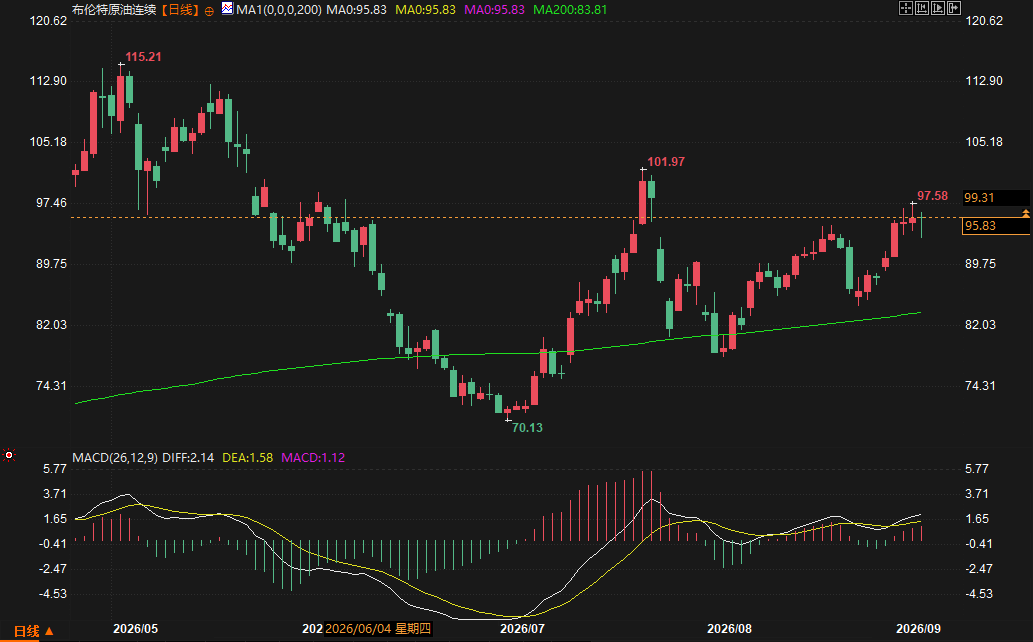
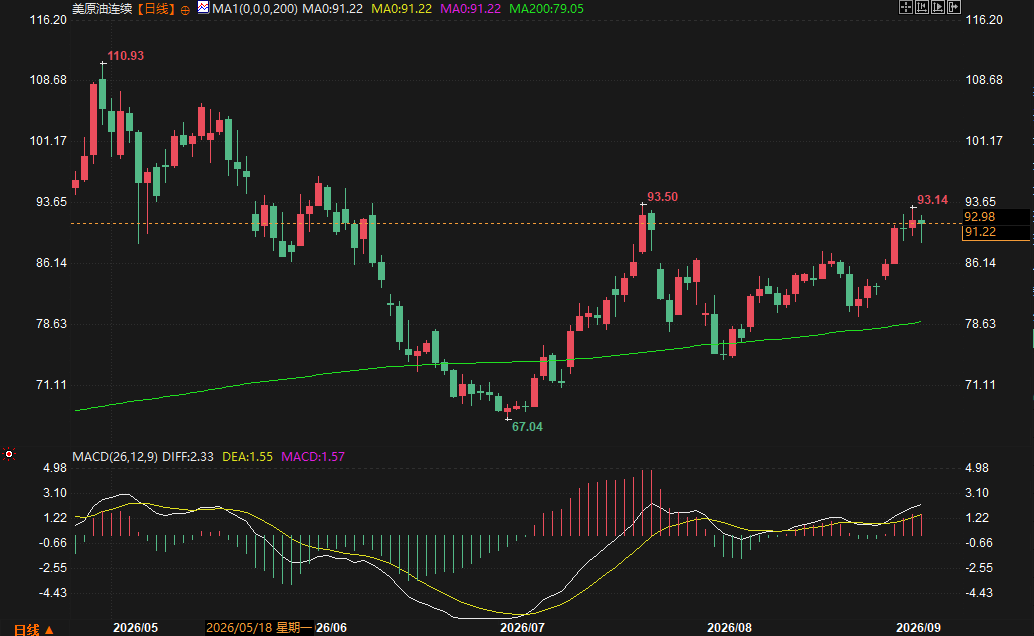 In terms of economic data and events, the resumption of fighting between the US and Iran after seven months of conflict became the core trigger for this week's price increase. A sharp drop in traffic through the Strait of Hormuz further exacerbated market concerns about the Persian Gulf's shipping capacity. The US added 162,000 jobs in August, easing concerns about a rapidly cooling labor market and strengthening the likelihood of the Federal Reserve raising interest rates again in late September. CFTC data shows that managed funds increased their net long positions in WTI crude oil futures and options in New York and London by 15,816 contracts to 118,894 contracts, indicating that speculative funds are still tilting towards the bullish side. Regarding institutional views, Citigroup raised its third-quarter Brent crude oil average price forecast from $80 to $86 per barrel, citing the longer-than-expected reopening of the Strait of Hormuz. Rystad Energy's chief economist, Claudio Galimberti, pointed out that rising diesel prices are pushing up overall inflation and supporting high US Treasury yields, with market expectations of continued inflation becoming self-reinforcing.
Crude oil sector
In this week's market review, both Brent and WTI crude oil have completed their consolidation at higher levels after a continuous upward trend. Brent crude oil briefly approached $97 during the session before slightly retreating to around $95.83 on Friday, still recording a weekly gain of nearly 7%. WTI crude oil has shown strong consolidation with four positive and one negative candlestick over the past five trading days, with the price approximately 15% above the 200-day moving average. The MACD histogram remains bullish, indicating that the bullish momentum has not weakened significantly. Domestic SC crude oil saw a weekly gain of over 11%, outperforming international markets, suggesting that supply concerns within the region are more concentrated. In terms of economic data and events, the resumption of fighting between the US and Iran after seven months of conflict became the core trigger for this week's price increase. A sharp drop in traffic through the Strait of Hormuz further exacerbated market concerns about the Persian Gulf's shipping capacity. The US added 162,000 jobs in August, easing concerns about a rapidly cooling labor market and strengthening the likelihood of the Federal Reserve raising interest rates again in late September. CFTC data shows that managed funds increased their net long positions in WTI crude oil futures and options in New York and London by 15,816 contracts to 118,894 contracts, indicating that speculative funds are still tilting towards the bullish side. Regarding institutional views, Citigroup raised its third-quarter Brent crude oil average price forecast from $80 to $86 per barrel, citing the longer-than-expected reopening of the Strait of Hormuz. Rystad Energy's chief economist, Claudio Galimberti, pointed out that rising diesel prices are pushing up overall inflation and supporting high US Treasury yields, with market expectations of continued inflation becoming self-reinforcing.Refined oil and natural gas sector
In this week's market review, the average retail price of diesel in the US rose to $5.85, a new record high. Heating oil futures contracts also surged, indicating that the market is pricing in winter heating demand in advance. RBOB gasoline futures rose 4.30% for the week, US fuel oil rose 5.74%, and natural gas rose 2.16%. Diesel's gains significantly outpaced crude oil, and crack spreads remained strong. In terms of economic data and events, supply disruptions are driven not only by the US-Iran situation. The ongoing attacks by Ukraine on Russian refineries in the Russia-Ukraine conflict pose additional challenges to distillate fuel supplies in Europe and globally. US agricultural states are entering the harvest and planting season, and diesel, as a primary fuel for agricultural equipment, enjoys seasonal demand support. With inventories drastically reduced, diesel prices are significantly more sensitive to supply disruptions. Regarding institutional views, data from the American Automobile Association shows that the average diesel price is already at a historical high. The market focus is on the potential for continued price increases in diesel, a fundamental fuel across various sectors of the economy, to be transmitted to a broader price system through transportation and production costs. If the Federal Reserve is forced to maintain a high-interest-rate environment for a longer period, risk asset pricing will face additional constraints. This week's oil price increase was not driven by a single event, but rather by a combination of geopolitical conflicts, bottlenecks in key shipping routes, structural shortages of refined oil products, and increased speculative buying. The sharp drop in traffic in the Strait of Hormuz provided the most direct signal of supply risk, while record high diesel prices amplified concerns about sticky inflation. The increase in net long positions held by managed funds resonated with the bullish technical formation, but rising expectations of a Fed rate hike also suggest that demand-side pressures may gradually emerge. Until supply risks are resolved, prices are expected to remain highly volatile, and the sustainability of event-driven price movements remains a key focus for future monitoring.QA module
Question 1: Was the main driver of this week's surge in crude oil prices supply disruptions or demand expectations? The main drivers were supply disruptions and supply risk premiums. The resumption of fighting between the US and Iran and the sharp drop in traffic through the Strait of Hormuz directly compressed market expectations for Persian Gulf shipping capacity. There was no significant increase in demand; US employment data only mitigated concerns about a downturn and did not signal new demand expansion. Question 2: What does the current bottleneck in the Strait of Hormuz mean for the market? Only four commodity ships passed through on Thursday, far below the daily average of fifteen, indicating that traffic efficiency has been substantially affected. Even if the channel is not completely closed, slow passage will extend transportation cycles, increase insurance and freight costs, support spot premiums, and reinforce market pricing of supply disruptions. Question 3: Why is the record high in diesel more noteworthy than crude oil itself? Diesel directly connects agriculture, transportation, and industrial production, and its price transmission path to end users is shorter. A record high in diesel will push up overall inflation expectations and affect global asset pricing through government bond yields. While crude oil price increases can be partially absorbed by strategic reserves or refinery profits, diesel price increases have a more direct impact on the real economy. Question 4: What signal does the increase in net long positions by managed funds send? As of the week ending September 1st, managed funds increased their net long positions by 15,816 contracts, indicating that speculative funds had already shifted towards long positions before the escalation of the US-Iran conflict. The increase in net long positions coincided with the price increase, suggesting that the rise was not driven by short covering but rather by new long positions actively entering the market, indicating strong short-term sentiment. However, it also implies that profit-taking pressure may accumulate simultaneously. Question 5: Is Citi's upward revision of its Brent crude oil forecast sufficient? Citi raised its third-quarter average price forecast from $80 to $86, citing the longer reopening of the Strait of Hormuz. This logic focuses on the duration of the supply bottleneck rather than demand growth, thus aligning with the current core market contradiction. However, the forecast is still lower than Friday's closing price, indicating that institutions remain cautious about the sustainability of the event.- Risk Warning and Disclaimer
- The market involves risk, and trading may not be suitable for all investors. This article is for reference only and does not constitute personal investment advice, nor does it take into account certain users’ specific investment objectives, financial situation, or other needs. Any investment decisions made based on this information are at your own risk.