Goldman Sachs refutes the claim that "strong employment will lead to interest rate hikes"! Non-farm payrolls are insufficient to drive interest rate increases; this week's CPI is the key.
2026-09-07 08:08:06
Goldman Sachs commented on Friday's non-farm payroll data, stating that while the August jobs report exceeded expectations, it was "solid rather than overheated," removing an obstacle to a September rate hike. However, this Friday's inflation data will be the key variable truly determining the Fed's policy direction in September. Goldman Sachs pointed out that wage and unit labor cost growth are at or below the 2% inflation target, and the unemployment rate is holding steady near the Fed's estimated full employment level. Goldman Sachs attributes the current higher-than-expected inflation to special factors such as tariffs, energy prices, and non-market costs, which it expects to subside over the next year. 
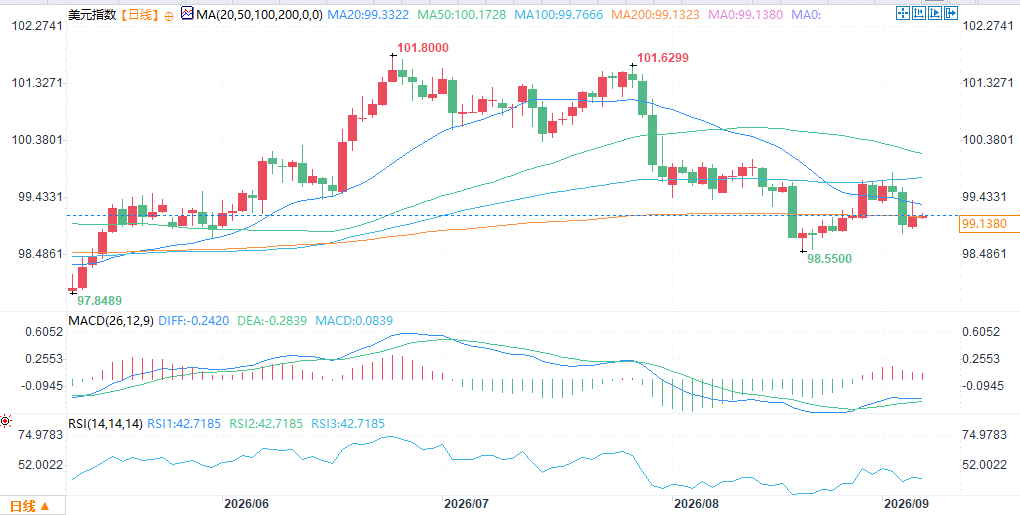 (US Dollar Index Daily Chart, Source: EasyForex) At 7:57 Beijing time, the US Dollar Index was at 99.15.
Non-farm payrolls "cleared obstacles" but did not change the baseline assessment.
Goldman Sachs, in interpreting the August non-farm payroll report, explicitly pointed out that the data as a whole presented a "solid rather than overheated" characteristic, effectively removing a potential obstacle for the Federal Reserve to consider raising interest rates at its September meeting. The report showed that job growth exceeded market expectations, while June and July data were also revised upwards, and the unemployment rate remained stable near full employment. Wage growth and the growth rate of unit labor costs were both at or below the range consistently aligned with the Fed's 2% inflation target, indicating that the labor market did not show significant signs of overheating, nor did it create any new significant upward pressure on prices. From a policy transmission perspective, the healthy performance of the employment data means that the Fed does not need to worry about the economy accelerating inflation again due to an imbalance between labor supply and demand. In the past few months, the market has been focused on whether an overheated labor market would force the central bank to tighten monetary policy prematurely, and this report has alleviated this concern to some extent. Goldman Sachs emphasized that although the employment data was good, it merely "cleared the way" and did not fundamentally change the bank's baseline scenario of maintaining interest rates unchanged in September. In the Fed's decision-making framework, employment is only one aspect of a multi-dimensional consideration; the path of inflation remains the truly decisive factor. In other words, the improved employment data has reduced the urgency of raising interest rates, but it is insufficient to make it the primary scenario. Market participants need to recognize that the current policy environment remains highly dependent on subsequent inflation data for confirmation, rather than simply on short-term fluctuations in the labor market. Furthermore, moderate growth in wages and unit labor costs at full employment levels reflects manageable labor cost pressures for businesses, helping to support the soft landing narrative. Goldman Sachs' stance indicates that even if employment data exceeds expectations, the policy rate path will still proceed in a data-dependent manner, avoiding premature or excessive reactions to a single indicator.Inflation is the "decisive factor," and special factors are expected to subside.
Goldman Sachs further emphasizes that the inflation data to be released this Friday is the key variable that will truly determine the Fed's policy direction in September. The current higher-than-expected inflation is mainly attributable to temporary or special factors such as tariffs, energy price volatility, and non-market costs, rather than persistent demand-driven pressures. The bank expects these special factors to gradually subside over the next year, pushing overall inflation back to a level closer to the target. Within this framework, if this week's CPI report shows a moderate reading, it will be sufficient to support the Fed keeping interest rates unchanged at its September meeting. Conversely, if the CPI unexpectedly rises and exceeds expectations, it could reopen the policy window for rate hikes. Goldman Sachs' analysis suggests that a single key CPI data point may have a greater impact on the September decision at this juncture than the previous non-farm payroll report. This is because inflation is directly related to the core of the central bank's dual mandate of price stability, while the labor market is already largely in equilibrium. The expectation of the fading of special factors is based on assumptions of supply chain adjustments, energy market normalization, and the gradual digestion of tariff effects. Once these assumptions are validated by data, the inflation path will more clearly point towards the target. Goldman Sachs believes that inflation plays a decisive role in its probability distribution of directly altering the path of policy interest rates, while employment data primarily serves to confirm economic resilience. Therefore, when assessing the outlook for the September meeting, investors should prioritize inflation data rather than simply relying on the employment report as the final basis. This data-dependent policy logic further highlights the Federal Reserve's cautious approach to the risk of sticky inflation at this stage.Market Impact: The US dollar is driven by inflation expectations in the short term.
Goldman Sachs clearly distinguishes the different weights of employment and inflation data in the Fed's decision-making: employment data mainly serves to clear obstacles, while inflation data directly determines the final outcome. Therefore, the short-term movement of the US dollar may be driven more by inflation expectations than by the employment data itself. If Friday's CPI data is moderate, the market's probability of a September rate hike will further decline, potentially putting pressure on the dollar; conversely, if the CPI is overheated, it could reignite expectations of a rate hike, thus supporting the dollar. After the employment report was released, the market has partially digested the information about a robust labor market, but what can truly trigger a directional change in the dollar is the confirmation of the inflation path. If the inflation data supports a scenario of maintaining interest rates unchanged, the dollar may face some downward pressure, especially against the backdrop of narrowing interest rate expectation gaps; if the data re-strengthens tightening expectations, the dollar is expected to gain some support. In addition, investors should also pay attention to the spillover effects of inflation data on other asset classes, such as the yield curve of US Treasury bonds and the linkage reaction of risk assets. Goldman Sachs' analysis reminds the market that the most critical variable before the September meeting is always the evolution of inflation, not the already released employment data. Dollar traders should remain sensitive to policy pricing adjustments following data releases and be flexible in responding to potential amplified volatility. Overall, the short-term dollar trend will be data-driven, with the inflation report results directly shaping market expectations and exchange rate direction ahead of the September meeting.Summarize
Goldman Sachs believes that the non-farm payrolls data cleared the way for a rate hike, but inflation is the decisive factor. If Friday's CPI is moderate, the Fed will likely hold rates steady in September; if it's overheated, the window for a rate hike may reopen. The dollar may be driven more by inflation expectations in the short term; attention should be paid to the impact of Friday's CPI data on the probability of a rate hike and the direction of the dollar. Goldman Sachs' view further confirms the Fed's policy path's high dependence on inflation data and provides the market with a clear decision-making framework—before the September meeting, inflation data has more "pricing power" than employment data. (US Dollar Index Daily Chart, Source: EasyForex) At 7:57 Beijing time, the US Dollar Index was at 99.15.
- Risk Warning and Disclaimer
- The market involves risk, and trading may not be suitable for all investors. This article is for reference only and does not constitute personal investment advice, nor does it take into account certain users’ specific investment objectives, financial situation, or other needs. Any investment decisions made based on this information are at your own risk.