Crude oil trading alert: Escalating supply risks in the Middle East are driving up crude oil risk premiums, and a test of a dense resistance zone may be imminent in the short term.
2026-09-07 09:34:06
International crude oil markets regained upward momentum on Monday, with WTI crude rising to around $92 per barrel during Asian trading hours. While oil prices had previously experienced a short-term correction, risks to energy transportation in the Middle East have not subsided significantly. Escalating military action between the US and Iran has reignited market concerns about the continuity of regional oil supply and the security of shipping through the Strait of Hormuz.  The key to this shift in the situation lies not merely in the military action itself, but in its potential further impact on the global energy transportation system. Over the weekend, the US took military action against Iranian oil tankers, and Iran subsequently expanded the restricted area near the Strait of Hormuz, raising new concerns about the future efficiency of commercial vessel passage. Since the Strait of Hormuz has long been crucial for global energy transportation, continued restrictions on navigation could extend beyond localized transport to global crude oil spot supply, freight rates, and inventory expectations. US Energy Secretary Chris Wright stated that the US will maintain a naval presence in the area, push for restrictions on Iranian crude oil exports, and attempt to ensure the passage of commercial vessels through the Strait of Hormuz. This implies that the US strategy is not simply to reduce its military presence, but to maintain the operation of energy transportation routes while strengthening regional control. However, what truly captures market attention is the significant discrepancy between shipping data and official statements. Kpler's tracking data shows that the number of ships passing through the Strait of Hormuz has recently dropped to approximately 10 per day, a multi-month low. In contrast, the US Navy emphasizes that escort operations are being strengthened. The discrepancy between the two sets of information suggests that even if commercial vessels can theoretically still receive escorts, actual transport efficiency may have already been significantly impacted. This change is significant for the crude oil market. Oil prices don't necessarily need to wait for a substantial global supply gap to rise; as long as the market judges that reduced transport efficiency may lead to future supply reductions, futures prices may already factor in the risk premium. Therefore, the current rebound of WTI crude oil prices above $90 largely reflects the market's repricing of future supply uncertainty, rather than simply an immediate reaction to changes in spot inventories. Commerzbank analysts believe that the current crude oil transport situation in the Strait of Hormuz remains highly uncertain, especially given the significant discrepancies in assessments of daily actual crude oil throughput across different channels. What the market truly needs to confirm is whether the current decline in transport volume is a short-term hedging behavior or has created a persistent supply bottleneck. If it's merely a temporary reduction in voyages by shipowners, crude oil transport may gradually recover as escort capabilities improve; however, if the duration of the traffic restrictions is further prolonged, then the supply pressure in the global spot market may increase significantly. Therefore, the energy market data released this week will be of high reference value. The market will focus on the latest assessments from energy agencies regarding global crude oil supply, maritime transport, and inventory changes. Trade data from major Asian countries may also help investors assess whether Asian crude oil import demand remains resilient. If transport volumes remain low while demand does not cool significantly, the supply gap in the crude oil market is expected to widen further. From a global market perspective, rising oil prices will first affect inflation expectations through energy cost channels. If WTI continues to trade above $90 and extends to higher levels, gasoline, jet fuel, and industrial energy costs may be affected, increasing the difficulty for major economies to control inflation. At the same time, high oil prices will increase cost pressures in energy-importing regions and may reshape the flow of funds between the US dollar, bond yields, and risk assets. On the other hand, current market sentiment has clearly shifted from focusing on inventory and demand to geopolitical risks and actual transport. After the recent significant rise in oil prices, investors have not simply chased the rally but are paying closer attention to daily actual transport volumes in the Strait of Hormuz, the status of commercial vessel escorts, changes in exports from major oil-producing regions, and whether global inventories can continue to provide a buffer. This means that subsequent oil price movements may exhibit a clear two-way volatility. Once shipping data shows a recovery in crude oil transportation, the risk premium previously priced in by the market may be quickly reversed; conversely, if the number of daily ships passing through continues to decline and there are more signs of delays in crude oil exports, WTI may retest previous highs. Therefore, the core issue for oil prices has gradually shifted from "whether supply will be affected" to "the extent and duration of the supply disruption." From a daily chart perspective, WTI has re-entered a strong zone around $92 after its previous rapid rise. The short-term moving average system remains generally bullish, and the price is trading above the medium-term trend line, indicating that the bullish dominance has not been broken. However, after the continuous rise in oil prices, market momentum has clearly strengthened, and short-term technical indicators face the risk of overbought conditions. Therefore, the $90 level is both a psychological barrier and a crucial area of contention between bulls and bears. If the price can stabilize above $90 and further break through the recent resistance level of $94-$96, it could open up space for further upward movement; if the price encounters resistance, the first support level to watch is around $88, followed by the $85-$86 area. As long as the pullback holds above the key mid-term support, the overall upward structure remains intact. Looking at the 4-hour chart, WTI is still in a high-level consolidation with a slightly bullish bias. After the rapid rise in the previous period, there has been some profit-taking, but the price is moving back towards the $92 level, indicating that buyers are still looking for opportunities to buy at lower levels. Momentum indicators such as the MACD have improved again after a short-term correction. If the price can effectively break through the $95 area, the short-term upward trend may be further strengthened, potentially testing $98 or even the previous high. Conversely, if the price fails to hold above $90 and a momentum divergence appears on the 4-hour chart, the risk of a rapid pullback should be noted. Currently, the more important factor is not a single technical indicator, but whether the $90 level can transform from resistance into effective support, which will directly affect the continuation of the short-term trend.
 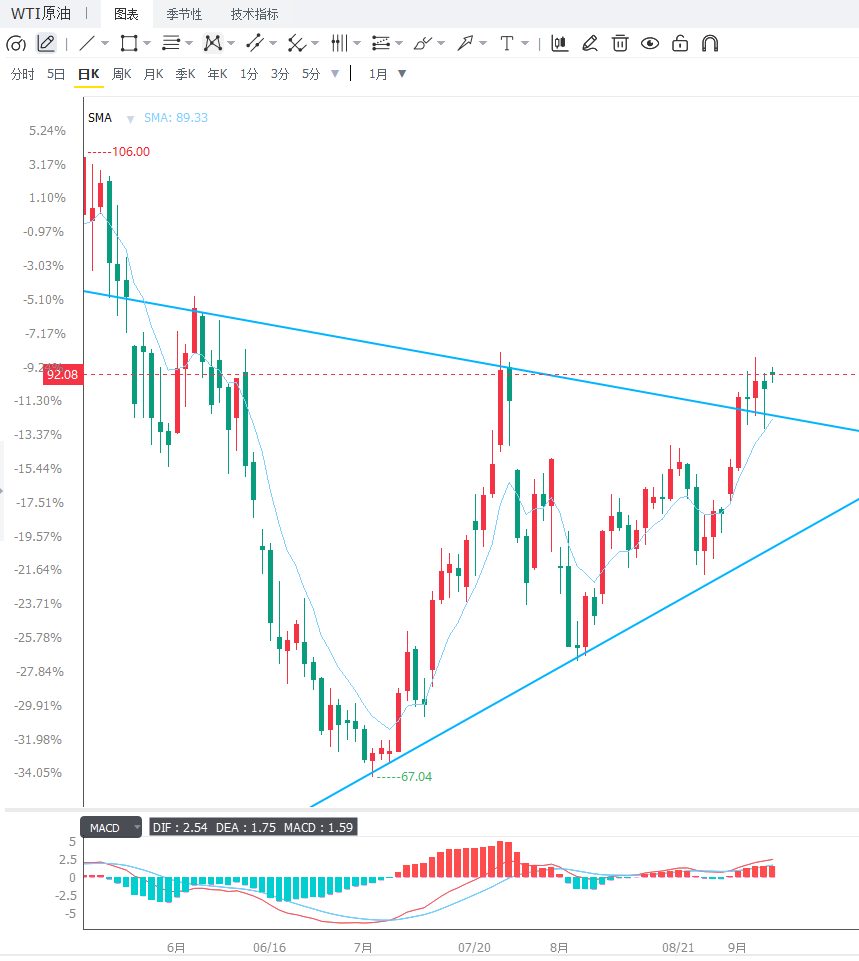 The editor's summary indicates that WTI crude oil's return to around $90 suggests the market is repricing the risks associated with Middle Eastern energy transportation. The core driver of the current oil price increase is not simply improved demand, but rather the decline in actual traffic volume in the Strait of Hormuz and the uncertainty surrounding future supply disruptions. In the short term, as long as military tensions do not ease significantly, crude oil prices are likely to maintain a high risk premium; if transportation disruptions further expand, the probability of WTI breaking through previous highs will increase. However, high oil prices also face significant contrarian risks. Once the escort operation improves commercial vessel traffic, or subsequent energy data proves that the actual impact on crude oil supply is less than market expectations, the previously accumulated risk premium could be quickly released. Therefore, the focus should be on monitoring actual traffic volume in the Strait of Hormuz, global crude oil inventories, exports from major oil-producing regions, and crude oil import demand from major Asian countries. Above $90, crude oil bulls remain in control, but price volatility will also increase accordingly; the risks of chasing the rally and potential pullbacks need to be assessed simultaneously.
The key to this shift in the situation lies not merely in the military action itself, but in its potential further impact on the global energy transportation system. Over the weekend, the US took military action against Iranian oil tankers, and Iran subsequently expanded the restricted area near the Strait of Hormuz, raising new concerns about the future efficiency of commercial vessel passage. Since the Strait of Hormuz has long been crucial for global energy transportation, continued restrictions on navigation could extend beyond localized transport to global crude oil spot supply, freight rates, and inventory expectations. US Energy Secretary Chris Wright stated that the US will maintain a naval presence in the area, push for restrictions on Iranian crude oil exports, and attempt to ensure the passage of commercial vessels through the Strait of Hormuz. This implies that the US strategy is not simply to reduce its military presence, but to maintain the operation of energy transportation routes while strengthening regional control. However, what truly captures market attention is the significant discrepancy between shipping data and official statements. Kpler's tracking data shows that the number of ships passing through the Strait of Hormuz has recently dropped to approximately 10 per day, a multi-month low. In contrast, the US Navy emphasizes that escort operations are being strengthened. The discrepancy between the two sets of information suggests that even if commercial vessels can theoretically still receive escorts, actual transport efficiency may have already been significantly impacted. This change is significant for the crude oil market. Oil prices don't necessarily need to wait for a substantial global supply gap to rise; as long as the market judges that reduced transport efficiency may lead to future supply reductions, futures prices may already factor in the risk premium. Therefore, the current rebound of WTI crude oil prices above $90 largely reflects the market's repricing of future supply uncertainty, rather than simply an immediate reaction to changes in spot inventories. Commerzbank analysts believe that the current crude oil transport situation in the Strait of Hormuz remains highly uncertain, especially given the significant discrepancies in assessments of daily actual crude oil throughput across different channels. What the market truly needs to confirm is whether the current decline in transport volume is a short-term hedging behavior or has created a persistent supply bottleneck. If it's merely a temporary reduction in voyages by shipowners, crude oil transport may gradually recover as escort capabilities improve; however, if the duration of the traffic restrictions is further prolonged, then the supply pressure in the global spot market may increase significantly. Therefore, the energy market data released this week will be of high reference value. The market will focus on the latest assessments from energy agencies regarding global crude oil supply, maritime transport, and inventory changes. Trade data from major Asian countries may also help investors assess whether Asian crude oil import demand remains resilient. If transport volumes remain low while demand does not cool significantly, the supply gap in the crude oil market is expected to widen further. From a global market perspective, rising oil prices will first affect inflation expectations through energy cost channels. If WTI continues to trade above $90 and extends to higher levels, gasoline, jet fuel, and industrial energy costs may be affected, increasing the difficulty for major economies to control inflation. At the same time, high oil prices will increase cost pressures in energy-importing regions and may reshape the flow of funds between the US dollar, bond yields, and risk assets. On the other hand, current market sentiment has clearly shifted from focusing on inventory and demand to geopolitical risks and actual transport. After the recent significant rise in oil prices, investors have not simply chased the rally but are paying closer attention to daily actual transport volumes in the Strait of Hormuz, the status of commercial vessel escorts, changes in exports from major oil-producing regions, and whether global inventories can continue to provide a buffer. This means that subsequent oil price movements may exhibit a clear two-way volatility. Once shipping data shows a recovery in crude oil transportation, the risk premium previously priced in by the market may be quickly reversed; conversely, if the number of daily ships passing through continues to decline and there are more signs of delays in crude oil exports, WTI may retest previous highs. Therefore, the core issue for oil prices has gradually shifted from "whether supply will be affected" to "the extent and duration of the supply disruption." From a daily chart perspective, WTI has re-entered a strong zone around $92 after its previous rapid rise. The short-term moving average system remains generally bullish, and the price is trading above the medium-term trend line, indicating that the bullish dominance has not been broken. However, after the continuous rise in oil prices, market momentum has clearly strengthened, and short-term technical indicators face the risk of overbought conditions. Therefore, the $90 level is both a psychological barrier and a crucial area of contention between bulls and bears. If the price can stabilize above $90 and further break through the recent resistance level of $94-$96, it could open up space for further upward movement; if the price encounters resistance, the first support level to watch is around $88, followed by the $85-$86 area. As long as the pullback holds above the key mid-term support, the overall upward structure remains intact. Looking at the 4-hour chart, WTI is still in a high-level consolidation with a slightly bullish bias. After the rapid rise in the previous period, there has been some profit-taking, but the price is moving back towards the $92 level, indicating that buyers are still looking for opportunities to buy at lower levels. Momentum indicators such as the MACD have improved again after a short-term correction. If the price can effectively break through the $95 area, the short-term upward trend may be further strengthened, potentially testing $98 or even the previous high. Conversely, if the price fails to hold above $90 and a momentum divergence appears on the 4-hour chart, the risk of a rapid pullback should be noted. Currently, the more important factor is not a single technical indicator, but whether the $90 level can transform from resistance into effective support, which will directly affect the continuation of the short-term trend. The editor's summary indicates that WTI crude oil's return to around $90 suggests the market is repricing the risks associated with Middle Eastern energy transportation. The core driver of the current oil price increase is not simply improved demand, but rather the decline in actual traffic volume in the Strait of Hormuz and the uncertainty surrounding future supply disruptions. In the short term, as long as military tensions do not ease significantly, crude oil prices are likely to maintain a high risk premium; if transportation disruptions further expand, the probability of WTI breaking through previous highs will increase. However, high oil prices also face significant contrarian risks. Once the escort operation improves commercial vessel traffic, or subsequent energy data proves that the actual impact on crude oil supply is less than market expectations, the previously accumulated risk premium could be quickly released. Therefore, the focus should be on monitoring actual traffic volume in the Strait of Hormuz, global crude oil inventories, exports from major oil-producing regions, and crude oil import demand from major Asian countries. Above $90, crude oil bulls remain in control, but price volatility will also increase accordingly; the risks of chasing the rally and potential pullbacks need to be assessed simultaneously.
- Risk Warning and Disclaimer
- The market involves risk, and trading may not be suitable for all investors. This article is for reference only and does not constitute personal investment advice, nor does it take into account certain users’ specific investment objectives, financial situation, or other needs. Any investment decisions made based on this information are at your own risk.