Strong US jobs data failed to push the dollar higher.
2026-09-07 18:08:05
Despite strong US employment data, the US dollar failed to capitalize on the momentum and instead remained cautious amid a tug-of-war between bulls and bears. The US labor market delivered better-than-expected results: August non-farm payrolls increased by 162,000, three times the market consensus; meanwhile, June and July employment figures were revised upwards by a combined 55,000, and the unemployment rate remained at 4.1%. This robust employment report alleviated a major concern among Federal Open Market Committee (FOMC) members—the risk that interest rate hikes would directly cause a sudden freeze in the labor market and a rapid economic slowdown. The path of monetary policy tightening is now clearly visible to the market, but the US dollar index has not rushed into a rally. This reflects that the current foreign exchange market is no longer simply about "good data = a stronger dollar," and more variables are diverting funds from the pricing logic.  The underlying reasons can be found in the pricing stability of the interest rate futures market. CME Group interest rate derivatives continue to price, with the probability of a Fed rate hike in September remaining around 60%; while the market's expectation of completing two rounds of monetary tightening by 2026 has fallen to 44%. Traders are not betting on aggressive rate hikes based solely on non-farm payroll data, but are instead focusing on the upcoming August US inflation data. This inflation report will be the most important benchmark for the Federal Open Market Committee's next policy meeting, thus the market has entered a short waiting window. Meanwhile, voices contradicting the Fed's policy are emerging in the US domestic political arena. Donald Trump does not agree with the logic that "rate hikes can stabilize the debt market," and has instead publicly called for the Fed to shift to rate cuts. Treasury Secretary Scott Bessant argues that once the conflict in the Middle East subsides and international oil prices fall sharply to the $40-50/barrel range, US Treasury yields will subsequently decline. Public statements from political circles have diverged significantly from the Federal Reserve's policy stance, further complicating market analysis of the policy outlook and suppressing the dollar's upward momentum to some extent. The driving factors pushing up US Treasury yields are not limited to geopolitical tensions and expectations of Fed tightening. As of September 1st, Japan's holdings of overseas securities decreased by $87.8 billion, roughly matching the amount of funds used for currency intervention by Japan during the July-August transition. The market infers that the Japanese authorities are highly likely to raise funds by selling US Treasury bonds to intervene in the yen's exchange rate, and this large-scale selling of US Treasury bonds has become a significant contributor to the rise in US Treasury yields.
 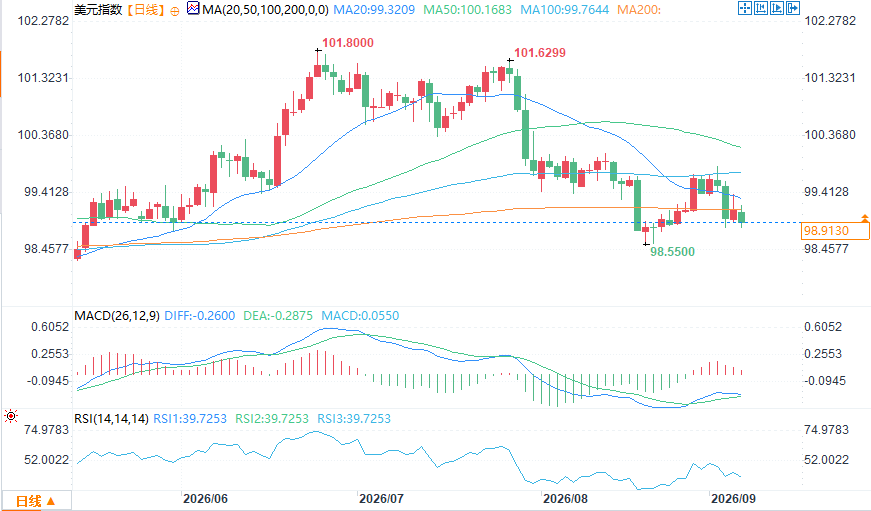 (US Dollar Index Daily Chart Source: FX678) The USD/JPY pair retreated, further catalyzed by news from Norway's sovereign wealth fund. Reports indicate that the Norwegian government pension fund plans to adjust its asset allocation framework, investing $17 billion in Japanese bonds. Previously, the fund allocated overseas bonds primarily based on economy size; the new rule uses market capitalization weighting. This restructuring will reduce the proportion of US bonds and increase the holdings of Japanese bonds. This large-scale rebalancing of funds provides significant buying support for the yen, directly pressuring the USD/JPY exchange rate. Accelerated job growth is a bearish signal for gold. The continued rise in US Treasury real yields, coupled with market confirmation of the Federal Reserve's independent decision-making ability and its ability to withstand political pressure from the White House to implement monetary policy, has significantly strengthened market confidence in the central bank's policy independence. The core logic driving the previous surge in spot gold—the "currency devaluation trade"—has weakened, leading to capital outflows from long gold positions and putting downward pressure on gold prices.
The underlying reasons can be found in the pricing stability of the interest rate futures market. CME Group interest rate derivatives continue to price, with the probability of a Fed rate hike in September remaining around 60%; while the market's expectation of completing two rounds of monetary tightening by 2026 has fallen to 44%. Traders are not betting on aggressive rate hikes based solely on non-farm payroll data, but are instead focusing on the upcoming August US inflation data. This inflation report will be the most important benchmark for the Federal Open Market Committee's next policy meeting, thus the market has entered a short waiting window. Meanwhile, voices contradicting the Fed's policy are emerging in the US domestic political arena. Donald Trump does not agree with the logic that "rate hikes can stabilize the debt market," and has instead publicly called for the Fed to shift to rate cuts. Treasury Secretary Scott Bessant argues that once the conflict in the Middle East subsides and international oil prices fall sharply to the $40-50/barrel range, US Treasury yields will subsequently decline. Public statements from political circles have diverged significantly from the Federal Reserve's policy stance, further complicating market analysis of the policy outlook and suppressing the dollar's upward momentum to some extent. The driving factors pushing up US Treasury yields are not limited to geopolitical tensions and expectations of Fed tightening. As of September 1st, Japan's holdings of overseas securities decreased by $87.8 billion, roughly matching the amount of funds used for currency intervention by Japan during the July-August transition. The market infers that the Japanese authorities are highly likely to raise funds by selling US Treasury bonds to intervene in the yen's exchange rate, and this large-scale selling of US Treasury bonds has become a significant contributor to the rise in US Treasury yields. (US Dollar Index Daily Chart Source: FX678) The USD/JPY pair retreated, further catalyzed by news from Norway's sovereign wealth fund. Reports indicate that the Norwegian government pension fund plans to adjust its asset allocation framework, investing $17 billion in Japanese bonds. Previously, the fund allocated overseas bonds primarily based on economy size; the new rule uses market capitalization weighting. This restructuring will reduce the proportion of US bonds and increase the holdings of Japanese bonds. This large-scale rebalancing of funds provides significant buying support for the yen, directly pressuring the USD/JPY exchange rate. Accelerated job growth is a bearish signal for gold. The continued rise in US Treasury real yields, coupled with market confirmation of the Federal Reserve's independent decision-making ability and its ability to withstand political pressure from the White House to implement monetary policy, has significantly strengthened market confidence in the central bank's policy independence. The core logic driving the previous surge in spot gold—the "currency devaluation trade"—has weakened, leading to capital outflows from long gold positions and putting downward pressure on gold prices.
- Risk Warning and Disclaimer
- The market involves risk, and trading may not be suitable for all investors. This article is for reference only and does not constitute personal investment advice, nor does it take into account certain users’ specific investment objectives, financial situation, or other needs. Any investment decisions made based on this information are at your own risk.