Gold prices rebounded weakly as rising inflation suppressed gold buying.
2026-09-08 17:58:05
On Tuesday (September 8), spot gold prices rose and then fell back during the Asian and European sessions, currently down about 0.19% and trading around 4396. The rebound in oil prices exacerbated market concerns about inflation, coupled with the continued anticipation of a Fed rate hike, causing gold prices to fluctuate repeatedly around the 4400 level, showing limited upward momentum. 
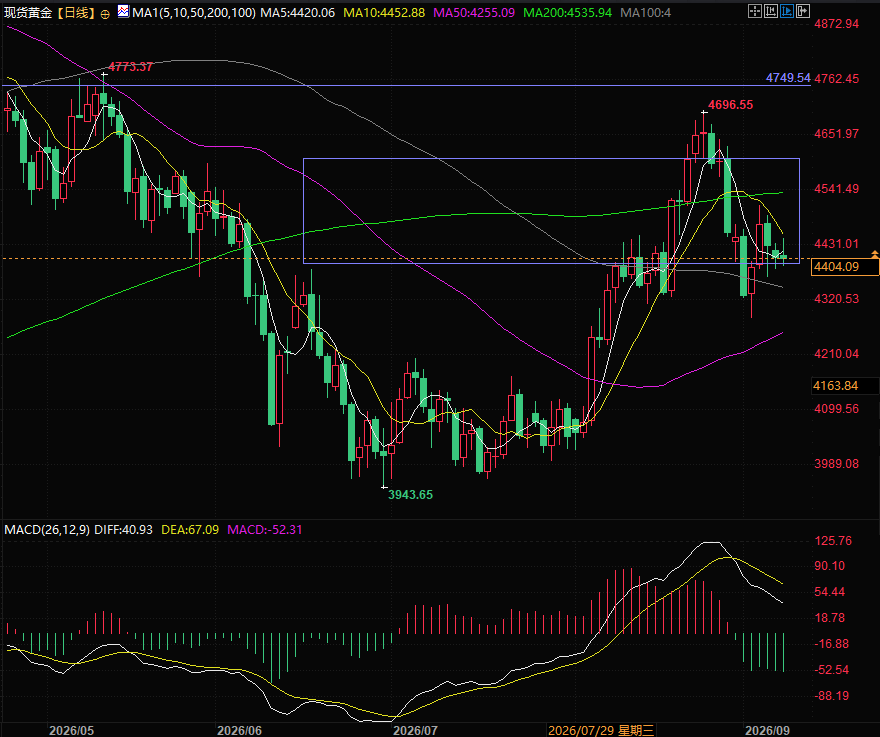 (Spot gold daily chart, source: FX678) At 17:55 Beijing time, spot gold is currently trading at $4404 per ounce.
Geopolitical Drivers: Houthi Attacks Worsen Saudi Oil Market's Tight Balance
On Tuesday, Houthi rebels launched a large-scale attack on southern Saudi Arabia, injuring more than 70 people (including women and children), causing fires and temporary disruptions to operations at multiple oil facilities and public utilities. The coalition characterized the attack as a "serious escalation." Just hours earlier, the Houthis had accused Saudi Arabia of airstrikes on a prison in Al-Jawf province, resulting in six deaths and seven injuries, completely shattering the four-year ceasefire in Yemen. Looking at the passageway, the official daily volume of cargo ships in the Bab el-Mandeb Strait is around 60, close to normal levels. However, only 29 commercial vessels were recorded on Monday (17 the previous day), with approximately 23 "hidden" vessels passing through daily with their transponders off—the Houthis have imposed a maritime embargo on Saudi vessels since July 20, forcing some oil tankers to turn around and bypass the embargo. The Bab el-Mandeb Strait has become a "second front" in Iran's pressure campaign: both the Red Sea and the Persian Gulf, two vital chokepoints, are now exposed to risk. Saudi exports are under pressure on both the east and west: Eastbound passage through the Hormuz has plummeted, the US-Iran attacks on oil tankers, coupled with Iran's newly established restricted zones, are forcing Persian Gulf loading ports to undergo a comprehensive reassessment of security, insurance, and shipping routes; westbound, the Houthi embargo directly targets Saudi-owned vessels, drastically increasing the risk to Saudi-flagged ships on the Red Sea route. While there are domestic east-west land pipelines that can partially bypass the Hormuz, alternative routes are limited if the westbound passage is blocked. The Hormuz shipping capacity is even more dire: before the war, approximately 90-140 commodity ships per day and crude oil and refined product flow of about 20 million barrels per day; only 7 commodity ships passed through on Monday, and the 10-day average up to September 6th was about 10 ships, the lowest since May, dropping to around 5 ships at one point over the weekend. In terms of shipping volume, Macquarie estimates that only about 7 million barrels per day currently cross the Strait of Hormuz, while Wittor estimates about 10 million barrels per day, a reduction of 60-70% compared to pre-war levels. Coupled with the "restricted zone + new shipping route map," the recovery of shipping capacity is a long way off. For crude oil, the already tight supply-demand balance has worsened due to the Houthi attacks, and supply premiums have rebounded.Inflation is a double-edged sword: the pressure from rising refined oil prices and the crowding-out effect remain uncertain.
There are two pathways through which geopolitical shocks transmit to inflation. First, there's a shortage of refined oil supplies—Russia and the Middle East combined are short by approximately 3.8 million barrels per day, global diesel inventories are nearing their bottom, and US diesel prices have already exceeded $5.9 per gallon. This means that even if crude oil prices rise only slightly, gas station retail prices will continue to rise, turning the energy component's drag on inflation into a boost. Second, there's a crowding-out effect: high oil prices reduce the frequency of people's travel and increase transportation costs, which will squeeze consumer spending in other areas, potentially dragging down core CPI unexpectedly. These two paths are in opposite directions, making the upcoming CPI data highly uncertain.Policy game: White House blames Fed rate hikes as pricing heats up
Amidst rising oil prices and inflationary pressures, the rift between the White House and the Federal Reserve has been laid bare. Trump threatened on social media that he would halt trade with countries with trade surpluses unless the Fed cuts interest rates—his first direct threat to the Fed using tariffs. Senior economic advisor Navarro called the rate hike "reckless" and denounced FOMC members as "clowns." Vice President Vance and Treasury Secretary Bessant also publicly called for rate cuts. The underlying logic is not hard to understand: Trump launched the oil war and imposed tariffs because of excessive government debt and the urgent need for low interest rates to alleviate debt repayment pressure, while the Fed's high interest rates are seen as the "culprit"—a clear attempt to shift blame. However, this political pressure may trigger a backlash within the Fed: to defend its independence, the Fed is more likely to retaliate against the White House with a 25 basis point rate hike, a move already priced into the market.Trading Outlook: Real Interest Rates Suppress Gold Prices, CPI Sets Short-Term Direction
For gold, the core short-term contradiction lies in the tug-of-war between "geopolitical safe-haven buying" and "interest rate hike expectations." US Treasury yields continue to rise—the 10-year yield has climbed from 4.16% at the beginning of the year to 4.8%, a 19-month high, while the 30-year yield is around 5.27%. Rising nominal interest rates coupled with controlled inflation expectations have led to higher real interest rates, directly suppressing gold, a non-interest-bearing asset. This explains why, despite ongoing geopolitical turmoil, gold prices have struggled to rebound. The key variable going forward is core CPI: if the data unexpectedly falls, interest rate hike expectations will cool, and gold prices may immediately rebound; if inflation remains stubborn and interest rate hikes materialize, gold prices will face further pressure. In terms of trading, a short-term strategy of selling on rallies is recommended, paying attention to the 4400 level. Going long requires waiting for a clear signal after the CPI data is released. Despite the bearish technical factors, gold prices are still holding near the lower edge of the 4400 trading range. The recent rebound in gold prices has been weak, but this can be seen as a digestion of the weekend's negative CPI data. In other words, even if prices fall below 4400, the downside may be very limited. (Spot gold daily chart, source: FX678) At 17:55 Beijing time, spot gold is currently trading at $4404 per ounce.
- Risk Warning and Disclaimer
- The market involves risk, and trading may not be suitable for all investors. This article is for reference only and does not constitute personal investment advice, nor does it take into account certain users’ specific investment objectives, financial situation, or other needs. Any investment decisions made based on this information are at your own risk.