Goldman Sachs says: The gold bull market is not over; $4,000 is a good buying opportunity.
2026-09-08 18:28:05
Gold prices have retreated about 20% from their record high in January, prompting calls for a "bull market top." However, Goldman Sachs disagrees. Tony Kim, Goldman Sachs' global head of metals trading, stated explicitly on the firm's official market podcast that the current pullback is merely a "prolonged consolidation," not the end of the bull market. His stance was clear: Goldman Sachs remains bullish on gold and advises investors to consider a return to around $4,000/ounce as an ideal area to gradually build long positions. This statement comes against the backdrop of gold prices showing clear signs of stabilization in August after a sharp pullback, and the market is on the eve of two major events—this week's US CPI data and the September FOMC meeting.  Where Did the Correction Come From: Two Overlapping Factors Regarding the causes of this round of gold price correction, Kim offered two specific explanations, which overlapped and jointly suppressed gold prices. The first reason is the policy uncertainty brought about by the change of Federal Reserve Chairman. Fed Chairman Warsh's policy inclinations are unclear, and the market is still figuring out his "reaction function"—that is, in the face of different inflation data, will the new chairman favor raising interest rates, lowering interest rates, or remaining on hold? Coupled with the Trump administration's recent public comments on Fed policy, the entire interest rate pricing system is in a state of flux, and non-interest-bearing assets like gold are naturally the first to be affected. The second reason is the spillover effect of geopolitical shocks. The US-Iran conflict has disrupted the energy, agricultural, and metal markets, not only changing market expectations for the inflation path, but more importantly, interrupting the flow of reserve funds from Asia that would normally flow back to the precious metals market. Kim revealed that, as a result, most institutions within Goldman Sachs' client system have reduced their gold holdings, but among all the fund flows, only central bank buying has remained unchanged—this is the core reason why Goldman Sachs dares to declare that "the bull market is not over." The Foundation of the Bull Market: Central Banks Buy Up One-Third of New Supply Supporting this assessment is a clear, verifiable supply and demand logic. Kim points out that global annual gold mine supply is approximately 3,500 tons, while central banks' annual gold purchases have more than doubled, jumping from 400-500 tons before the Russia-Ukraine conflict (the freezing of Russia's foreign exchange reserves being a clear watershed) to the current 1,000-1,100 tons. In other words, central banks alone consume nearly one-third of the annual new mined gold, significantly compressing the new supply left for jewelry consumption, gold ETFs, and physical investment. This situation leads to a crucial conclusion: because the market has less available new supply, the threshold for new investment funds needed to significantly push up gold prices has actually become lower. As long as this structural force of central bank gold purchases does not reverse, the underlying foundation of the bull market remains intact. The Weakness Lies in Asia: Energy Security Takes Priority, Gold Purchases Take a Back Seat
 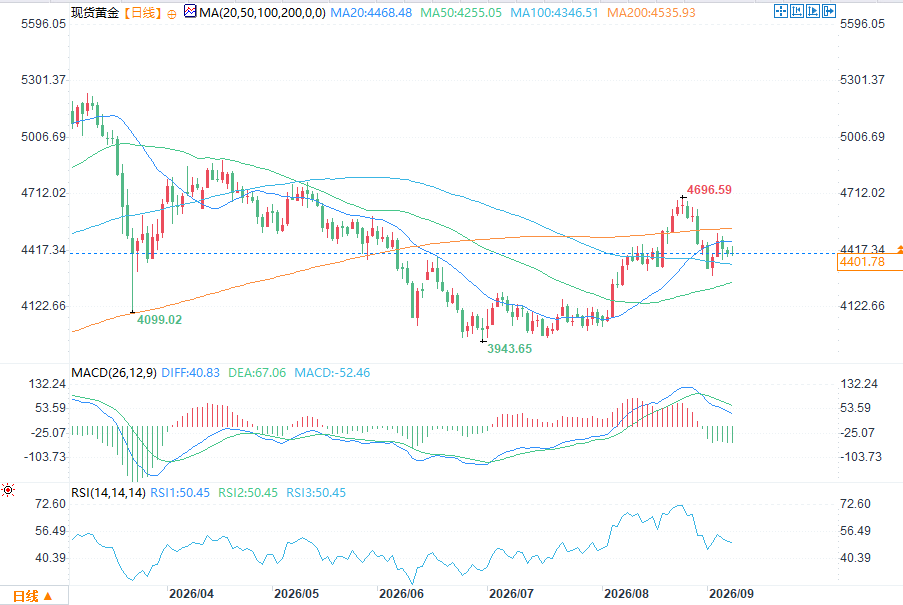 (Spot gold daily chart source: EasyForex) However, Kim also frankly pointed out the weak link in this round of market movements—Asian physical demand. Asia has historically been both a major pillar of gold jewelry consumption and central bank gold purchases, but its performance this year has been significantly weak. The reason for this is that the US-Iran conflict has disrupted the region's pace of generating foreign exchange reserves through trade surpluses, and countries like India are currently prioritizing their precious foreign exchange reserves to defend their currencies and ensure energy imports, leaving them no time to increase their gold holdings; more importantly, India has even introduced some policies to actively restrict gold consumption. In Kim's view, the sustainable return of this capital flow depends on whether the Middle East energy market can achieve a prolonged period of normalization, and it is difficult to expect it to become a new growth engine in the short term. Don't follow the trend with silver: a high-beta "lottery ticket" Compared to gold, Kim's remarks on silver are much more cautious. He is actually reminding clients not to confuse the two. In the structure of the silver market, investment demand only accounts for about one-fifth of total demand, with the majority of the rest coming from industrial use, and global central banks do not systematically buy silver in the same way they hoard gold. This means that silver's price discovery mechanism relies more heavily on the resonance of retail sentiment, physical premiums, and speculative funds, resulting in an astonishingly wide potential range for its equilibrium price. Kim's assessment is that, depending on how various fund flows coordinate, silver's clearing price could fall anywhere between $50 and $100 per ounce. In short, gold is a fundamentally driven trade, while silver is more like a high-beta lottery ticket dominated by retail sentiment; the two play completely different roles. Focus on CPI, and buy in batches around $4000 . In terms of operational strategy, Kim's plan is very specific: utilize the volatility window created by this week's macroeconomic data releases, and before the September FOMC meeting, buy in batches when gold prices fall back to around $4000 per ounce and hold. This price level was chosen because Goldman Sachs observed that sovereign wealth funds and institutional buying would provide solid support around this level. This week's CPI report is seen by Goldman Sachs economists as the most crucial catalyst in the near term—the market will use this data to recalibrate its pricing of the Fed's new response function, and Kim himself has explicitly stated that inflation data is his most closely watched variable at present. It's worth noting that the $4,000 level was repeatedly contested by the market in the first half of this year, with gold prices briefly falling below this level in late June, and subsequently being tested as a psychological support level multiple times. Goldman Sachs's statement this time essentially redefines this key psychological level as an active entry point, rather than a stop-loss line that needs to be defended. Of course, Goldman Sachs's "$4,000 floor" is ultimately just an institutional view, not a guarantee of principal protection in any sense. Cautious voices in the market are already reminding investors that support levels given by banks are never a guarantee of buying. If the macroeconomic environment deteriorates further, gold prices could very well break through this level before stabilizing. The significance of building positions in stages lies precisely in mitigating the volatility risk along this path. For ordinary investors, a more prudent approach is to use Goldman Sachs' framework as a reference point—whether the central bank's gold purchase pace continues, how the CPI data will be released, and what signals the FOMC meeting will send—use these real-world variables that can be checked one by one to decide whether to follow this "buy low" train.
Where Did the Correction Come From: Two Overlapping Factors Regarding the causes of this round of gold price correction, Kim offered two specific explanations, which overlapped and jointly suppressed gold prices. The first reason is the policy uncertainty brought about by the change of Federal Reserve Chairman. Fed Chairman Warsh's policy inclinations are unclear, and the market is still figuring out his "reaction function"—that is, in the face of different inflation data, will the new chairman favor raising interest rates, lowering interest rates, or remaining on hold? Coupled with the Trump administration's recent public comments on Fed policy, the entire interest rate pricing system is in a state of flux, and non-interest-bearing assets like gold are naturally the first to be affected. The second reason is the spillover effect of geopolitical shocks. The US-Iran conflict has disrupted the energy, agricultural, and metal markets, not only changing market expectations for the inflation path, but more importantly, interrupting the flow of reserve funds from Asia that would normally flow back to the precious metals market. Kim revealed that, as a result, most institutions within Goldman Sachs' client system have reduced their gold holdings, but among all the fund flows, only central bank buying has remained unchanged—this is the core reason why Goldman Sachs dares to declare that "the bull market is not over." The Foundation of the Bull Market: Central Banks Buy Up One-Third of New Supply Supporting this assessment is a clear, verifiable supply and demand logic. Kim points out that global annual gold mine supply is approximately 3,500 tons, while central banks' annual gold purchases have more than doubled, jumping from 400-500 tons before the Russia-Ukraine conflict (the freezing of Russia's foreign exchange reserves being a clear watershed) to the current 1,000-1,100 tons. In other words, central banks alone consume nearly one-third of the annual new mined gold, significantly compressing the new supply left for jewelry consumption, gold ETFs, and physical investment. This situation leads to a crucial conclusion: because the market has less available new supply, the threshold for new investment funds needed to significantly push up gold prices has actually become lower. As long as this structural force of central bank gold purchases does not reverse, the underlying foundation of the bull market remains intact. The Weakness Lies in Asia: Energy Security Takes Priority, Gold Purchases Take a Back Seat (Spot gold daily chart source: EasyForex) However, Kim also frankly pointed out the weak link in this round of market movements—Asian physical demand. Asia has historically been both a major pillar of gold jewelry consumption and central bank gold purchases, but its performance this year has been significantly weak. The reason for this is that the US-Iran conflict has disrupted the region's pace of generating foreign exchange reserves through trade surpluses, and countries like India are currently prioritizing their precious foreign exchange reserves to defend their currencies and ensure energy imports, leaving them no time to increase their gold holdings; more importantly, India has even introduced some policies to actively restrict gold consumption. In Kim's view, the sustainable return of this capital flow depends on whether the Middle East energy market can achieve a prolonged period of normalization, and it is difficult to expect it to become a new growth engine in the short term. Don't follow the trend with silver: a high-beta "lottery ticket" Compared to gold, Kim's remarks on silver are much more cautious. He is actually reminding clients not to confuse the two. In the structure of the silver market, investment demand only accounts for about one-fifth of total demand, with the majority of the rest coming from industrial use, and global central banks do not systematically buy silver in the same way they hoard gold. This means that silver's price discovery mechanism relies more heavily on the resonance of retail sentiment, physical premiums, and speculative funds, resulting in an astonishingly wide potential range for its equilibrium price. Kim's assessment is that, depending on how various fund flows coordinate, silver's clearing price could fall anywhere between $50 and $100 per ounce. In short, gold is a fundamentally driven trade, while silver is more like a high-beta lottery ticket dominated by retail sentiment; the two play completely different roles. Focus on CPI, and buy in batches around $4000 . In terms of operational strategy, Kim's plan is very specific: utilize the volatility window created by this week's macroeconomic data releases, and before the September FOMC meeting, buy in batches when gold prices fall back to around $4000 per ounce and hold. This price level was chosen because Goldman Sachs observed that sovereign wealth funds and institutional buying would provide solid support around this level. This week's CPI report is seen by Goldman Sachs economists as the most crucial catalyst in the near term—the market will use this data to recalibrate its pricing of the Fed's new response function, and Kim himself has explicitly stated that inflation data is his most closely watched variable at present. It's worth noting that the $4,000 level was repeatedly contested by the market in the first half of this year, with gold prices briefly falling below this level in late June, and subsequently being tested as a psychological support level multiple times. Goldman Sachs's statement this time essentially redefines this key psychological level as an active entry point, rather than a stop-loss line that needs to be defended. Of course, Goldman Sachs's "$4,000 floor" is ultimately just an institutional view, not a guarantee of principal protection in any sense. Cautious voices in the market are already reminding investors that support levels given by banks are never a guarantee of buying. If the macroeconomic environment deteriorates further, gold prices could very well break through this level before stabilizing. The significance of building positions in stages lies precisely in mitigating the volatility risk along this path. For ordinary investors, a more prudent approach is to use Goldman Sachs' framework as a reference point—whether the central bank's gold purchase pace continues, how the CPI data will be released, and what signals the FOMC meeting will send—use these real-world variables that can be checked one by one to decide whether to follow this "buy low" train.- Risk Warning and Disclaimer
- The market involves risk, and trading may not be suitable for all investors. This article is for reference only and does not constitute personal investment advice, nor does it take into account certain users’ specific investment objectives, financial situation, or other needs. Any investment decisions made based on this information are at your own risk.