Labor Day saw a surge in gasoline prices, putting pressure on both the US economy and the presidential election.
2026-09-09 12:08:06
Labor Day (Monday, September 7th) in the United States, originally a holiday commemorating the contributions of workers, has now evolved into one of the largest retail sales holidays in the country, second only to Black Friday in terms of retail activity, and also a period when many Americans travel. The Transportation Security Administration (TSA) estimates that more than 17 million people will pass through security during the holiday period. However, this year, American drivers are facing enormous pressure, with gasoline prices soaring. Coupled with the ongoing geopolitical conflicts in the Middle East, crude oil prices have rebounded, and refined product inventories continue to decline. High energy costs are not only suppressing consumer spending and travel, but have also become a key issue influencing the election. 
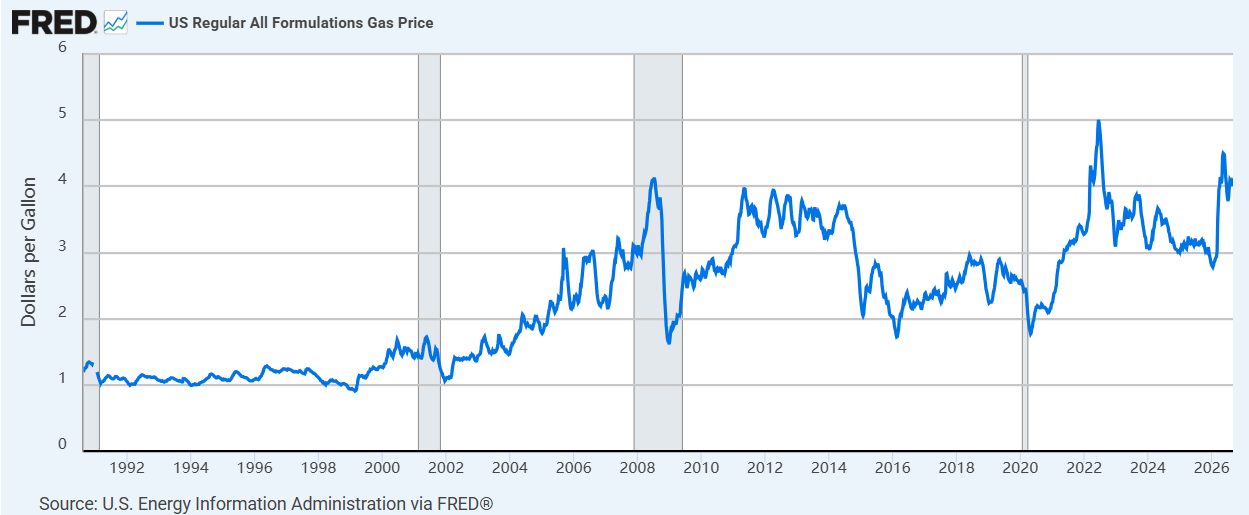 Chart: Average retail price of regular unleaded gasoline across the United States, including taxes and fees, weekly data.
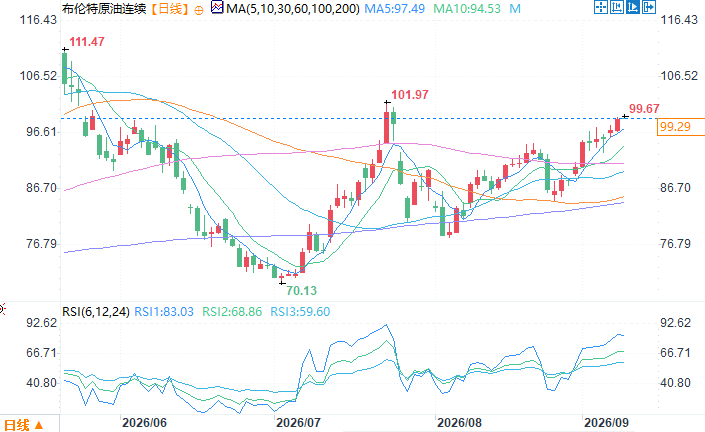 Brent crude oil daily chart source: EasyTrade. At 12:07 Beijing time on September 9th, Brent crude oil was trading at $99.31 per barrel.
Gasoline prices hit a record high for the same period on Labor Day, forcing people to reduce travel.
This Labor Day, the national average price of regular gasoline in the United States reached $4.15 per gallon, a 30% increase year-over-year, significantly surpassing the previous record of $3.83 per gallon set on Labor Day in 2012. The driving force behind this surge is the ongoing conflict in the Middle East. Diesel prices also rose sharply, reaching $5.90 per gallon, compared to $3.70 per gallon during the same period last year. Patrick DeHaan, chief analyst at GasBuddy, wrote in a recent blog post that while current gasoline prices haven't yet reached their all-time high, they have already set a new record for the later part of the year, meaning that the average Labor Day gasoline price in the US has surpassed the $4 mark for the first time. Regionally, California, Hawaii, and Washington have the highest gasoline prices in the country; while Utah, Colorado, Montana, Idaho, Wyoming, and North Dakota have seen the most dramatic price increases since the outbreak of the conflict. High fuel costs have forced many people to reduce their road trip plans and cancel long-distance travel arrangements for the fall and winter. Domestic airfares in the United States rose by about 20% year-on-year during Labor Day, with travel costs increasing across the board and suppressing holiday spending. Chart: Average retail price of regular unleaded gasoline across the United States, including taxes and fees, weekly data.As geopolitical conflicts continue to escalate, crude oil prices have rebounded again.
Oil prices show no signs of easing in the short term, as a new round of military conflict between the US and Iran reverses the previous decline in crude oil prices (see attached chart at the end of this article). Last weekend, the US sank three Iranian oil tankers in retaliation for the Iranian Islamic Revolutionary Guard Corps' ballistic missile attack on US naval vessels. The sunken ships included a very large crude carrier (VLCC) in the Persian Gulf near Kharg Island and two Suezmax tankers near the Gulf of Oman. The Iranian Revolutionary Guard Corps launched a Qassem Basir anti-ship ballistic missile, claiming it hit a US aircraft carrier, while the US denied any damage to its ships. Meanwhile, Israeli forces continued heavy bombing of Hezbollah targets in southern Lebanon, while Iran launched strikes against bases in Kuwait and the UAE. Iranian Parliament Speaker Mohammad Bagher Ghalibaf warned that if the US continues to attack oil tankers and maintain its maritime blockade, US oil and gas companies operating in the Middle East will become legitimate targets. Iran's Supreme National Security Council announced plans to establish a no-navigation zone outside the Strait of Hormuz, prohibiting unauthorized vessels from passing through. In addition, Ukraine's continued attacks on Russian oil refining facilities have further tightened global fuel supplies. The attacks paralyzed approximately 40% of Russia's refining capacity, forcing Russia to suspend gasoline and diesel exports and even switch to importing refined petroleum products, further pressuring the already strained global energy market supply.Global refined product inventories are running low, and high oil prices are becoming a key variable in the election.
Data from the U.S. Energy Information Administration (EIA) shows that as of the week ending August 28, 2026, U.S. gasoline inventories fell to 205.7 million barrels, far below the five-year average of 217.6 million barrels in August. Fuel inventories in the Amsterdam-Rotterdam-Antwerp (ARA) core storage region in Europe also fell to historic lows. Since the outbreak of the Iran conflict six months ago, Europe has continuously increased its imports of refined petroleum products from the United States. Even with U.S. refineries operating at near full capacity, it is still difficult to meet external demand. High energy costs continue to erode U.S. household income and have become a sharp point of political conflict. According to Brown University's Iran War Energy Cost Tracker Project, the conflict has already cost U.S. consumers over $100 billion in additional energy expenses, a huge challenge for the Trump administration before the midterm elections. Polls show that 46% of U.S. respondents said soaring oil prices would directly influence their voting choices in November. Energy inflation has evolved from a purely economic issue into a crucial livelihood issue that will determine the election outcome.Conclusion
In summary, the high oil prices during the US Labor Day holiday were not a simple matter of supply and demand in a single market, but rather a result of multiple geopolitical events coupled with declining inventories. The US-Iran maritime standoff, shipping risks in the Strait of Hormuz, and damage to Russian refining facilities all contributed to pushing up crude oil and refined product prices. High oil prices directly reduce travel and consumption among Americans, while also profoundly influencing voter attitudes. The market needs to continue monitoring shipping dynamics in the Strait and US-Iran military actions. If the conflict escalates further, oil prices could rise further, and inflationary pressures and political maneuvering will intensify simultaneously. Brent crude oil daily chart source: EasyTrade. At 12:07 Beijing time on September 9th, Brent crude oil was trading at $99.31 per barrel.
- Risk Warning and Disclaimer
- The market involves risk, and trading may not be suitable for all investors. This article is for reference only and does not constitute personal investment advice, nor does it take into account certain users’ specific investment objectives, financial situation, or other needs. Any investment decisions made based on this information are at your own risk.