Nearly 90% of central banks plan to increase their gold holdings! UBS: The current gold price pullback is a strategic buying window, not a signal to retreat.
2026-09-09 12:06:07
On Wednesday (September 9th) during Asian trading hours, spot gold rebounded after some volatility, currently trading around $4375 per ounce, potentially ending its previous three-day losing streak. Despite escalating geopolitical risks—the Iranian Revolutionary Guard claimed to have attacked US destroyers and ships in the Strait of Hormuz—gold's safe-haven reaction remained relatively restrained, with prices accumulating over 4% in the past two weeks, erasing some of the 15% gains from the first three weeks of August. Against this backdrop, UBS Group explicitly told clients in its latest research report that this decline is a short-term headwind caused by changes in the Federal Reserve's interest rate expectations, rather than a breakdown in the long-term investment logic of gold. UBS recommends that investors with insufficient positions take advantage of the current weak market to establish strategic long positions, based primarily on the continued record-breaking gold purchases by global central banks. 
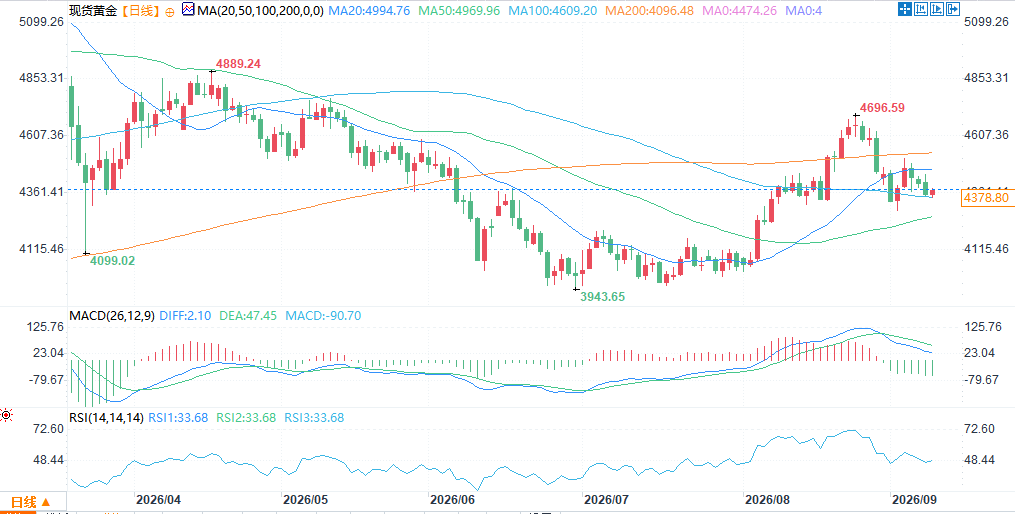 (Spot gold daily chart, source: FX678) At 12:04 Beijing time, spot gold was trading at $4374.76 per ounce.
Gold prices have retreated more than 4% in two weeks, with a shift in interest rate expectations being the main driver.
Gold has fallen more than 4% in the past two weeks, erasing a significant portion of the 15% gains made in the first three weeks of August. The macroeconomic backdrop triggering this pullback is quite clear: rising US Treasury yields, coupled with hawkish comments from Federal Reserve Chairman Warsh and consecutive stronger-than-expected non-farm payroll data, have significantly shifted market expectations regarding the Fed's monetary policy. UBS has accordingly adjusted its interest rate forecasts, now expecting the Fed to raise rates by 50 basis points this year. The bank believes that the resulting rise in real yields and a stronger dollar will continue to put downward pressure on gold in the short term. This assessment implies that any tactical rebound in gold may depend more on a shift in interest rate expectations than simply on geopolitical catalysts.Interest rate headwinds do not change the medium-term investment value; UBS adopts a similar stance to the equity market.
UBS's analytical framework clearly separates short-term price volatility from long-term allocation value. The bank points out that just as its medium-term bullish stance on global equities has not changed due to short-term interest rate risks (supported by factors including AI-related spending, economic resilience, and broad-based earnings growth), the same logic applies to gold—recent interest rate pressures do not diminish gold's strategic role in a diversified portfolio. This analogy is crucial: it positions gold as a structural allocation tool, not a tactical trading instrument for the next Fed meeting. This framework provides clear guidance for understanding the implications of further weakness—if UBS's assessment holds true, declines driven by yields or a stronger dollar will be seen by strategic allocators as entry opportunities, not signals to reduce positions.Central bank gold purchases: the most solid long-term pillar
Central bank demand is the core pillar of UBS's long-term bullish view on gold, and the relevant data is highly convincing: The People's Bank of China added 650,000 ounces of gold in August, 10,000 ounces more than the previous month, marking the largest monthly increase in nearly 11 months and the 22nd consecutive month of net purchases. Globally, a World Gold Council survey shows that nearly 90% of central banks expect their official reserves to rise in the next 12 months, with 45% planning to increase their own holdings. UBS believes that annual central bank gold purchases of 750 to 1,000 tons have become the most solid structural support for the gold market.Concerns about fiscal sustainability constitute the second pillar
UBS also pointed out that although current high US interest rates and economic resilience support a stronger dollar, persistent market concerns about fiscal sustainability and high government debt may limit the dollar's appreciation potential over a longer period. This assessment reinforces UBS's expectation of a gradual diversification of global reserve assets away from the dollar, from which gold, as an alternative store of value, will benefit. UBS believes that the medium- to long-term outlook for a weaker dollar will further support gold demand.Gold's traditional roles: inflation hedge and geopolitical buffer
The report also points out that gold's traditional role as an inflation hedge and a buffer against geopolitical uncertainty remains a key reason for institutional investors to include it in their portfolios. UBS cites data from the Global Investment Returns Yearbook showing that since 1900, the real returns of gold and commodities have been positively correlated with inflation, and gold's performance during various crises has historically validated this allocation logic.Summarize
UBS's core view on gold can be summarized as: short-term focus on interest rates, long-term focus on central banks. The current pullback is driven by expectations of Federal Reserve policy and does not represent a deterioration in the structural outlook for gold. UBS continues to forecast annual central bank gold purchases in the range of 750 to 1,000 tons, citing the People's Bank of China's 22 consecutive months of increases and strong buying intentions in global central bank surveys as key arguments. For investors with insufficient positions, UBS suggests viewing the current weakness as a window to build strategic exposure. The long-term narrative for gold—de-dollarization, fiscal concerns, and inflation hedging—remains intact. (Spot gold daily chart, source: FX678) At 12:04 Beijing time, spot gold was trading at $4374.76 per ounce.
- Risk Warning and Disclaimer
- The market involves risk, and trading may not be suitable for all investors. This article is for reference only and does not constitute personal investment advice, nor does it take into account certain users’ specific investment objectives, financial situation, or other needs. Any investment decisions made based on this information are at your own risk.