The New Zealand dollar rebounded slightly but gains were limited: the Reserve Bank of New Zealand's "data-dependent" approach deterred the market from chasing the rally.
2026-09-10 12:06:08
On Thursday (September 10) during Asian trading hours, the New Zealand dollar rebounded slightly to around 0.5850 against the US dollar, mainly boosted by a weaker dollar. Market focus shifted to the upcoming release of the US August Producer Price Index (PPI) data, which will provide new clues to the policy path of the Federal Reserve's September 14-15 policy meeting. 
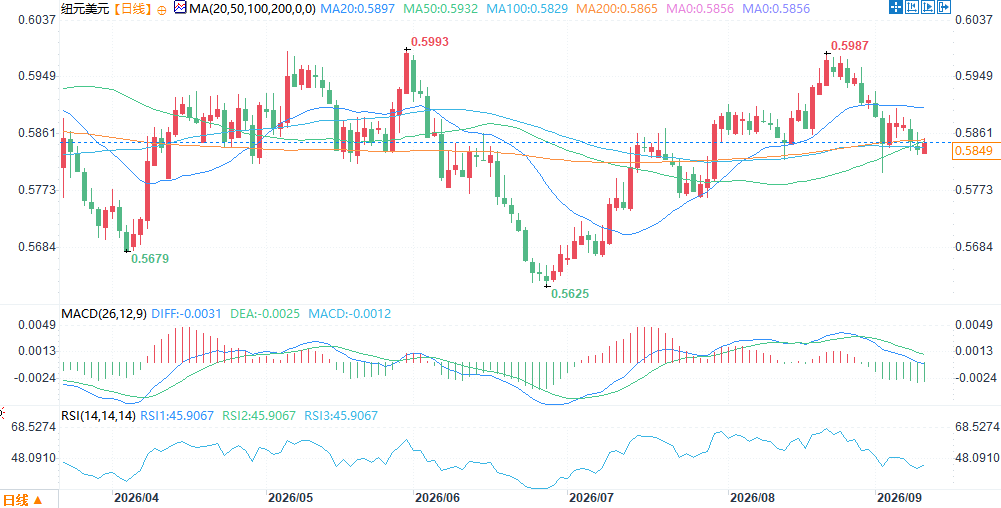 (NZD/USD daily chart, source: EasyForex) At 12:05 Beijing time, the NZD/USD exchange rate was 0.5849/50.
A weaker dollar provided support, with PPI data becoming a key variable.
Economists expect the US overall PPI to rise 5.3% year-on-year in August, while core PPI is expected to rise 4.6% year-on-year. Market participants point out that "if the CPI data is strong, it will almost certainly lock in a September rate hike and support a stronger dollar; if the data is moderate, it will strengthen the reason for holding rates steady, putting pressure on the dollar to repric. If the US PPI data is stronger than expected, it may strengthen expectations of a Fed rate hike and boost the dollar, thus suppressing the New Zealand dollar; conversely, if the data is moderate, the dollar may come under pressure, providing further upside potential for the New Zealand dollar. When global risk appetite recovers, safe-haven demand declines, putting pressure on the dollar as a traditional safe-haven currency, directly benefiting the New Zealand dollar, which is highly correlated with commodities and risk sentiment. Liquidity was relatively thin during the Asian session, but the weakening dollar has already created significant upward momentum for the New Zealand dollar. Traders are closely watching the upcoming US Producer Price Index (PPI), as it is often seen as a leading indicator of the Consumer Price Index (CPI), revealing in advance how corporate cost pressures are being transmitted to end-user prices. If both overall PPI and core PPI significantly exceed expectations, the market will quickly raise the probability of a Fed rate hike in September, potentially leading to a rapid rebound in the US dollar and putting pressure on the New Zealand dollar's (NZD) appreciation against the US dollar. Conversely, if the data is moderate or even below expectations, it will further reinforce the pricing in that the Fed may pause or slow tightening, increasing selling pressure on the US dollar and potentially allowing the NZD to continue its rebound and test higher resistance levels. Furthermore, the market is also weighing the impact of energy price volatility, supply chain conditions, and global economic growth expectations on inflation; these factors will amplify the volatility following the release of PPI data. In the short term, the NZD's movement will be highly dependent on the direction of the US dollar, which itself is locked into the upcoming inflation data. Therefore, PPI becomes a key variable determining the short-term exchange rate direction.Reserve Bank of New Zealand's cautious tone limits New Zealand dollar gains
The Reserve Bank of New Zealand's (RBNZ) cautious stance is a major internal constraint on the New Zealand dollar. The RBNZ stated that current interest rates remain stimulative and is focused on "gradually phasing out monetary stimulus." Economists generally expect at least one more rate hike before the end of the year, likely in December. The RBNZ's cautious tone and forward guidance have dampened market expectations for an aggressive tightening cycle. A chief economist at a prominent institution noted, "The RBNZ's view is unlikely to change significantly. Given the significant uncertainties at present, we believe there will be no major adjustments to the RBNZ's official cash rate forecast." Analysts at Commerzbank pointed out that the RBNZ "raised the official cash rate by 25 basis points to 2.75% as expected," with policymakers stating that "gradually phasing out monetary stimulus is appropriate to sustainably restore inflation to the target level." The bank added that the central bank "emphasized that the future path of interest rates is not predetermined," indicating that "further tightening is possible, but will depend on the persistence of inflation and the strength of the recovery." The RBNZ's statements demonstrate a clear cautious approach, neither wanting to end the tightening process prematurely nor sending overly hawkish signals, lest it tighten excessively given the continued uncertainty in the economic outlook. The wording of "gradually phasing out stimulus" implies that the central bank is more data-driven than pre-planning an aggressive path, thus limiting market expectations for rapid and continuous interest rate hikes. For the New Zealand dollar, this cautious tone weakens the support from widening interest rate differentials. While there may still be one rate hike before the end of the year, the uncertainty surrounding its magnitude and timing makes it difficult for the market to form a strong bullish consensus. Meanwhile, the speed of the decline in New Zealand's domestic inflation, the resilience of the labor market, and the adjustment in the housing market will all be key references for the central bank's subsequent decisions. If inflation continues to exceed expectations, the possibility of further tightening remains; however, if the economic recovery is insufficient or external demand weakens, the central bank may be more cautious. An analysis by Commerzbank also confirms this: the future interest rate path is not predetermined, and further action depends on the actual performance of inflation and the recovery. Overall, while a weaker external dollar can provide short-term upward momentum, the Reserve Bank of New Zealand's cautious stance constitutes an internal ceiling, limiting the New Zealand dollar's gains. Traders should pay attention to US data while also continuously tracking New Zealand's domestic economic indicators and speeches by Reserve Bank officials to assess the potential room for adjustment in interest rate expectations.Summarize
The New Zealand dollar is currently trading around 0.5850 against the US dollar. A weaker dollar is providing short-term support, but the Reserve Bank of New Zealand's cautious tone is limiting gains. Market focus is entirely on the upcoming US PPI data – stronger-than-expected data would strengthen bets on a Fed rate hike and support the dollar, potentially putting downward pressure on the New Zealand dollar; if the data is moderate, the dollar may face downward pressure, and the New Zealand dollar could further test resistance above 0.5850. Regarding the Reserve Bank of New Zealand, the market widely expects another rate hike before the end of the year, but the central bank emphasized that the future path is not predetermined, and further tightening will depend on the persistence of inflation and the strength of the recovery. In the short term, the New Zealand dollar's movement will be highly dependent on the outcome of US inflation data. (NZD/USD daily chart, source: EasyForex) At 12:05 Beijing time, the NZD/USD exchange rate was 0.5849/50.
- Risk Warning and Disclaimer
- The market involves risk, and trading may not be suitable for all investors. This article is for reference only and does not constitute personal investment advice, nor does it take into account certain users’ specific investment objectives, financial situation, or other needs. Any investment decisions made based on this information are at your own risk.