













US Treasury bond buybacks and Trump's verbal easing measures triggered a recovery in gold prices.
2026-09-10 16:06:06
Gold prices rose and then fell during the Asian and European sessions on Thursday (September 10), but held onto all of Wednesday's gains, trading around 4407. Many factors have influenced gold prices recently, making for a very interesting day. Looking at the price action, the primary driver remains oil prices, which are anchored to the geopolitical tensions between the US and Iran. Interest rates and government intervention are also playing a role. 
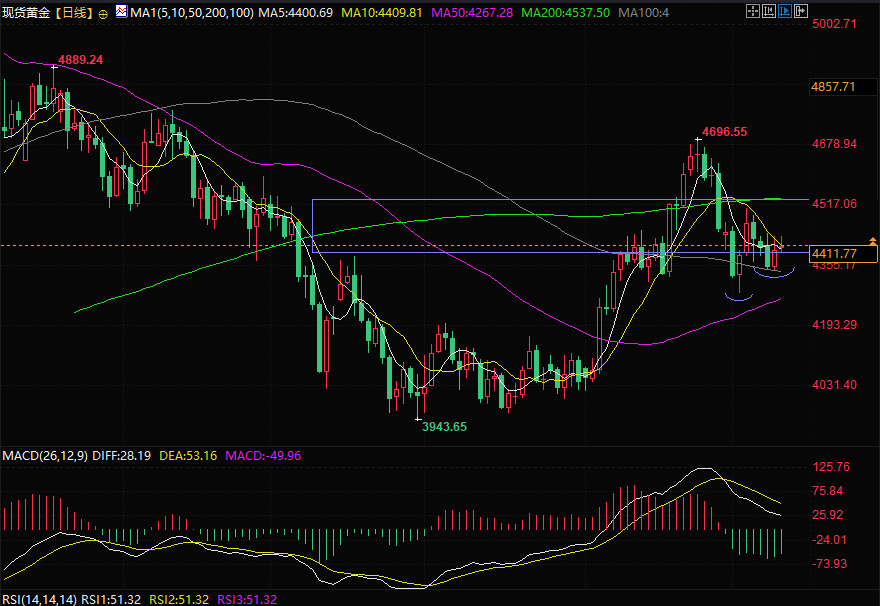 (Spot gold daily chart, source: EasyTrade) At 16:02 Beijing time, spot gold is currently trading at $4410 per ounce.
Geopolitical tensions are putting downward pressure on oil prices, while gold prices have stabilized first.
Trump stated that the US-Iran conflict would cease immediately after the midterm elections, while Secretary of State Rubio simultaneously issued a strong signal, stating that Iran could not reverse the situation, that Iranian attacks on oil tankers had already caused continuous damage, and that the US would continue to use economic means to pressure Iran. This series of statements conveyed to the market that the US held the initiative, the risk of the conflict spiraling out of control had decreased in the short term, and oil prices were suppressed. As expectations for rising oil prices cooled and inflation concerns eased marginally, gold prices were the first to stabilize.Long-term bond repurchase agreements provide a floor for interest rates and help reduce the cost of holding gold.
Following this, U.S. Treasury Secretary Bessenter announced a long-term Treasury bond repurchase program, with the Treasury planning to conduct up to $6 billion in long-term bond repurchase operations, three times the size of regular operations. From a pricing perspective, gold is a non-interest-bearing asset, and the yield on long-term U.S. Treasury bonds represents the opportunity cost of holding gold. The initial purpose of the repurchase operation is to absorb long-term bond selling pressure, lower long-term U.S. Treasury yields, and theoretically reduce the opportunity cost of holding gold, thus providing support for gold prices. However, the market also noted that the repurchase size was at the lower end of market expectations, and long-term bond yields initially surged after the announcement, indicating that relying solely on a limited scale of repurchases is unlikely to completely reverse the pressure from the massive supply of Treasury bonds.Rising expectations of fiscal dividends helped gold prices rebound.
Trump's proposal of a $5,000 voter bonus, announced in his Dallas speech, further fueled expectations of a gold price rebound. As promised, if the Republicans gain control of Congress, they will provide $5,000 to every adult voter. The market understands that this policy faces numerous hurdles to implement, requiring congressional legislation and funding, and is not ready for immediate execution in the short term. However, the campaign promise still injects long-term fiscal easing expectations into the market: once trillions of dollars in fiscal stimulus are implemented, it will widen the US fiscal deficit and increase inflation and sovereign debt risks. These fiscal easing expectations are transmitted to the gold market, further boosting gold prices.Summary of multi-dimensional perspectives from mainstream institutions (oil prices, US Treasury bonds, fiscal expectations)
Combining the three core drivers of this round of gold price increases, mainstream institutions have formed a unified and tiered assessment, rather than solely focusing on oil price fluctuations: Regarding geopolitical factors and oil prices, UBS and Goldman Sachs point out that the US-Iran situation is under control in stages, the risk of extreme upward pressure on oil prices has subsided, and inflation expectations are cooling down in an orderly manner, completely removing the biggest negative factor that previously suppressed gold prices and laying the foundation for gold valuation recovery. However, geopolitical recurrence still retains the tail risk of oil price fluctuations. Regarding US Treasury repurchase and interest rates, CICC and PGIM Credit believe that although the current $6 billion long-term bond repurchase is limited in scale and cannot reverse the massive supply pressure of US Treasury bonds, it represents a clear signal from the Ministry of Finance to support the market, effectively stabilizing the long-term interest rate center and repairing the cost of holding gold. Coupled with the continued rise in US debt and the weakening of the credit premium between the US dollar and US Treasury bonds, the hedging value of gold continues to stand out. At the same time, several institutions warn that policy intervention goes against market fundamentals, and repeated fluctuations in long-term yields will exacerbate gold price volatility. Regarding expectations of fiscal easing, analysts from Mizuno Securities and Industrial Bank believe that while Trump's $5,000 universal stimulus proposal is unlikely to materialize in the short term, the expectation of trillions of dollars in fiscal easing has already been priced in. The trading logic of expanding US deficits and rising long-term inflation has taken shape, becoming a significant support for gold prices in the medium to long term. Even if the policy ultimately fails to materialize, the prevailing easing sentiment will provide a floor for gold. The overall institutional consensus is that gold prices have shifted from being driven solely by inflation to a multi-faceted support pattern supported by interest rate recovery, credit hedging, and geopolitical equilibrium, with a clear upward trend amid fluctuations.Current market landscape: a complex interplay of multiple factors and multi-dimensional dynamics.
In summary, despite numerous positive factors, the rebound in gold prices remains limited. Short-term trading focus remains on oil price fluctuations driven by the US-Iran tensions, as changes in oil prices directly impact inflation expectations, thus influencing the Fed's policy pricing. Meanwhile, the market is closely watching Friday's CPI inflation data and the upcoming Fed interest rate decision. Gold bulls remain hesitant, unwilling to increase their long positions significantly before the Fed meeting. The Fed's interest rate path remains the core variable determining the medium-term upside for gold. In addition, the US Treasury's intervention in the bond market and expectations regarding US election-related fiscal policies will continue to disrupt long-term bond yields and the dollar's credit premium, amplifying gold price volatility. Technically, spot gold broke below the bottom of its trading range and rebounded to the top through a double bottom pattern. If gold can maintain its price within the range, it is expected to continue its rebound, with support at 4390 and resistance around 4530. (Spot gold daily chart, source: EasyTrade) At 16:02 Beijing time, spot gold is currently trading at $4410 per ounce.
- Risk Warning and Disclaimer
- The market involves risk, and trading may not be suitable for all investors. This article is for reference only and does not constitute personal investment advice, nor does it take into account certain users’ specific investment objectives, financial situation, or other needs. Any investment decisions made based on this information are at your own risk.

