Crude oil trading alert: Geopolitical uncertainty keeps oil prices high.
2026-09-14 09:34:07
International crude oil markets strengthened significantly on Monday, with WTI futures rising to around $103 at one point, a clear rebound from the previous trading day. WTI rose more than 2% in early trading, while Brent crude also rose above $107, with oil prices once again approaching recent highs. This rise was not simply a technical rebound driven by fundamental factors, but rather a result of renewed supply disruptions in the Middle East's energy transportation system, rapidly escalating market concerns about the actual capacity of crude oil supply.  The most concerning issue for the market is the suspension of operations on the Saudi East-West oil pipeline. This pipeline, approximately 1200 kilometers long, transports crude oil from Saudi Arabia's eastern oil fields to the port of Yanbu on the Red Sea coast, serving as a crucial alternative export route for Saudi Arabia amidst restrictions on shipping through the Strait of Hormuz. Following the drone attack, Saudi Arabia temporarily suspended operations for security reasons, and no clear timeline for full resumption has been given. The importance of this pipeline is particularly pronounced in the current environment. Due to severe disruptions to shipping through the Strait of Hormuz, Saudi Arabia has significantly increased its reliance on exporting crude oil via the Red Sea. If the East-West pipeline remains inoperable for an extended period, some crude oil will lose its export route bypassing the Strait of Hormuz, potentially further reducing the effective supply available to the global market. Market estimates indicate that the pipeline normally transports approximately 4 to 5 million barrels per day, equivalent to about 4% of global oil supply. The reason this supply risk has quickly translated into upward pressure on oil prices is that the current global crude oil market itself lacks sufficient safety buffers. Latest information shows that Saudi crude oil production has declined significantly since the beginning of the year, and regional supply is constrained by multiple factors. If oil pipelines cannot be quickly restored, existing inventories at Yanbu Port may only last a limited time, leading to market concerns about a further decline in export capacity. Meanwhile, the risks in the Strait of Hormuz have not significantly eased. Recent attacks on ships in the Gulf region have further weakened market confidence in the restoration of normal energy transportation. At the same time, limited progress in diplomatic efforts to establish temporary shipping lanes makes it difficult for the market to form a clear expectation that the supply disruption is about to end. For oil traders, the most important issue has shifted from damage to a single facility to whether the Strait of Hormuz, the Red Sea, and Saudi Arabia's alternative oil transportation system may be simultaneously affected. This shift indicates that the oil market is re-establishing a high geopolitical risk premium. The significant recovery of WTI after a nearly 4% single-day drop suggests that the pressure from profit-taking by some long positions and demand concerns is being offset by new supply risks. In other words, while concerns remain about high oil prices potentially leading to decreased demand and slower economic growth, supply-side risks have regained dominance in the short term. Rising energy prices may also further transmit to global inflation. US diesel prices are already near historical highs, and continued increases in crude oil prices will increase cost pressures in transportation, industry, and consumer sectors, potentially altering major central banks' assessments of inflation. The market is currently particularly focused on the Federal Reserve's policy path, as the combination of rising energy prices and core inflationary pressures could limit future interest rate cuts. Oil prices are therefore no longer just a matter for the commodity market itself, but are gradually becoming a significant variable influencing the US dollar, bond yields, and global risk assets. Market sentiment is also shifting. The previous pullback in oil prices after the initial surge mainly reflected investor concerns about high prices suppressing demand and slowing economic growth. However, following the attack on a key Saudi oil pipeline, traders have begun pricing in supply disruptions again. If the pipeline remains unrestored in the coming days, and shipping in the Strait of Hormuz and the Red Sea continues to be disrupted, the market may further expand its valuation of the supply gap; conversely, if the pipeline is quickly restored and shipping risks decrease, the large geopolitical risk premium accumulated recently could be quickly reversed. Therefore, three variables need to be closely monitored. First, the progress of the restoration of Saudi Arabia's east-west oil pipelines will directly determine the market's assessment of actual supply losses. Second, the passage of ships in the Strait of Hormuz and the Red Sea; if more energy transport facilities or tankers are attacked, oil prices may continue to gain new risk premiums. Finally, US crude oil inventories, refined product prices, and macroeconomic data will also play a role. If high oil prices begin to significantly suppress demand, the upside potential for crude oil may be limited. However, if the rate of supply contraction exceeds the rate of demand decline, WTI may remain strong. From a daily chart perspective, after a sharp pullback following its previous rapid rise, WTI has regained bullish momentum, with prices rising back above the psychological level of $100 and extending towards $102. $100 has gradually transformed from a previous psychological resistance level into a key short-term support area. If the daily chart can stabilize above this level, it indicates that the bulls still hold the main initiative. The first resistance level to watch is the $103.50 to $105 area, with further upside potential towards the previous high. If oil prices can effectively break through this resistance zone, the market may open up further upside potential. Conversely, if the price falls below $100 after a surge, a rapid retracement of the risk premium generated by the previous rise should be anticipated, with the key support level to watch being the $97.50 to $98 area. Looking at the 4-hour chart, WTI has broken free from the weakness created by the previous rapid decline, with prices returning above $100. Short-term moving averages are gradually realigning upwards, indicating a significant improvement in market momentum. Currently, the bulls need to confirm whether the $102 level can transform from resistance into effective support. If the 4-hour chart can hold above $102 and further break through to around $103.50, oil prices are expected to continue challenging $105 or even previous highs. If prices repeatedly encounter resistance in the $102 to $103.50 area, a technical pullback cannot be ruled out. As long as the short-term pullback does not fall below $100 again, the overall structure remains biased towards a high-level consolidation with a slightly bullish bias. A breach of $100 would mean the market needs to reassess the sustainability of this upward trend.
 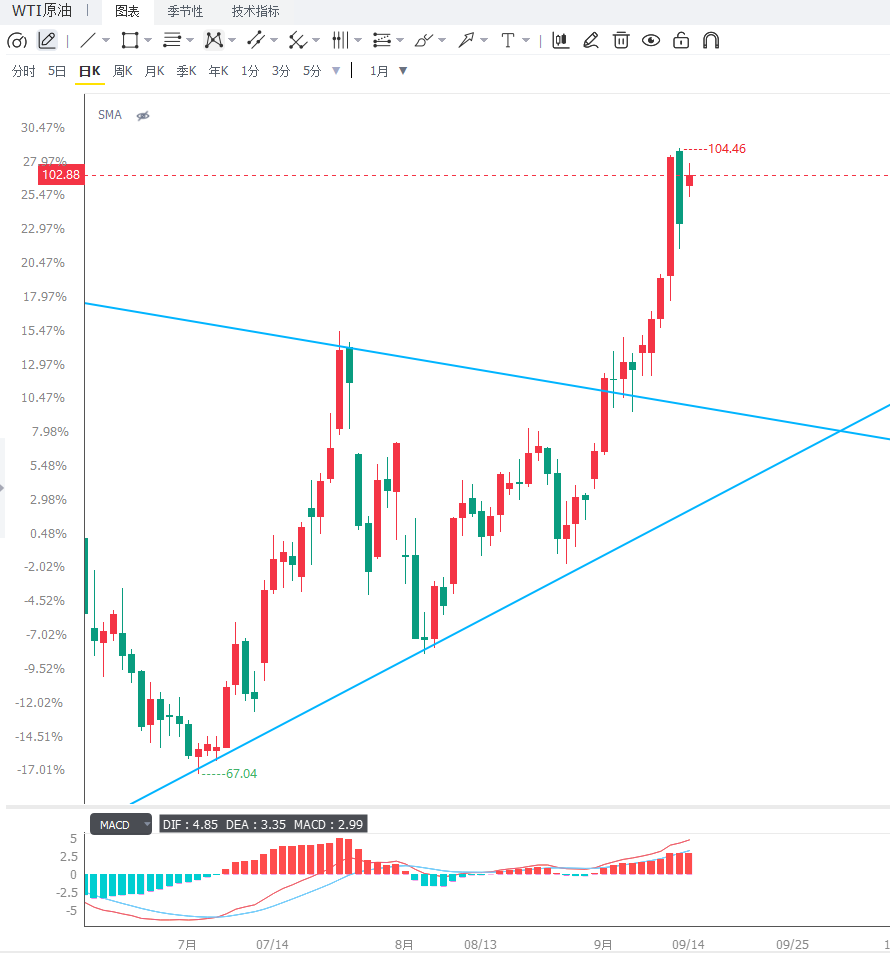 Editor's Summary: Attacks on Saudi Arabia's east-west oil pipelines have escalated supply risks in the crude oil market. WTI crude has now broken through $100 and risen above $102, reflecting the market's pricing in a higher risk premium for further disruptions to the Middle East's energy transportation system. In the short term, the Strait of Hormuz, Red Sea shipping, and the progress of Saudi pipeline restoration will continue to dominate oil prices, while the medium-term trend depends on the sustainability of supply losses and the extent to which high oil prices suppress global demand. If supply-side risks spread further, WTI could potentially move towards previous highs or even higher levels; however, if key transportation facilities are restored and diplomatic communication progresses, oil prices could also experience a rapid correction. Therefore, the $100 mark will be a crucial dividing line between bullish and bearish forces.
The most concerning issue for the market is the suspension of operations on the Saudi East-West oil pipeline. This pipeline, approximately 1200 kilometers long, transports crude oil from Saudi Arabia's eastern oil fields to the port of Yanbu on the Red Sea coast, serving as a crucial alternative export route for Saudi Arabia amidst restrictions on shipping through the Strait of Hormuz. Following the drone attack, Saudi Arabia temporarily suspended operations for security reasons, and no clear timeline for full resumption has been given. The importance of this pipeline is particularly pronounced in the current environment. Due to severe disruptions to shipping through the Strait of Hormuz, Saudi Arabia has significantly increased its reliance on exporting crude oil via the Red Sea. If the East-West pipeline remains inoperable for an extended period, some crude oil will lose its export route bypassing the Strait of Hormuz, potentially further reducing the effective supply available to the global market. Market estimates indicate that the pipeline normally transports approximately 4 to 5 million barrels per day, equivalent to about 4% of global oil supply. The reason this supply risk has quickly translated into upward pressure on oil prices is that the current global crude oil market itself lacks sufficient safety buffers. Latest information shows that Saudi crude oil production has declined significantly since the beginning of the year, and regional supply is constrained by multiple factors. If oil pipelines cannot be quickly restored, existing inventories at Yanbu Port may only last a limited time, leading to market concerns about a further decline in export capacity. Meanwhile, the risks in the Strait of Hormuz have not significantly eased. Recent attacks on ships in the Gulf region have further weakened market confidence in the restoration of normal energy transportation. At the same time, limited progress in diplomatic efforts to establish temporary shipping lanes makes it difficult for the market to form a clear expectation that the supply disruption is about to end. For oil traders, the most important issue has shifted from damage to a single facility to whether the Strait of Hormuz, the Red Sea, and Saudi Arabia's alternative oil transportation system may be simultaneously affected. This shift indicates that the oil market is re-establishing a high geopolitical risk premium. The significant recovery of WTI after a nearly 4% single-day drop suggests that the pressure from profit-taking by some long positions and demand concerns is being offset by new supply risks. In other words, while concerns remain about high oil prices potentially leading to decreased demand and slower economic growth, supply-side risks have regained dominance in the short term. Rising energy prices may also further transmit to global inflation. US diesel prices are already near historical highs, and continued increases in crude oil prices will increase cost pressures in transportation, industry, and consumer sectors, potentially altering major central banks' assessments of inflation. The market is currently particularly focused on the Federal Reserve's policy path, as the combination of rising energy prices and core inflationary pressures could limit future interest rate cuts. Oil prices are therefore no longer just a matter for the commodity market itself, but are gradually becoming a significant variable influencing the US dollar, bond yields, and global risk assets. Market sentiment is also shifting. The previous pullback in oil prices after the initial surge mainly reflected investor concerns about high prices suppressing demand and slowing economic growth. However, following the attack on a key Saudi oil pipeline, traders have begun pricing in supply disruptions again. If the pipeline remains unrestored in the coming days, and shipping in the Strait of Hormuz and the Red Sea continues to be disrupted, the market may further expand its valuation of the supply gap; conversely, if the pipeline is quickly restored and shipping risks decrease, the large geopolitical risk premium accumulated recently could be quickly reversed. Therefore, three variables need to be closely monitored. First, the progress of the restoration of Saudi Arabia's east-west oil pipelines will directly determine the market's assessment of actual supply losses. Second, the passage of ships in the Strait of Hormuz and the Red Sea; if more energy transport facilities or tankers are attacked, oil prices may continue to gain new risk premiums. Finally, US crude oil inventories, refined product prices, and macroeconomic data will also play a role. If high oil prices begin to significantly suppress demand, the upside potential for crude oil may be limited. However, if the rate of supply contraction exceeds the rate of demand decline, WTI may remain strong. From a daily chart perspective, after a sharp pullback following its previous rapid rise, WTI has regained bullish momentum, with prices rising back above the psychological level of $100 and extending towards $102. $100 has gradually transformed from a previous psychological resistance level into a key short-term support area. If the daily chart can stabilize above this level, it indicates that the bulls still hold the main initiative. The first resistance level to watch is the $103.50 to $105 area, with further upside potential towards the previous high. If oil prices can effectively break through this resistance zone, the market may open up further upside potential. Conversely, if the price falls below $100 after a surge, a rapid retracement of the risk premium generated by the previous rise should be anticipated, with the key support level to watch being the $97.50 to $98 area. Looking at the 4-hour chart, WTI has broken free from the weakness created by the previous rapid decline, with prices returning above $100. Short-term moving averages are gradually realigning upwards, indicating a significant improvement in market momentum. Currently, the bulls need to confirm whether the $102 level can transform from resistance into effective support. If the 4-hour chart can hold above $102 and further break through to around $103.50, oil prices are expected to continue challenging $105 or even previous highs. If prices repeatedly encounter resistance in the $102 to $103.50 area, a technical pullback cannot be ruled out. As long as the short-term pullback does not fall below $100 again, the overall structure remains biased towards a high-level consolidation with a slightly bullish bias. A breach of $100 would mean the market needs to reassess the sustainability of this upward trend. Editor's Summary: Attacks on Saudi Arabia's east-west oil pipelines have escalated supply risks in the crude oil market. WTI crude has now broken through $100 and risen above $102, reflecting the market's pricing in a higher risk premium for further disruptions to the Middle East's energy transportation system. In the short term, the Strait of Hormuz, Red Sea shipping, and the progress of Saudi pipeline restoration will continue to dominate oil prices, while the medium-term trend depends on the sustainability of supply losses and the extent to which high oil prices suppress global demand. If supply-side risks spread further, WTI could potentially move towards previous highs or even higher levels; however, if key transportation facilities are restored and diplomatic communication progresses, oil prices could also experience a rapid correction. Therefore, the $100 mark will be a crucial dividing line between bullish and bearish forces.
- Risk Warning and Disclaimer
- The market involves risk, and trading may not be suitable for all investors. This article is for reference only and does not constitute personal investment advice, nor does it take into account certain users’ specific investment objectives, financial situation, or other needs. Any investment decisions made based on this information are at your own risk.