Rising core inflation in the US strengthened expectations of a Federal Reserve rate hike, putting downward pressure on spot gold as it awaited the Fed's interest rate decision.
2026-09-14 11:02:10
Spot gold continued its weakness in early Asian trading on Monday, falling back to around $4,350. Earlier released US inflation data reinforced market expectations for further interest rate hikes by the Federal Reserve this week, prompting investors to reassess the future path of interest rates. The dollar and US Treasury yields remained relatively strong, putting temporary downward pressure on gold, which does not generate interest income.  Latest data shows that the US core consumer price index rose 0.3% month-on-month in August, higher than July's 0.2% and exceeding market expectations of 0.2%. Against the backdrop of continued upward pressure on overall inflation from rising energy prices, the core inflation data, exceeding expectations again, has further strengthened market expectations that the Federal Reserve will maintain its tightening policy. The market had already increased its expectations for interest rate hikes due to rising producer price pressures, and these expectations were further reinforced after the release of the core CPI data. Changes in the interest rate market have become the main driving factor behind the short-term decline in gold prices. Market estimates indicate that the probability of a 25 basis point rate hike at the Fed's September meeting has risen to approximately 86% , significantly higher than the approximately 72% before the producer price data release. The market's focus has therefore gradually shifted from whether the Fed will take action to what signals it will send regarding the subsequent interest rate path after this week's policy meeting. Typically, higher interest rate expectations increase the attractiveness of yield-generating assets such as bonds, while simultaneously increasing the opportunity cost of holding gold, thus putting pressure on gold prices. Especially when the market rapidly increases the probability of a rate hike, gold is easily affected by both a stronger dollar and rising US Treasury yields. The recent pullback in spot gold prices reflects a readjustment of some previously established long positions. However, the gold market does not currently show signs of a one-sided bearish trend. Despite strong US inflation data, an increased probability of a Fed rate hike, and continued high international energy prices, gold prices have managed to hold above the important $4,300 level, indicating that medium- to long-term investment funds have not completely withdrawn from the market. The inflationary risks from rising energy prices may force the Fed to maintain higher interest rates, putting short-term pressure on gold. On the other hand, high oil prices may increase uncertainty in global economic growth and financial markets, continuing to provide some safe-haven demand for gold. Therefore, gold is currently facing a significant tug-of-war between bulls and bears. On one hand, renewed US inflation has raised concerns that the Fed will further tighten its policy, and the widening dollar interest rate advantage may continue to limit gold price increases. On the other hand, high energy prices, global supply risks, and economic uncertainty have provided continuous buying support for gold during pullbacks. Some institutions believe that gold's recent ability to maintain support at high levels demonstrates the resilience of the precious metals market to changes in interest rate expectations. Even as the market digests a higher probability of a Fed rate hike, gold has not broken below key medium-term trend support, meaning that investor focus on inflation risks and macroeconomic uncertainties continues to limit a significant decline in gold prices. The biggest focus this week is undoubtedly the Fed's interest rate decision on Wednesday. If the Fed raises rates by 25 basis points as widely expected and further emphasizes that inflation risks remain high, the dollar may continue to receive support, while gold may face new downward pressure. However, since the market has already priced in a higher probability of a rate hike, the Fed's statement on its future policy path will truly determine the short-term direction of gold prices. If the Fed implements a rate hike but its policy statement and the chairman's press conference release a cautious signal, suggesting that current inflationary pressures are mainly driven by factors such as energy and not explicitly supporting continuous rate hikes, then the market may lower its expectations for further tightening, and gold may have a chance to rebound. Conversely, if the policy stance clearly leans towards continued tightening, gold prices may further test the important support level below $4,300. The current rise in oil prices is changing global inflation expectations. If energy costs continue to rise, subsequent US inflation data may remain resilient, which will be a significant macroeconomic factor limiting a gold rebound. However, if high oil prices begin to significantly drag down economic growth, market concerns about future economic risks could reignite gold's safe-haven appeal. Therefore, changes in Fed policy, energy prices, and economic growth will jointly determine the direction of gold's price movement after this week's interest rate decision. From a daily chart perspective, spot gold is currently in a neutral consolidation phase after a high-level pullback, trading around $4350 and continuing to hold above the 100-day moving average of around $4330 , indicating that the medium-term trend support remains effective for now. However, gold prices are still being suppressed by the 20-day Bollinger Band's middle line, and the bulls have not yet regained short-term control. The 14-day RSI is approximately 47.11, in the neutral zone, reflecting that the previous pullback has significantly cooled market momentum, but it has not yet reached an extreme oversold state. On the daily chart, the first support level to watch is the 100-day moving average around $4330. A break below this area could see the bears test the lower Bollinger Band around $4250. On the upside, the key level to watch is the 20-day moving average middle band around $4460. Only a break above this level could give gold a stronger upward momentum, with further resistance around $4680. Looking at the 4-hour chart, gold has recently shown a weak, oscillating trend, finding a new equilibrium between $4330 and $4460 after falling from its highs. $4330 is a crucial short-term support level. If the 4-hour chart can hold above $4330, the bulls still have a chance to push the price back towards $4400 and $4460. A break below $4330 could allow the bears to extend their advantage and increase the likelihood of testing support around $4300 and $4250. Current short-term momentum remains cautious, and it's crucial to watch whether the price can regain $4400 before the Fed's decision. If gold can break through and stabilize above $4,400, short-term selling pressure is expected to ease; conversely, if it repeatedly encounters resistance below $4,460, gold may still maintain a weak and volatile pattern at high levels.
 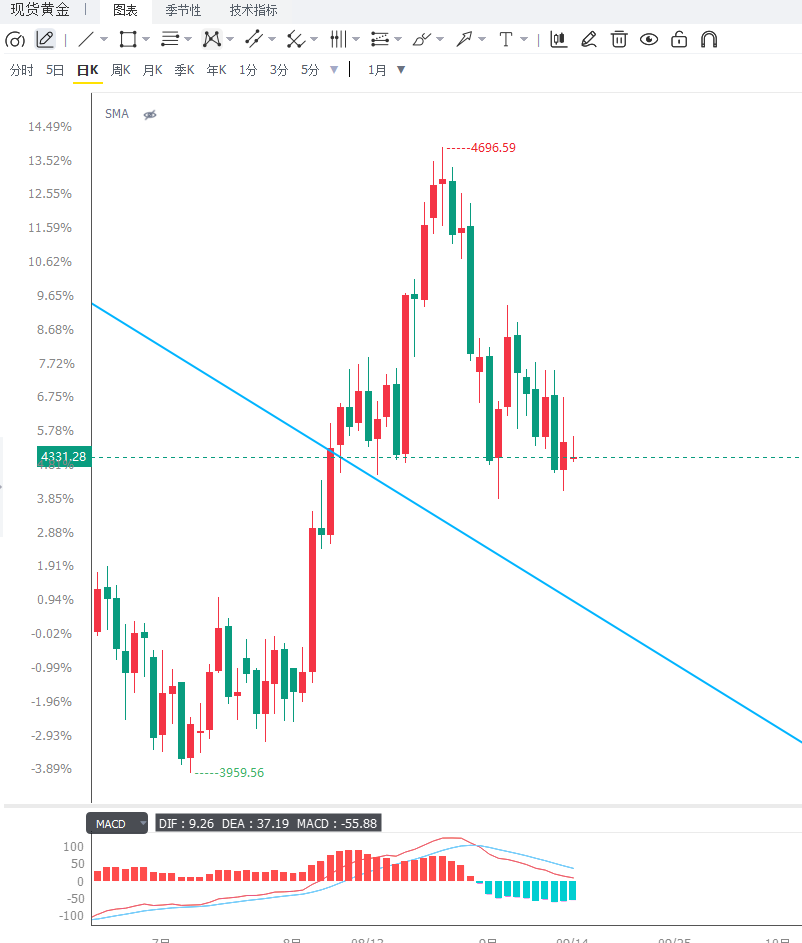 Editor's Summary: Higher-than-expected core inflation in the US has driven market expectations for a Federal Reserve rate hike this week to a high level. The strength of the US dollar and US Treasury yields has put short-term pressure on gold, with spot gold prices falling back to around $4350. However, gold prices are currently holding above the important medium-term support level of around $4330, indicating that the market has not yet formed a clear trend reversal to bearish. In the short term, the Fed's interest rate decision and subsequent policy guidance will be key to determining the direction of gold. $4330 is an important downside watershed, while $4460 is a significant resistance level for the bulls to regain their advantage. If the policy stance is weaker than previously expected by the market, gold may see a rebound; if the Fed continues to strengthen its tightening signals, gold prices still need to be wary of the risk of further declines to around $4250.
Latest data shows that the US core consumer price index rose 0.3% month-on-month in August, higher than July's 0.2% and exceeding market expectations of 0.2%. Against the backdrop of continued upward pressure on overall inflation from rising energy prices, the core inflation data, exceeding expectations again, has further strengthened market expectations that the Federal Reserve will maintain its tightening policy. The market had already increased its expectations for interest rate hikes due to rising producer price pressures, and these expectations were further reinforced after the release of the core CPI data. Changes in the interest rate market have become the main driving factor behind the short-term decline in gold prices. Market estimates indicate that the probability of a 25 basis point rate hike at the Fed's September meeting has risen to approximately 86% , significantly higher than the approximately 72% before the producer price data release. The market's focus has therefore gradually shifted from whether the Fed will take action to what signals it will send regarding the subsequent interest rate path after this week's policy meeting. Typically, higher interest rate expectations increase the attractiveness of yield-generating assets such as bonds, while simultaneously increasing the opportunity cost of holding gold, thus putting pressure on gold prices. Especially when the market rapidly increases the probability of a rate hike, gold is easily affected by both a stronger dollar and rising US Treasury yields. The recent pullback in spot gold prices reflects a readjustment of some previously established long positions. However, the gold market does not currently show signs of a one-sided bearish trend. Despite strong US inflation data, an increased probability of a Fed rate hike, and continued high international energy prices, gold prices have managed to hold above the important $4,300 level, indicating that medium- to long-term investment funds have not completely withdrawn from the market. The inflationary risks from rising energy prices may force the Fed to maintain higher interest rates, putting short-term pressure on gold. On the other hand, high oil prices may increase uncertainty in global economic growth and financial markets, continuing to provide some safe-haven demand for gold. Therefore, gold is currently facing a significant tug-of-war between bulls and bears. On one hand, renewed US inflation has raised concerns that the Fed will further tighten its policy, and the widening dollar interest rate advantage may continue to limit gold price increases. On the other hand, high energy prices, global supply risks, and economic uncertainty have provided continuous buying support for gold during pullbacks. Some institutions believe that gold's recent ability to maintain support at high levels demonstrates the resilience of the precious metals market to changes in interest rate expectations. Even as the market digests a higher probability of a Fed rate hike, gold has not broken below key medium-term trend support, meaning that investor focus on inflation risks and macroeconomic uncertainties continues to limit a significant decline in gold prices. The biggest focus this week is undoubtedly the Fed's interest rate decision on Wednesday. If the Fed raises rates by 25 basis points as widely expected and further emphasizes that inflation risks remain high, the dollar may continue to receive support, while gold may face new downward pressure. However, since the market has already priced in a higher probability of a rate hike, the Fed's statement on its future policy path will truly determine the short-term direction of gold prices. If the Fed implements a rate hike but its policy statement and the chairman's press conference release a cautious signal, suggesting that current inflationary pressures are mainly driven by factors such as energy and not explicitly supporting continuous rate hikes, then the market may lower its expectations for further tightening, and gold may have a chance to rebound. Conversely, if the policy stance clearly leans towards continued tightening, gold prices may further test the important support level below $4,300. The current rise in oil prices is changing global inflation expectations. If energy costs continue to rise, subsequent US inflation data may remain resilient, which will be a significant macroeconomic factor limiting a gold rebound. However, if high oil prices begin to significantly drag down economic growth, market concerns about future economic risks could reignite gold's safe-haven appeal. Therefore, changes in Fed policy, energy prices, and economic growth will jointly determine the direction of gold's price movement after this week's interest rate decision. From a daily chart perspective, spot gold is currently in a neutral consolidation phase after a high-level pullback, trading around $4350 and continuing to hold above the 100-day moving average of around $4330 , indicating that the medium-term trend support remains effective for now. However, gold prices are still being suppressed by the 20-day Bollinger Band's middle line, and the bulls have not yet regained short-term control. The 14-day RSI is approximately 47.11, in the neutral zone, reflecting that the previous pullback has significantly cooled market momentum, but it has not yet reached an extreme oversold state. On the daily chart, the first support level to watch is the 100-day moving average around $4330. A break below this area could see the bears test the lower Bollinger Band around $4250. On the upside, the key level to watch is the 20-day moving average middle band around $4460. Only a break above this level could give gold a stronger upward momentum, with further resistance around $4680. Looking at the 4-hour chart, gold has recently shown a weak, oscillating trend, finding a new equilibrium between $4330 and $4460 after falling from its highs. $4330 is a crucial short-term support level. If the 4-hour chart can hold above $4330, the bulls still have a chance to push the price back towards $4400 and $4460. A break below $4330 could allow the bears to extend their advantage and increase the likelihood of testing support around $4300 and $4250. Current short-term momentum remains cautious, and it's crucial to watch whether the price can regain $4400 before the Fed's decision. If gold can break through and stabilize above $4,400, short-term selling pressure is expected to ease; conversely, if it repeatedly encounters resistance below $4,460, gold may still maintain a weak and volatile pattern at high levels. Editor's Summary: Higher-than-expected core inflation in the US has driven market expectations for a Federal Reserve rate hike this week to a high level. The strength of the US dollar and US Treasury yields has put short-term pressure on gold, with spot gold prices falling back to around $4350. However, gold prices are currently holding above the important medium-term support level of around $4330, indicating that the market has not yet formed a clear trend reversal to bearish. In the short term, the Fed's interest rate decision and subsequent policy guidance will be key to determining the direction of gold. $4330 is an important downside watershed, while $4460 is a significant resistance level for the bulls to regain their advantage. If the policy stance is weaker than previously expected by the market, gold may see a rebound; if the Fed continues to strengthen its tightening signals, gold prices still need to be wary of the risk of further declines to around $4250.
- Risk Warning and Disclaimer
- The market involves risk, and trading may not be suitable for all investors. This article is for reference only and does not constitute personal investment advice, nor does it take into account certain users’ specific investment objectives, financial situation, or other needs. Any investment decisions made based on this information are at your own risk.