Without the US in the Hormuz shipping diplomacy, the risk premium in oil prices will take longer to cool down.
2026-09-14 10:56:11
On Monday (September 14) during Asian trading hours, Brent crude futures surged more than 3%, reaching a high of $108.43 per barrel, continuing to hold steady near the highs since May 21. Behind this strong upward surge, besides supply-side shocks such as the attack on Saudi pipelines, the US's "backing off" in its shipping diplomacy in the Strait of Hormuz is also noteworthy. According to media reports on Sunday (September 13) citing three sources familiar with the matter, Trump administration officials have privately informed relevant parties in the Gulf region that they hope future US-Iran negotiations will focus on Iran's nuclear program, rather than the issue of passage through the Strait of Hormuz. This means Washington has chosen to remain outside the shipping diplomacy brokered by Oman. This detail has limited impact on immediate price movements, but it is crucial for traders to understand the upper limit of any recent easing of tensions in the Strait of Hormuz—the party with the most military leverage choosing not to anchor its diplomacy in the strait means that shipping and toll issues will continue to be primarily pursued through Oman and the Gulf states. 
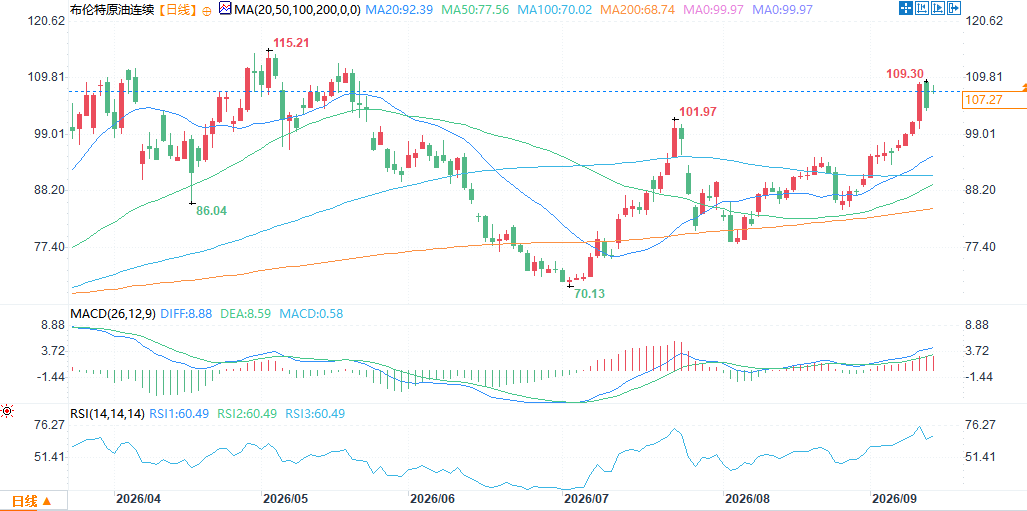 (Brent crude oil futures daily chart, source: EasyTrade) At 10:54 Beijing time, Brent crude oil futures were trading at $107.44 per barrel.
US Strategy as Seen Through the Postponement of the Oman Conference: Separating Shipping Diplomacy from Nuclear Issues
This disclosure helps explain why the United States decided not to participate in the scheduled meeting between Iran and Gulf Arab states in Oman on Monday—a meeting aimed at advancing Oman-brokered plans to restore normal tanker traffic in the Strait of Hormuz. Despite the severe disruption to shipping through the Strait of Hormuz and Washington's continued tanker escort operations, the US had no plans to attend the meeting. President Trump stated that the current state of the strait is temporarily acceptable given the presence of military escorts, indicating that the administration sees no urgent need to intervene in the specific diplomatic track of Hormuz. According to media reports, diplomats had previously hoped that the Omani meeting would build momentum after months of private discussions, with the proposed legal framework allowing Iran and Oman to charge fees for vessels using the strait. The emerging Omani framework leans towards voluntary payments linked to navigational safety and environmental protection, an approach more attractive to regional parties than direct transit fees from Iran—which remain widely rejected. The negotiations appear to be progressing primarily as a matter between Tehran, Muscat, and other Gulf states, rather than being directly led by Washington.The meaning of the dual-track strategy: regional diplomacy to alleviate path dependence.
The main theme conveyed by media reports is that the Trump administration seems inclined to allow specific diplomatic efforts related to the Strait of Hormuz to proceed independently through Oman and the Gulf states, while reserving bilateral leverage with Iran for the nuclear issue. This divergence could affect the speed at which a lasting shipping arrangement for the Straits is formed—because the party with the most direct military leverage over the waterway has not used it as a bargaining chip in the Hormuz negotiations themselves. This distinction could influence how current diplomatic setbacks are interpreted. With the Oman meeting postponed due to the attacks on Saudi East-West pipelines and Washington remaining a bystander rather than a participant, the path to easing the Hormuz standoff appears to depend primarily on whether Iran, Oman, and the wider Gulf region can reach a consensus among themselves, independent of any parallel or lack thereof in the broader US-Iran nuclear relationship.Regional diplomacy is driving the détente process, and the Brent risk premium is receding more slowly than expected.
The US's decision not to directly intervene in the Hormuz shipping diplomacy means that the party with the most military leverage has not used it at the negotiating table, and the path to de-escalation will primarily rely on regional consensus among Iran, Oman, and the Gulf states. The advantage of this arrangement is that the US chooses to step back, reducing the risk of broader issues like the nuclear program interfering with negotiations; however, the disadvantages are equally clear—without direct US involvement, the time required to reach a lasting shipping agreement could be prolonged, and every incident like the attack on the Saudi pipeline could potentially reset the negotiation process to zero. For oil prices, this means that the geopolitical risk premium currently embedded in prices may recede more slowly than the market previously expected. If regional negotiations make substantial progress, oil prices may give back some of the premium; however, if negotiations continue to drag on or if another attack occurs, the risk bias for oil prices will continue to rise. In short, this news does not change the immediate direction of oil prices, but it extends the "shelf life" of the risk premium.Summarize
Three sources familiar with the matter revealed that the Trump administration hopes future US-Iran negotiations will focus on Iran's nuclear program rather than the Strait of Hormuz, with Washington choosing to remain outside of Oman-mediated shipping diplomacy. The Oman meeting, originally scheduled for Monday, was postponed, and the US had no plans to participate anyway. Trump stated that the current state of the Strait is "acceptable for the time being." This split-track strategy means that shipping and toll issues will continue to be addressed through Oman and the Gulf states, with the path to de-escalation relying primarily on regional diplomacy rather than a breakthrough between the US and Iran. With the Oman meeting postponed and Washington in a bystander position, the prospect of easing the Hormuz standoff depends on whether Iran, Oman, and the Gulf states can reach a consensus on their own. For the oil market, this means that the current risk premium may recede more slowly than previously expected. (Brent crude oil futures daily chart, source: EasyTrade) At 10:54 Beijing time, Brent crude oil futures were trading at $107.44 per barrel.
- Risk Warning and Disclaimer
- The market involves risk, and trading may not be suitable for all investors. This article is for reference only and does not constitute personal investment advice, nor does it take into account certain users’ specific investment objectives, financial situation, or other needs. Any investment decisions made based on this information are at your own risk.