The probability of a Fed rate hike this week is nearly 90%, but this does not change the long-term bullish trend for gold.
2026-09-14 13:48:15
Despite the August US CPI data reinforcing market expectations of an interest rate hike, with the CME FedWatch tool showing a near 90% probability of a rate hike, spot gold prices held above $4,300 per ounce, indicating that the negative impact of a single rate hike is waning. Many institutions are warning that, compared to inflation, the continuously expanding US government debt is impacting the US Treasury market. Coupled with upcoming interest rate meetings from several central banks and the potential unwinding risk of yen carry trades, global asset markets are experiencing undercurrents. While gold prices are under short-term pressure, the long-term support logic remains intact.
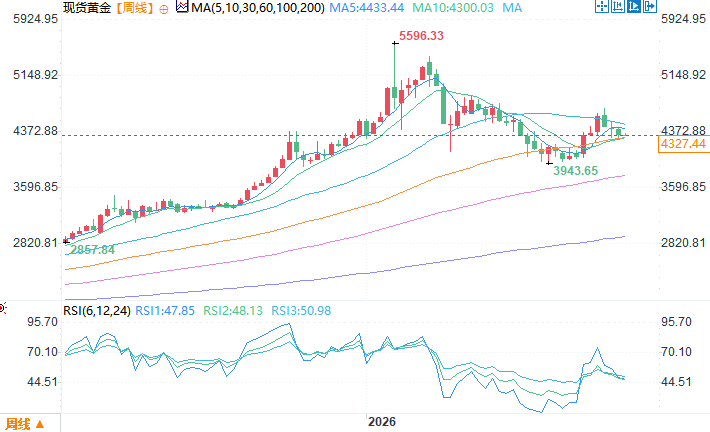 Spot gold weekly chart source: FX678. As of 13:46 Beijing time on September 14th, spot gold was trading at $4330.44 per ounce.
US August CPI fuels expectations of an interest rate hike; gold prices pull back but hold key support.
Spot gold fell 1.83% last week, closing at $4,349.30 per ounce, finding support around the $4,300 level. The August Consumer Price Index (CPI) is seen by some economists as a key signal for a potential interest rate hike. Excluding volatile food and energy prices, core inflation rose 2.4% year-on-year, in line with expectations, but rose 0.3% month-on-month, higher than the expected 0.2%. Although prices did not accelerate further, they remained above the Federal Reserve's 2% target. Chris Zaccarelli, chief investment officer at Northern Light Asset Management, said, "The Fed may not necessarily raise rates this week, but it's difficult to find a reason to keep rates unchanged." Data from the CME FedWatch Tool shows that the market is pricing in a near 90% probability of a rate hike this week. Even with the strong expectation of a rate hike, gold prices did not experience a significant breakdown, and the market is beginning to realize that the negative impact of a single rate hike is gradually weakening.High debt levels constrain the Federal Reserve's actions, increasing the risk weighting in the bond market.
Analysts suggest that the Federal Reserve faces challenges far beyond inflation. The US government debt exceeding $40 trillion continues to pressure the Treasury market, with the 10-year Treasury yield remaining at a three-year high and steadily approaching the 5% mark. Even with the Treasury's purchase of over $5 billion in long-term bonds last Thursday, yields remained high, indicating the repurchase operation's effectiveness fell short of expectations. Jeff Sarti, CEO of Morton Wealth, stated that the Fed is unlikely to aggressively raise interest rates given the current fiscal environment. He said, "The Fed can do its best to combat inflation, but constrained by the current domestic fiscal situation, the room for rate hikes is very limited, and inflation is likely to remain high. More importantly, the continuously deteriorating fiscal situation has already sent a very clear signal in the bond market." Naeem Aslam, Chief Investment Officer of Zaye Capital Markets, believes that the Fed's credibility is being tested, thus providing strong support for gold. Federal Reserve Chairman Kevin Warsh reiterated in his speech at the Jackson Hole Economic Symposium in Wyoming last month that the policy focus is on stabilizing prices and pushing inflation back to the target range. Naim Aslan said, "If the Fed raises interest rates, Treasury yields will still struggle to meet market expectations; if it chooses to hold rates steady, its policy credibility will be questioned. Holding gold remains the preferred strategy at present."Divergent opinions among institutions, with multiple central banks around the world issuing policy decisions in quick succession.
In a research report last Friday, Ryan McKay, head of commodity strategy at TD Securities, noted that while downside risks for gold prices had increased ahead of the Fed's interest rate decision on Wednesday, the downside was relatively limited. He stated, "Strong economic data and a hawkish Fed may only trigger minor, programmed selling. Weakening dollar credibility, continued gold purchases by central banks, and ETF inflows are providing strong support for long-term capital allocation. Short-term pullbacks in gold prices can be seen as buying opportunities. " Ryan McIntyre, president of Sprout, believes the Fed may not choose to raise interest rates and may maintain a neutral policy , arguing that the current inflation is largely driven by energy prices pushed up by the Iranian conflict. He added that even if a rate hike is implemented, the market has already fully priced it in, and gold prices below $4,400 have already factored in the impact of a 25 basis point rate hike. He stated that regardless of the Fed's choice, the long-term upward trend in sovereign debt risk will not change. In addition to the Federal Reserve, the Bank of England will announce its interest rate decision on Thursday this week, with the market expecting the benchmark interest rate to remain unchanged at 3.75%. The Bank of Japan will also hold a meeting before the weekend, with the market expecting a 25 basis point rate hike. Adam Turnquist, Chief Technical Strategist at LPL Financial, cautioned that Japan's rate hike will have a global ripple effect, and attention should be paid to whether the USD/JPY pair can break below the support level around 152. He said that if it does break below this level, the yen will strengthen rapidly, triggering short covering, igniting the risk of unwinding yen carry trades, and impacting various global assets, including US Treasuries.Conclusion
Short-term expectations of a Fed rate hike remain the direct factor suppressing gold prices; however, gold's ability to hold above $4,300 demonstrates the resilience of long-term buying. Market focus should not be limited to the Fed's recent 25-basis-point policy change. The pressure on the US bond market from its massive debt, coupled with policy changes by the Bank of England and the Bank of Japan, and the potential risks of yen carry trades, collectively constitute the core variables for global assets. Most institutions believe that the short-term gold price correction is a sign of market volatility, and the supporting logic of long-term sovereign debt and central bank gold purchases remains valid, indicating that the medium- to long-term outlook for gold prices still has room for growth. Spot gold weekly chart source: FX678. As of 13:46 Beijing time on September 14th, spot gold was trading at $4330.44 per ounce.
- Risk Warning and Disclaimer
- The market involves risk, and trading may not be suitable for all investors. This article is for reference only and does not constitute personal investment advice, nor does it take into account certain users’ specific investment objectives, financial situation, or other needs. Any investment decisions made based on this information are at your own risk.