The yen has moved from 160 to 152: the market structure has changed.
2026-09-14 18:36:08
On Monday, September 14th, the USD/JPY pair was trading around 154.5. Following the release of the US August Consumer Price Index last week, federal funds rate futures raised the implied probability of a 25 basis point rate hike by the Federal Reserve this week to approximately 90%, and the two-year US Treasury yield rose to around 4.63%. Based on the logic of short-term interest rate differentials, the USD/JPY pair would typically find support. However, the actual market presented a different pricing scenario: the yen continued to strengthen despite unfavorable interest rate differentials, with the exchange rate falling from around 160 in early September and reaching a low of around 152.89 on September 8th. This divergence is noteworthy, as the Bank of Japan's policy expectations have outweighed short-term interest rate differentials, becoming the dominant variable. With the Federal Reserve and the Bank of Japan holding meetings this week, market focus has shifted from whether each will raise rates by 25 basis points to how the communication strategy will rewrite the subsequent path. 
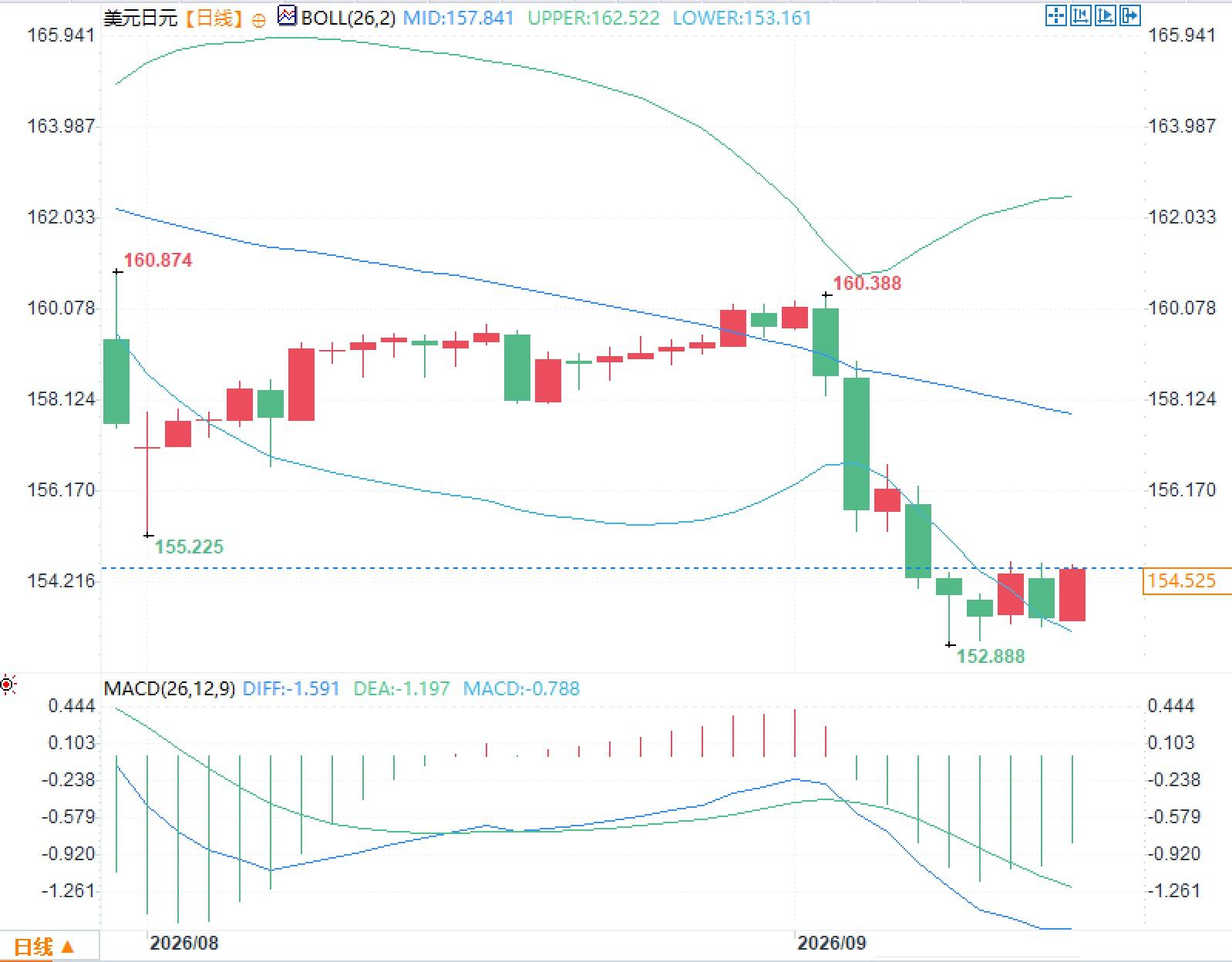 What needs to be considered separately is the overlap between the price level and the timing of the policy event. Indicators show that momentum has not yet returned above the zero line, and the Bollinger Band middle line is still above the current price, indicating that the correction from the end of August to the beginning of September has been included in the daily chart structure.
Interest rate pricing divergence and the shift in exchange rate drivers
The Federal Reserve's current policy rate range is 3.50% to 3.75%, with its policy meeting scheduled for September 15-16. In August, the US Consumer Price Index (CPI) rose 0.4% month-over-month and 3.4% year-over-year; the core CPI rose 0.3% month-over-month, slightly higher than the market's previous forecast of 0.2%, and 2.4% year-over-year. Following the data release, short-term US Treasury yields rose, raising the price of interest rate hikes. In Japan, the policy rate remains at 1.0%, a level established after a 25 basis point increase in June, and maintained unchanged at the July 30-31 meeting by a vote of 8 to 1. The yield on 10-year Japanese government bonds is currently around 2.99%, and the yield on 2-year bonds is around 1.84%. A significant short-term interest rate differential between the US and Japan still exists, but this has not been reflected in the exchange rate. The recent strengthening of the yen is not primarily due to a sudden loss of attractiveness in dollar asset yields, but rather to the repricing of the Japanese policy rate path. Just one meeting after the June rate hike, the market had already priced in the 25 basis point increase expected at the September 17-18 meeting. If the policy rate were to rise further, it would reach 1.25%, a level not seen in approximately 31 years. This means the driving factor has shifted from the "stock of interest rate spreads" to the "speed of change in interest rate spreads" and "whether the door to further normalization has been closed." In early September, Kazuo Ueda stated that rate hikes would be fully discussed at every policy meeting, including the next one; financial conditions remained relatively loose, and he hoped for further rate increases; however, given that there had already been five rate hikes, a careful assessment of the cumulative impact on the economy was needed, and greater attention would be paid to the upside risks of inflation in policy operations than before. After the July meeting, he also mentioned that if financial conditions were deemed excessively loose, the pace of rate hikes could accelerate. These statements shifted market attention from a single 25 basis point increase to the overall path of interest rate increases.Speculative position reversal reveals changes in capital structure
Data from the U.S. Commodity Futures Trading Commission for the week ending September 8 showed that non-commercial traders' net positions in Japanese yen futures turned net long by 10,796 contracts, compared to a net short of 92,227 contracts the previous week, a weekly change of approximately 103,000 contracts. This marks the first time since February that the yen has turned net long. Leveraged funds have completed a directional shift, while asset management accounts still recorded approximately 570 net short contracts, not yet synchronized with speculative positions. The position structure thus exhibits a stratification of "fast money turning first, long money not yet fully formed." Positions themselves are not a sufficient condition for price movement. The significant contraction in net short positions indicates that positions previously financed in the yen have undergone a round of liquidation; the limited size of net long positions suggests that the crowding of new long positions is not high. Some analysts believe that further exchange rate extension requires the return of funds and the subsequent decline in the dollar and U.S. Treasury yields. In other words, the position reversal explains why the exchange rate can adjust downwards even when short-term U.S. Treasury yields are strong, but it cannot solely determine the sustainability of the next phase of volatility. More informative is whether positions and interest rate pricing move in the same direction: if the Bank of Japan only delivers the 25 basis points already priced in and remains vague about the subsequent path, speculative positions that have already shifted lack a new pricing anchor; if communication leaves room for further normalization, then positions and interest rate expectations may reinforce each other.This week's dual-central bank window: the weighting difference between the decision itself and the communication tone.
The two interest rate decisions this week were almost simultaneous. The Federal Reserve meeting concluded first, followed by the Bank of Japan's announcement on September 18th. Both markets had already priced in a 25 basis point increase as the baseline scenario. For USD/JPY, the asymmetry lies in the fact that the Fed's rate hike has already been largely priced in after price data releases, with marginal variables focusing more on how the dot plot and the Chairman's press conference describe the subsequent pace. On the Bank of Japan's side, the 25 basis point increase itself is more heavily priced in, and the market is focusing more on Kazuo Ueda's guidance and whether the Bank of Japan will continue to leave room for further normalization. Kazuo Ueda framed the discussion between two constraints. One is that financial conditions remain relatively loose, with a desire to continue raising interest rates and a greater focus on the upward price disturbances caused by Middle East conflicts, energy prices, exchange rate volatility, and demand related to artificial intelligence. The other is that with multiple rate hikes already implemented, the lagged effects on businesses and households must be assessed. What the market needs to discern is not whether the statement mentions interest rate hikes, but whether the press conference reaffirms the "pace can be accelerated" statement made in July, and whether it lists the risk of rising prices as a condition requiring immediate action.Daily chart fluctuation structure
The daily Bollinger Bands have a middle band at 157.841, an upper band at 162.522, and a lower band at 153.161. The current price is below the middle band and close to the lower band. In early September, the exchange rate fluctuated around 160, followed by a series of long bearish candlesticks, with a low around 152.888, after which it consolidated around 154. The MACD DIFF is -1.591, DEA is -1.197, and the histogram is -0.788; both lines and the histogram are below the zero line. What needs to be considered separately is the overlap between the price level and the timing of the policy event. Indicators show that momentum has not yet returned above the zero line, and the Bollinger Band middle line is still above the current price, indicating that the correction from the end of August to the beginning of September has been included in the daily chart structure.Frequently Asked Questions
Question 1: Why hasn't the USD/JPY strengthened in tandem with the rise in short-term US Treasury yields? Answer: Short-term interest rate differentials are a fixed condition; exchange rate pricing focuses on marginal changes in these differentials. August US price data increased the probability of a Fed rate hike, but the Bank of Japan's 25 basis point rate hike in September has already been widely priced in. The market has shifted its focus to Kazuo Ueda's statements on subsequent normalization, thus the interest rate differential has temporarily given way to expectations of the policy path. Question 2: Does the shift from speculative positions to net long positions in the yen mean the correction is over? Answer: The shift from a net short position of 92,227 contracts to a net long position of 10,796 contracts indicates concentrated short covering, but this alone cannot prove the trend is complete. Asset management accounts remain slightly bearish; further developments will depend on the Bank of Japan's communication, capital inflows, and whether the USD and US Treasury yields change in tandem. Question 3: Is the magnitude of the rate hike or the press conference's wording the real pricing significance this week? Answer: The 25 basis point increase has been largely priced in on both sides; the marginal information lies in the policy path. The Federal Reserve is watching how the pace of future rate hikes will be described, while the Bank of Japan is watching whether it will continue to leave the door open for normalization.- Risk Warning and Disclaimer
- The market involves risk, and trading may not be suitable for all investors. This article is for reference only and does not constitute personal investment advice, nor does it take into account certain users’ specific investment objectives, financial situation, or other needs. Any investment decisions made based on this information are at your own risk.