A chart shows that freight rates for large vessels are collectively weakening, with the Baltic Dry Index falling to a near three-week low.
2026-09-15 23:16:09
The latest data shows that on September 15, 2026, the Baltic Dry Index (BDI) stood at 3360 points, a new low since September 2, 2026, down 2.47% month-on-month, marking the largest drop in three days and the fourth consecutive day of decline (including zero growth). Looking at the short-term charts, the recent 11 BDI data points show: 5 positive increases, 6 negative increases, and 0 zero increases. Specifically, the Panamax Freight Index (BPI) was 2364 points, down 1.21% from the previous value; the Capesize Freight Index (BCI) was 5687 points, down 3.81%; and the Supramax Freight Index (BSI) was 1736 points, up 0.64%. For detailed charts of the latest 720-day and 10-year trends of the Baltic Dry Index and its three main sub-indices, please refer to the charts specially created by FX678. 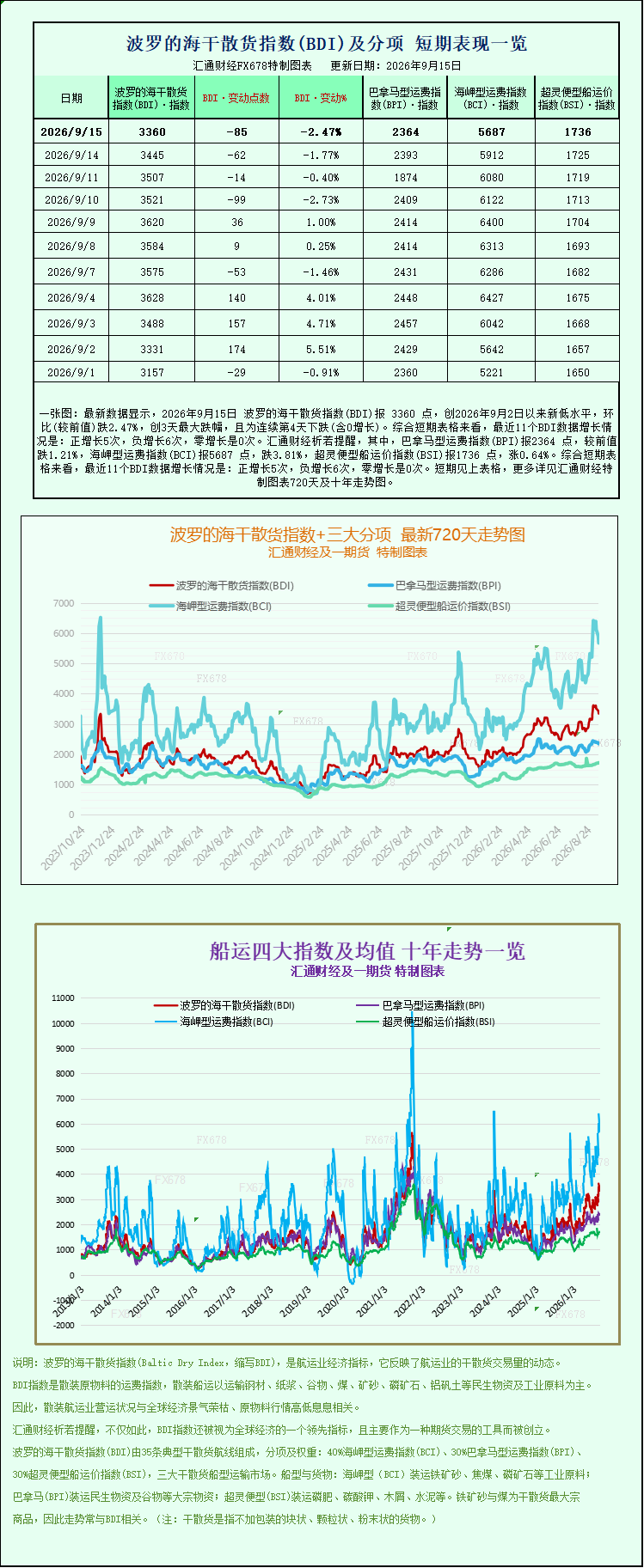 On September 15, 2026, the latest shipping market data showed a significant correction in the international dry bulk shipping market. The Baltic Dry Index (BDI) fell sharply on Tuesday, reaching its lowest level in nearly three weeks since September 2. This decline was not a general market drop, but rather a structural divergence, characterized by significantly weaker freight rates for large vessels and resilient increases for small and medium-sized vessels. The decline in freight rates for the two main shipping types, Capesize and Panamax, was the core factor dragging down the index, directly reflecting a temporary cooling in global demand for dry bulk shipping. Data showed that the Baltic Dry Index, which tracks freight rates for the three major dry bulk vessel types (Capesize, Panamax, and Supramax), fell 85 points that day, a 2.5% drop, closing at 3360 points, ending its previous short-term consolidation and hitting a new low in nearly three weeks. As a core indicator of the global dry bulk shipping market, the Baltic Dry Index (BDI) directly reflects the maritime activity of basic commodities such as iron ore, coal, and grain. This significant decline indicates a temporary contraction in global demand for industrial raw materials via sea freight. Among the various vessel types, Capesize vessels, the largest in size and primarily used for long-haul transportation of bulk industrial raw materials, suffered the most severe decline, becoming the biggest drag on the index. Data shows that the Capesize freight rate index plummeted by 225 points in a single day, a drop of 3.8%, closing at 5687 points. Correspondingly, in terms of market profitability, Capesize vessels mainly engaged in the ocean transport of 150,000-ton iron ore, coal, and other bulk industrial raw materials saw their average daily earnings shrink by $2047, with the latest average daily revenue falling to $48072, indicating a significant narrowing of profit margins. The sharp decline in Capesize freight rates is primarily driven by weak supply and demand in the upstream commodity market. The iron ore market has been continuously weakening recently, with futures prices falling for five consecutive trading days, and market sentiment continuing to cool. Meanwhile, the counter-trend rise in coking coal prices has squeezed costs, significantly reducing the production profits of major global steel mills. This has led to more conservative purchasing and operating intentions among steel mills, resulting in a continued decline in iron ore restocking demand. As the core cargo type transported by Capesize vessels, the cooling demand for seaborne iron ore directly impacts shipping orders. Coupled with the relatively ample supply of large vessels on long-haul routes recently, this supply-demand mismatch has caused Capesize freight rates to fall sharply. In addition to Capesize vessels, Panamax vessels, which mainly transport medium- and short-haul bulk cargo, also continued their downward trend, further dragging down the overall market index. Data shows that the Panamax freight rate index fell 29 points, a drop of 1.2%, closing at 2364 points. This vessel type mainly transports 60,000 to 70,000 tons of coal, grain, and other cargoes, covering major global trade routes. Its market profitability has also declined, with daily revenue decreasing by $264, the latest figure falling to $21,276. The decline in Panamax freight rates was mainly due to weak regional industrial coal demand and a slowdown in the release of grain shipping orders. On the one hand, the recovery of global industrial production was weaker than expected, with limited increases in demand for coal from thermal power and manufacturing, resulting in persistently low coal shipping bookings. On the other hand, the peak season for grain transportation in major global grain-producing regions was coming to an end, the order dividends from concentrated grain shipments had faded, and short-term market demand was weak. Coupled with ample shipping capacity on routes, this pushed Panamax freight rates steadily downward. The simultaneous weakening of the two main vessel types directly set the tone for the decline in the Baltic Dry Index. In stark contrast to the sluggish performance of large vessels, small Supramax vessels demonstrated strong market resilience, achieving a counter-trend increase, making this market adjustment show a clear structural differentiation. Data shows that the Supramax index rose 11 points, or 0.6%, to close at 1736 points. Supramax vessels, with their compact size and flexible transport capabilities, are well-suited for small-batch, high-frequency short-haul regional transport, primarily handling cargo such as building materials, small-volume grains, and industrial auxiliary materials. Their counter-trend rise is primarily due to stable demand in regional short-haul trade, relatively tight capacity supply in this segment, and the fact that demand for small-volume cargo is less affected by fluctuations in bulk industrial raw material prices, allowing them to maintain an independent market trend. This divergence in the performance of large and small vessel types accurately reflects the current state of the global shipping market: demand for bulk industrial raw materials is cooling, while demand for regional small-volume cargo remains stable. In summary, the recent decline in the Baltic Dry Index is the result of multiple factors, including the commodity market, industrial production, and shipping supply and demand. In the short term, the high price of coking coal squeezing steel mill profits and the continued weakness in iron ore demand are unlikely to reverse quickly, and freight rates for large dry bulk vessels may continue to fluctuate weakly; while Supramax vessels, relying on their flexible transport advantages, will maintain a stable trend. The subsequent market trend will mainly depend on the pace of recovery in global steel mill operations, fluctuations in commodity prices, and the strength of global trade orders. If industrial demand remains weak, the dry bulk index may continue its downward trend.
On September 15, 2026, the latest shipping market data showed a significant correction in the international dry bulk shipping market. The Baltic Dry Index (BDI) fell sharply on Tuesday, reaching its lowest level in nearly three weeks since September 2. This decline was not a general market drop, but rather a structural divergence, characterized by significantly weaker freight rates for large vessels and resilient increases for small and medium-sized vessels. The decline in freight rates for the two main shipping types, Capesize and Panamax, was the core factor dragging down the index, directly reflecting a temporary cooling in global demand for dry bulk shipping. Data showed that the Baltic Dry Index, which tracks freight rates for the three major dry bulk vessel types (Capesize, Panamax, and Supramax), fell 85 points that day, a 2.5% drop, closing at 3360 points, ending its previous short-term consolidation and hitting a new low in nearly three weeks. As a core indicator of the global dry bulk shipping market, the Baltic Dry Index (BDI) directly reflects the maritime activity of basic commodities such as iron ore, coal, and grain. This significant decline indicates a temporary contraction in global demand for industrial raw materials via sea freight. Among the various vessel types, Capesize vessels, the largest in size and primarily used for long-haul transportation of bulk industrial raw materials, suffered the most severe decline, becoming the biggest drag on the index. Data shows that the Capesize freight rate index plummeted by 225 points in a single day, a drop of 3.8%, closing at 5687 points. Correspondingly, in terms of market profitability, Capesize vessels mainly engaged in the ocean transport of 150,000-ton iron ore, coal, and other bulk industrial raw materials saw their average daily earnings shrink by $2047, with the latest average daily revenue falling to $48072, indicating a significant narrowing of profit margins. The sharp decline in Capesize freight rates is primarily driven by weak supply and demand in the upstream commodity market. The iron ore market has been continuously weakening recently, with futures prices falling for five consecutive trading days, and market sentiment continuing to cool. Meanwhile, the counter-trend rise in coking coal prices has squeezed costs, significantly reducing the production profits of major global steel mills. This has led to more conservative purchasing and operating intentions among steel mills, resulting in a continued decline in iron ore restocking demand. As the core cargo type transported by Capesize vessels, the cooling demand for seaborne iron ore directly impacts shipping orders. Coupled with the relatively ample supply of large vessels on long-haul routes recently, this supply-demand mismatch has caused Capesize freight rates to fall sharply. In addition to Capesize vessels, Panamax vessels, which mainly transport medium- and short-haul bulk cargo, also continued their downward trend, further dragging down the overall market index. Data shows that the Panamax freight rate index fell 29 points, a drop of 1.2%, closing at 2364 points. This vessel type mainly transports 60,000 to 70,000 tons of coal, grain, and other cargoes, covering major global trade routes. Its market profitability has also declined, with daily revenue decreasing by $264, the latest figure falling to $21,276. The decline in Panamax freight rates was mainly due to weak regional industrial coal demand and a slowdown in the release of grain shipping orders. On the one hand, the recovery of global industrial production was weaker than expected, with limited increases in demand for coal from thermal power and manufacturing, resulting in persistently low coal shipping bookings. On the other hand, the peak season for grain transportation in major global grain-producing regions was coming to an end, the order dividends from concentrated grain shipments had faded, and short-term market demand was weak. Coupled with ample shipping capacity on routes, this pushed Panamax freight rates steadily downward. The simultaneous weakening of the two main vessel types directly set the tone for the decline in the Baltic Dry Index. In stark contrast to the sluggish performance of large vessels, small Supramax vessels demonstrated strong market resilience, achieving a counter-trend increase, making this market adjustment show a clear structural differentiation. Data shows that the Supramax index rose 11 points, or 0.6%, to close at 1736 points. Supramax vessels, with their compact size and flexible transport capabilities, are well-suited for small-batch, high-frequency short-haul regional transport, primarily handling cargo such as building materials, small-volume grains, and industrial auxiliary materials. Their counter-trend rise is primarily due to stable demand in regional short-haul trade, relatively tight capacity supply in this segment, and the fact that demand for small-volume cargo is less affected by fluctuations in bulk industrial raw material prices, allowing them to maintain an independent market trend. This divergence in the performance of large and small vessel types accurately reflects the current state of the global shipping market: demand for bulk industrial raw materials is cooling, while demand for regional small-volume cargo remains stable. In summary, the recent decline in the Baltic Dry Index is the result of multiple factors, including the commodity market, industrial production, and shipping supply and demand. In the short term, the high price of coking coal squeezing steel mill profits and the continued weakness in iron ore demand are unlikely to reverse quickly, and freight rates for large dry bulk vessels may continue to fluctuate weakly; while Supramax vessels, relying on their flexible transport advantages, will maintain a stable trend. The subsequent market trend will mainly depend on the pace of recovery in global steel mill operations, fluctuations in commodity prices, and the strength of global trade orders. If industrial demand remains weak, the dry bulk index may continue its downward trend.
- Risk Warning and Disclaimer
- The market involves risk, and trading may not be suitable for all investors. This article is for reference only and does not constitute personal investment advice, nor does it take into account certain users’ specific investment objectives, financial situation, or other needs. Any investment decisions made based on this information are at your own risk.