The Australian dollar hit a near one-month low; institutions predict the Reserve Bank of Australia will hold rates steady in September, with October being the key month.
2026-09-16 11:00:12
The Australian dollar traded slightly lower against the US dollar during Asian trading hours on Wednesday (September 16), currently hovering around 0.7125. The exchange rate had previously fallen for two consecutive trading days and is currently at its lowest level since August 24. Amid this pressure, newly released leading indicators provided clues for the market to reassess the Reserve Bank of Australia's (RBA) policy path. The Westpac Leading Index rose to an annualized six-month growth rate of -0.09% in August, up from -0.17% in July, but still below the long-term trend. Growth momentum has improved since mid-year, but remains generally weak, sufficient to support the RBA maintaining a hawkish stance at its September meeting without immediately raising interest rates. 
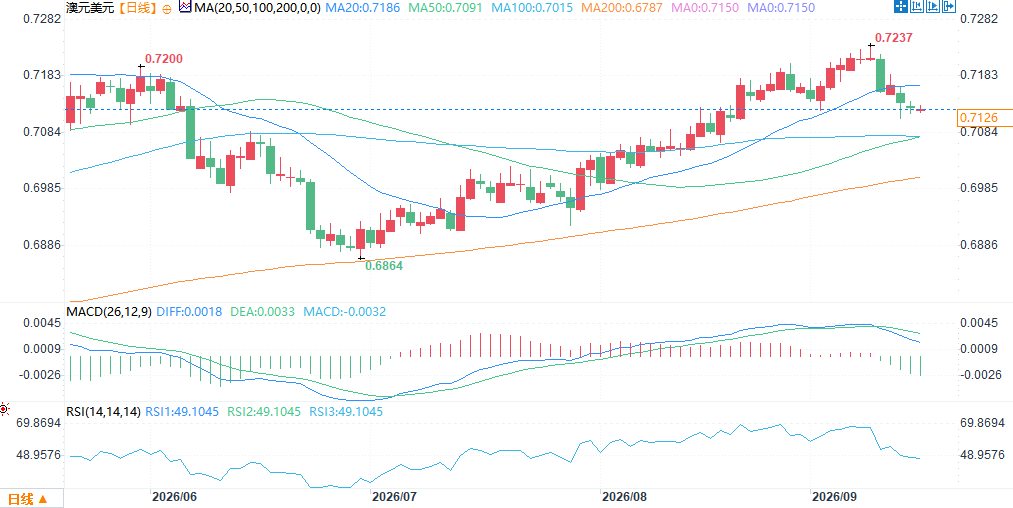 (Australian dollar to US dollar daily chart, source: EasyForex) At 10:58 Beijing time, the Australian dollar to US dollar exchange rate was 0.7126/27.
Leading indicator: Improved but not back to trend level
The latest leading indicators released by the Westpac Melbourne Institute show that the annualized six-month growth rate rose to -0.09% in August, a further improvement from -0.17% in July, continuing the recent slow recovery. Despite the positive changes, the reading remains significantly below the long-term trend level, indicating that Australian economic momentum has not yet fully returned to a sustainable expansionary trajectory. Historically, the current indicator has largely returned to the level of six months ago, only slightly lower than the -0.07% in February, showing a degree of stability. More importantly, the current below-trend performance is described as significantly mild, far better than the period of high cost of living pressures from 2022 to 2024—when the indicator averaged -0.46%, with lows approaching -1%. This contrast highlights the mildness of the current economic adjustment, rather than a sharp contraction. As a forward-looking tool, the leading indicator primarily captures signals of future economic activity. Its continued improvement helps alleviate market concerns about an economic slowdown, but it still reminds policymakers and investors that a full return to trend growth will take time, especially in an environment of high interest rates and external shocks.Improvements comprised of data center investment and residential approvals offsetting multiple drags.
Over the past six months, the composition of improvements in leading indicators has changed significantly, revealing structural divergence. The labor market, financial markets, commodity prices, and consumer confidence collectively dragged down the indicator's growth rate by 0.42 percentage points, reflecting multiple pressures from a cooling job market, asset price volatility, pressure on commodities, and weak household spending. In contrast, improvements in housing approvals contributed 0.32 percentage points, while stronger U.S. industrial production contributed an additional 0.08 percentage points, both offsetting the aforementioned drags. Of particular note is the increase in data center investment, which, along with the rebound in housing approvals, has provided some support and stabilized the overall reading. Westpac warns that this singular composition of improvement raises questions about its sustainability. Rising fuel prices and market concerns about further interest rate hikes appear to be suppressing consumer confidence again, while the sluggishness in the built-up housing market is also beginning to have an impact. Westpac further points out that these pressures could intensify in the short term and potentially spread to other components of the indicator, thereby weakening the current recovery. Overall, the coexistence of localized bright spots and widespread drags makes the indicator's improvement appear fragile and unbalanced.Reserve Bank of Australia: "Very hawkish, hold rates steady" in September, with another rate hike expected in October.
The Reserve Bank of Australia (RBA) has raised interest rates three times this year, with its core objective being to push inflation steadily back to the 2% to 3% target range. The market widely expects further tightening room. Westpac economists predict the RBA will implement another rate hike before the end of the year, but expect the September 28-29 meeting to remain on hold, primarily to await more comprehensive quarterly inflation data to be released on October 28. Westpac characterizes this possible decision as a "very hawkish hold," meaning that even if rates remain unchanged, the statement and forward guidance will maintain a hawkish stance, emphasizing inflation risks and the possibility of further action. Meanwhile, Westpac has raised its year-end annualized growth forecast from 1% to 1.5%, believing the relative resilience shown by the economy in the June quarter is likely to continue into the second half of 2026 and early 2027. While higher interest rates and the global energy shock are dragging down growth, domestic demand and support from some investment sectors provide a buffer. This assessment allows the RBA to retain policy flexibility, avoiding the risk of premature rate hikes while maintaining market expectations of tightening through a hawkish tone.Impact on the Australian Dollar: A Two-Sided Signal
The impact of this leading indicator report on the Australian dollar is clearly two-sided. On the one hand, the strengthening momentum and the resilience of the economy in the June quarter further support the Reserve Bank of Australia's (RBA) case for continuing to raise interest rates, which typically provides support for the Australian dollar in terms of interest rate differentials, enhancing its relative attractiveness. The market may interpret this data as a mildly positive signal of the central bank's hawkish stance, helping to stabilize or even boost the Australian dollar exchange rate to some extent. On the other hand, the report itself explicitly warns that the labor market, financial markets, commodity prices, and consumer confidence remain weak. If the current improvement cannot be sustained, there is a risk of disappointing the market, thus limiting the upside potential of the Australian dollar. As the RBA is not expected to act again before the inflation data release on October 28, this improvement in the leading indicator is unlikely to substantially change the recent interest rate expectation path. Overall, the data is more likely to be seen by the market as a neutral to positive confirmation rather than a significant factor enough to drive a substantial appreciation of the Australian dollar. In the short term, the exchange rate trend will still be mainly influenced by global risk appetite, commodity prices, and the Federal Reserve's policies. (Australian dollar to US dollar daily chart, source: EasyForex) At 10:58 Beijing time, the Australian dollar to US dollar exchange rate was 0.7126/27.
- Risk Warning and Disclaimer
- The market involves risk, and trading may not be suitable for all investors. This article is for reference only and does not constitute personal investment advice, nor does it take into account certain users’ specific investment objectives, financial situation, or other needs. Any investment decisions made based on this information are at your own risk.