Institutions: Gold price resilience reflects the risk of a power struggle between the Federal Reserve and the White House; the underlying logic for a long-term bullish outlook remains.
2026-09-16 12:04:09
Driven by persistent inflationary pressures, the market anticipates a Federal Reserve rate hike, causing US Treasury yields to rise to near 20-year highs, resulting in a sustained sell-off in the gold market. However, Commerzbank offers a different perspective, arguing that despite selling pressure, the market has strong support, making gold's resilience noteworthy. Thu Lan Nguyen, Head of Commodities Research at Commerzbank, analyzed in a recent research report that the market currently prices a 90% probability of a Fed rate hike this week. Furthermore, tensions in the Middle East are pushing up oil prices, thereby raising global interest rate expectations, affecting not only the US market. In this environment, the fact that gold prices have not fallen further is itself noteworthy. 
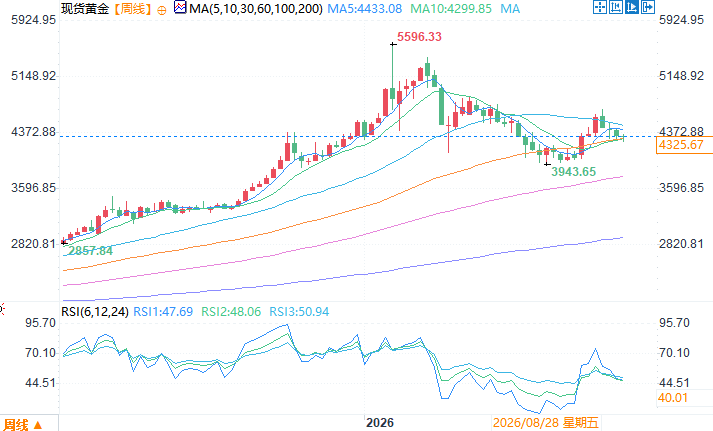 Spot gold weekly chart source: FX678. As of 12:01 PM Beijing time on September 16th, spot gold was trading at $4327.67 per ounce.
Gold prices defied the trend and resisted declines, reflecting the policy game between the Federal Reserve and the White House.
Ruan Qiulan stated that gold's relatively resilient performance reflects the market's hedging against the impending policy conflict between the Federal Reserve and the Trump administration. Nearly two years after his election victory, President Trump has actively lobbied the Fed to lower interest rates to boost the economy and has also launched investigations by the Department of Justice, attempting to replace members of the Monetary Policy Committee. She explained that at the beginning of the year, the market initially expected a significant Fed rate cut, pricing in two rate cuts within the year. However, after the conflict between the US and Israel and Iran, global energy supply was significantly impacted, and inflationary pressures rose again, causing a sharp reversal in market expectations. Ruan Qiulan stated that facing persistently high inflation, the pressure on the Fed to raise interest rates continues to increase, while President Trump has made strong statements , threatening extreme measures if the Fed refuses to cut rates. A direct conflict between the two sides is almost inevitable, and financial markets are increasingly incorporating this risk into their pricing. She added that the bank has long warned that strong political pressure from the White House could threaten the Fed's independence. The Fed's policy dilemma only becomes fully apparent when its policy objectives conflict with the US president's demands. She analyzed that this also explains why, despite US Treasury yields hitting near 20-year highs, the dollar remains under pressure, and the dollar risk premium continues to rise in the options market.Short-term gold price targets have been lowered, but the underlying logic for a long-term bullish outlook remains unchanged.
Gold itself does not generate interest income, and rising interest rates increase the opportunity cost of holding gold, putting downward pressure on gold prices. However, this German institution judges that the downside potential for gold prices is limited before the end of this year. Commerzbank lowered its gold price forecast in July, reducing its year-end gold price expectation from $4,800 per ounce in June to $4,500. Ruan Qiulan mentioned that the bank's long-term bullish view on gold remains unchanged, and the structural factors that drove gold prices higher in the first half of this year still exist. Uncertainty surrounding US policy has continued to weaken market confidence in the US dollar as a traditional safe-haven asset, continuously driving demand for physical gold. At the same time, the ever-expanding scale of government debt in developed economies has led to market concerns about the long-term safety of sovereign bonds. Gold, with its institutional neutrality and lack of default risk, further enhances its asset attractiveness.Conclusion
In summary, gold is currently in a unique phase of tug-of-war between bulls and bears. Rising US Treasury yields and expectations of a Fed rate hike are suppressing gold prices; conversely, political challenges to the Fed's independence, weakening of the dollar's safe-haven appeal, and global sovereign debt concerns provide underlying support for gold, which is key to its resilience against selling pressure. While Commerzbank's short-term downward revision of its gold price target serves as a warning against blindly chasing highs, the long-term structural positive factors remain intact. The subsequent Fed decision and the evolving policy tensions between the White House and the Fed will continue to dominate gold and dollar price movements. Spot gold weekly chart source: FX678. As of 12:01 PM Beijing time on September 16th, spot gold was trading at $4327.67 per ounce.
- Risk Warning and Disclaimer
- The market involves risk, and trading may not be suitable for all investors. This article is for reference only and does not constitute personal investment advice, nor does it take into account certain users’ specific investment objectives, financial situation, or other needs. Any investment decisions made based on this information are at your own risk.