The attack on Saudi oil pipelines has exhausted the oil market's buffer, and oil prices may surge again.
2026-09-16 13:44:11
The conflict with Iran, initially anticipated to be resolved by the US in about six weeks, has now entered its seventh month, and the oil market is beginning to show signs of pressure. The various buffers that existed in the market at the beginning of the Middle East conflict have been largely exhausted. The oversupply of oil seen in the first half of the year has disappeared; tanker traffic in the Strait of Hormuz was disrupted in March, leading to a rapid depletion of floating storage oil. The large-scale release of reserves led by the International Energy Agency has depleted the strategic oil reserves of developed countries, with the US strategic petroleum reserve now at its lowest level since the early 1980s. Major Asian countries proactively reduced their oil imports by 4 to 5 million barrels per day in May and June to suppress rising oil prices, but now that purchases are gradually recovering, this demand-adjusting mechanism that once stabilized the market has disappeared. Currently, the market has almost no surplus reserves, making it difficult to absorb the six-month-long disruption to oil flow through the Strait of Hormuz. Any further escalation of the conflict will threaten other oil transport routes.
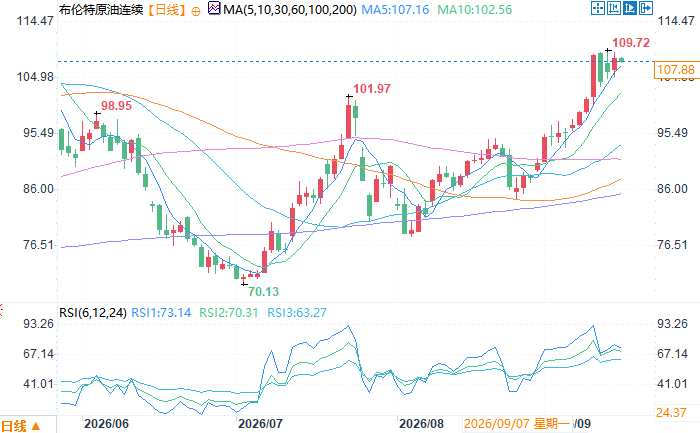 Brent crude oil daily chart source: EasyTrade. At 13:42 Beijing time on September 16th, Brent crude oil was trading at $107.96 per barrel.
The attack on Saudi Arabia's East-West oil pipeline has brought it to a standstill, posing a significant risk to Red Sea oil exports.
A new round of supply shocks has arrived. Saudi Arabia's vital East-West oil pipeline, which was designed to bypass the Strait of Hormuz and transport most of its crude oil to the Red Sea port of Yanbu, has been suspended following a drone attack last weekend, with the shutdown potentially lasting for weeks. This pipeline has enabled Saudi Arabia to shift most of its crude oil loading points from ports on the western Persian Gulf to Yanbu over the past six months. Now, with the pipeline out of service, approximately 4 million barrels of Saudi crude oil per day transported through Yanbu face significant risks. Saudi Arabia can rely on local storage in Yanbu to sustain exports for several days, but if the pipeline remains unrepaired for an extended period, Red Sea oil transportation will be severely impacted. The Houthi rebels in Yemen, with close ties to Iran, have continued to harass Saudi shipping, with tanker attacks occurring in July. Saudi oil buyers across Asia are urgently monitoring the situation. With market buffers largely exhausted, the oil market is pricing in the risk of another disruption to Middle Eastern oil supplies, and fuel markets across continents are showing signs of supply shortages.With the buffer in crude oil prices exhausted, energy executives warn of upside risks to oil prices.
Chevron CEO Mike Wirth stated on Friday (September 11th) that the buffer in the crude oil market has been exhausted, and oil prices may continue to rise in the coming months. He made these remarks at an energy conference at the University of Texas at Austin, as the average price of U.S. diesel broke through $6 per gallon for the first time in history, and a Saudi land pipeline had just been attacked by drones. He said, "It's hard to imagine oil prices falling quickly; the upside risks for oil prices dominate in the coming months." The International Energy Agency (IEA) disclosed in its September monthly report that global statistically available crude oil inventories fell by another 95 million barrels in August, bringing the cumulative destocking since February to 507 million barrels, an average daily reduction of 2.8 million barrels. Meanwhile, Middle Eastern shipping continued to be attacked, reducing the total amount of crude oil in floating storage at sea by 65 million barrels. Current oil prices have rebounded to their highest level since May, after the market's expectations for a rapid resolution to the conflict over the past six months have repeatedly failed to materialize. Helima Croft, Global Head of Commodities Strategy and Middle East Research at RBC Capital Markets, stated that even before the attack on Saudi Arabia's East-West pipeline, Saudi Red Sea crude oil exports had already fallen below 2 million barrels per day due to the Houthi threat and the escalating conflict between Saudi Arabia and the Houthis. She also mentioned that approximately 9 million barrels of crude oil supply per day in the Middle East is currently under substantial disruption. While the market has partially offset the supply gap through route adjustments and finding alternative sources, and with the help of covert shipping and US military escort, crude oil shipments through the Strait of Hormuz have recovered to more than half of pre-war levels. However, the longer the Middle East unrest continues, the weaker the market's buffer becomes. If the conflict escalates, oil prices will experience another surge. Currently, the crude oil market can only absorb the dramatic changes in the supply structure through shrinking demand, leading to a continued rise in war risk insurance premiums and tanker freight rates.Conclusion
Overall, the protracted geopolitical conflict in the Middle East has nearly exhausted the safety cushion of the crude oil market. Strategic reserves, floating storage at sea, and proactive demand reductions—measures that once suppressed oil prices—have all become ineffective. The attack on a key Saudi oil pipeline further amplifies supply-side uncertainty. The core contradiction in the crude oil market is no longer a short-term supply-demand mismatch, but rather a hard supply gap caused by persistent geopolitical disturbances. Any further developments in the Middle East could easily trigger a sharp rise in oil prices, causing a chain reaction of shocks to the global fuel and chemical supply chains. Brent crude oil daily chart source: EasyTrade. At 13:42 Beijing time on September 16th, Brent crude oil was trading at $107.96 per barrel.
- Risk Warning and Disclaimer
- The market involves risk, and trading may not be suitable for all investors. This article is for reference only and does not constitute personal investment advice, nor does it take into account certain users’ specific investment objectives, financial situation, or other needs. Any investment decisions made based on this information are at your own risk.