Soaring oil prices and rising US Treasury yields will cost American households an extra $1,760.
2026-09-17 11:04:10
The escalating conflict between the US and Iran has driven oil prices higher again, while the yield on 10-year US Treasury bonds has climbed to a near 19-year high. The combined pressure from rising oil prices and long-term bond yields is putting immense strain on ordinary American consumers, who are facing simultaneous increases in expenses such as fuel, mortgage payments, and car loan payments, leading to a continued tightening of household cash flow. Moody's analysis estimates that since the conflict began, the average American household has incurred an additional $1,760 in costs, highlighting the continued pressure on their livelihoods. 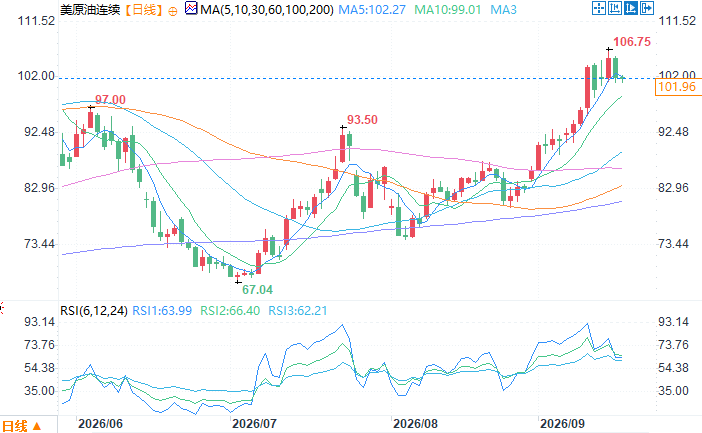 Chart: US Crude Oil Daily Chart Source: FX678 At 10:40 AM Beijing Time on September 17th, US crude oil was trading at $101.96 per barrel.
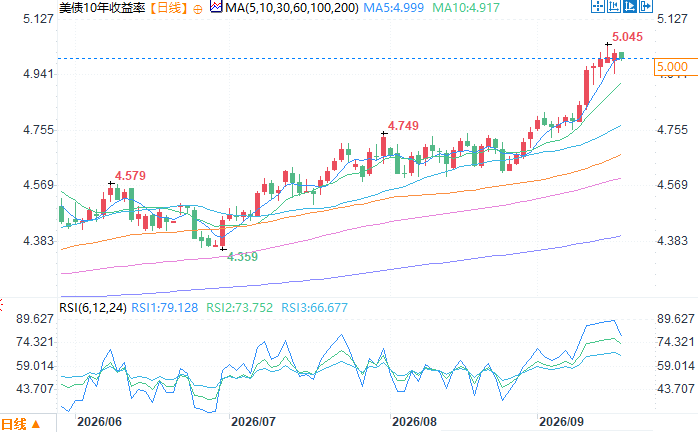 10-year US Treasury yield daily chart. Source: EasyTrade. Beijing time, September 17, 10:44 AM. The 10-year US Treasury yield is at 5%.
Chart: US Crude Oil Daily Chart Source: FX678 At 10:40 AM Beijing Time on September 17th, US crude oil was trading at $101.96 per barrel.Fuel prices continue to rise, and inflation is spreading throughout the entire industry chain.
Recent escalation of tensions between the US and Iran has driven oil prices rapidly upward. On Tuesday (September 15), US crude oil futures closed above $105 per barrel, reaching a new high since mid-May. Despite US Energy Secretary Chris Wright's statement that the impact of the closure of a Saudi oil pipeline would only last a few days, oil prices continued their strong upward trend. Data from the American Automobile Association (AAA) shows that the average price of gasoline in the US broke through $4.32 per gallon on Tuesday, up 6% week-on-week and 36% year-on-year; diesel prices recently hit a record high, breaking through $6 per gallon, with a year-on-year increase of nearly 70%. Diesel is a core fuel for the freight industry, and increased freight costs will ultimately be passed on to end-product prices such as food and daily necessities. Data from the University of Michigan Consumer Survey shows that among respondents in September, more than 29% mentioned the pressure from gasoline prices, far higher than the same period in 2024 and 2025. Deloitte research estimates that a 20% increase in crude oil prices will push up overall inflation by about 0.3 percentage points; if the effects of airfares, food, and other derivatives are added, the inflation increase will be even higher. Data from the U.S. Bureau of Labor Statistics shows that airfares surged 23% year-over-year in August due to the conflict, making it one of the fastest-rising categories in terms of inflation. Mark Zandi, chief economist at Moody's Analytics, stated, "Consumers are under tremendous financial pressure." Of the $1,760 in new household burdens, energy-related expenses accounted for $930, bringing the total additional energy expenditures by U.S. consumers to over $121 billion since the conflict began. 10-year US Treasury yield daily chart. Source: EasyTrade. Beijing time, September 17, 10:44 AM. The 10-year US Treasury yield is at 5%.Long-term bond yields hit multi-year highs, raising borrowing costs for residents across the board.
On Tuesday, the yield on the 10-year U.S. Treasury note rose to its highest level since 2007, a full percentage point higher than a year ago, a benchmark rate for mortgages and corporate financing. Bond investors are concerned that ongoing geopolitical conflicts will continue to push up inflation, while the ever-expanding U.S. federal debt continues to suppress Treasury prices and push up yields. The rise in yields directly increases the cost of large-scale consumer borrowing for residents ; this month, the 30-year fixed mortgage rate has climbed back above 7% for the first time in over a year. The Atlanta Fed's housing affordability index fell to a historic low this summer, significantly increasing the difficulty of buying a home. Diane Swonk, chief economist at KPMG Consulting, said, "People feel high interest rates very similarly to they feel inflation; the barriers to purchasing various goods have increased accordingly." Nicole Bachaud, a labor economist at ZipRecruiter, added that rising borrowing costs for businesses will slow hiring, and coupled with expectations of Fed rate hikes, the labor market is entering a weak equilibrium of low hiring and low layoffs. Data from the Federal Reserve Bank of New York shows that total U.S. credit card debt rose to $1.26 trillion in the second quarter, nearing its historical peak.Incomes are falling short of inflation, forcing people to deplete their savings to maintain consumption.
Moody's Analytics breaks down the additional $1,760 in expenses per household into three parts: $930 for energy costs, $425 for rising interest rates, and the remaining $405 for military spending. This latter cost will ultimately be borne by the entire population through increased national debt or tax increases. Economists point out that the increased spending due to rising energy prices has completely offset the benefits of the Trump administration's tax rebates. Lower-income groups, who allocate a higher proportion of their income to energy consumption, are more severely impacted , further widening the economic gap between income groups and creating a K-shaped recovery. Official data for August shows that inflation growth again outpaced wage growth, leading to a decline in real income after adjusting for inflation and a reduction in purchasing power. Luke Tilley, chief economist at M&T Bank and Wilmington Trust, stated that with slowing income growth and rising costs, people are forced to rely on savings to maintain daily consumption. The US personal savings rate is projected to fall to a level rarely seen since the financial crisis by 2026. Consumption is the primary engine of US economic growth; if residents are forced to reduce spending, the overall economy will face significant downward pressure. "With costs continuing to rise and revenue growth slowing, this situation is unsustainable and adjustments are inevitable," said Luke Tilley.Conclusion
The energy price surge triggered by the US-Iran conflict, coupled with rising US Treasury yields, has created dual inflationary and interest rate pressures, ultimately burdening ordinary American households with these costs. Rigid expenditures such as energy, housing, and transportation are rising simultaneously, while real wages are shrinking and savings are rapidly depleting, putting continued pressure on US consumer spending power. The Fed's interest rate hikes will further influence borrowing costs, and this pressure on people's livelihoods ignited by geopolitical conflict will continue to impact US inflation, employment, and the overall economic trend.- Risk Warning and Disclaimer
- The market involves risk, and trading may not be suitable for all investors. This article is for reference only and does not constitute personal investment advice, nor does it take into account certain users’ specific investment objectives, financial situation, or other needs. Any investment decisions made based on this information are at your own risk.