One chart: Capesize freight rates surged, while the Baltic Dry Index rose slightly.
2026-09-17 22:38:09
The latest data shows that on September 17, 2026, the Baltic Dry Index (BDI) stood at 3336 points, a 0.27% increase compared to the previous week, marking the largest increase since September 9, 2026. Looking at the short-term charts, the BDI has seen positive growth 5 times, negative growth 6 times, and zero growth 0 times in the last 11 BDI data points. Specifically, the Panamax Freight Index (BPI) was 2282 points, down 1.85% from the previous week; the Capesize Freight Index (BCI) was 5656 points, up 0.78%; and the Supramax Freight Index (BSI) was 1762 points, up 0.80%. For detailed charts of the latest 720-day and 10-year trends of the Baltic Dry Index and its three main sub-indices, please refer to the charts specially created by FX678. 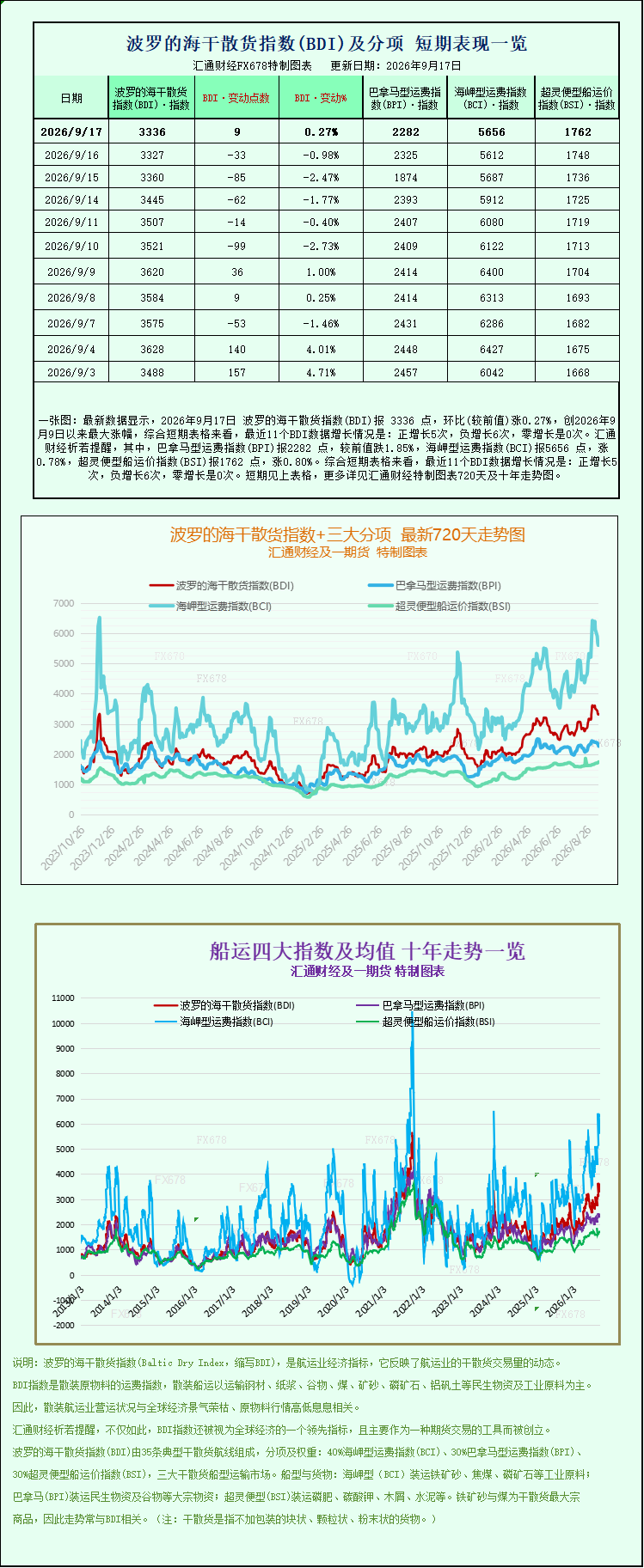 On Thursday, the international dry bulk shipping market exhibited a clear structural divergence. Supported by a strong rebound in Capesize (Good Hope) bulk carrier freight rates, the Baltic Dry Index (BDI) rose slightly, offsetting the drag from a decline in Panamax freight rates, highlighting the overall market resilience. The varying performance across different vessel types reflects the differentiated global demand for bulk raw materials by sea, and also reflects the phased changes in regional trade rhythms and end-user demand. Data shows that as of the close of trading on September 17, the Baltic Dry Index (BDI), which comprehensively reflects the global dry bulk shipping market's activity, rose 9 points, or 0.3%, to close at 3336 points. This index, which weights the freight rates of the three major bulk carrier types—Capesize, Panamax, and Supramax—is a core indicator of global commodity seaborne trade, directly reflecting the activity of global industrial, infrastructure, and agricultural trade. From the perspective of the logic behind this round of price increases, the rise in the index is entirely supported by the performance of large Capesize vessels, while the trends of medium and small vessel types are diverging, resulting in a very distinct structural characteristic of the overall market. As the vessel type with the highest weighting and greatest volatility in the BDI index, the Capesize market saw a significant recovery this week. Data shows that the Capesize Freight Index (BACI) surged 44 points in a single day, an increase of 0.8%, closing at 5656 points. The average daily earnings of a standard 150,000-tonnage Capesize vessel (mainly carrying ultra-large industrial raw materials such as iron ore and coal) also climbed, increasing by $396 in a single day, ultimately reaching $47,793 per day. Capesize vessels have large deadweight tonnage and are suitable for long-distance ocean transportation, mainly serving the transoceanic trade of basic industrial raw materials such as iron ore and coal. Their freight rate fluctuations are highly correlated with the global steel and energy industry boom and are also a core force determining the direction of the BDI index, accounting for nearly 40% of the weighting. The core driver of this round of strong Capesize freight rates comes from the release of pre-holiday restocking demand in the Chinese market. Recently, domestic steel companies have begun their pre-National Day holiday stockpiling cycle, significantly increasing their overseas iron ore sea freight purchases. This has led to a substantial increase in cargo volume on major iron ore routes from Brazil and Australia to China, releasing concentrated demand for ocean freight. Simultaneously, iron ore exports from the Atlantic region continue to strengthen, with Brazilian iron ore weekly shipments steadily increasing week-on-week. This has further boosted long-haul transportation demand for Capesize vessels, lengthening overall sea mileage and increasing ton-mile demand, providing strong support for freight rates. However, market risks remain. Currently, profits in the domestic steel industry continue to narrow, and the recovery in end-user demand from real estate and infrastructure is weak. Steel mill restocking is only a temporary pre-holiday operation, lacking sustained demand. This casts a shadow of uncertainty over future iron ore sea freight demand and Capesize vessel freight rate trends. In stark contrast to the strong performance of large Capesize vessels, the market for mainstream medium and large-sized Panamax vessels continues to weaken, becoming a major factor dragging down the overall market index. Data shows that the Panamax Freight Index (BPNI) fell 43 points, or 1.8%, to close at 2282 points, significantly underperforming the overall market. For Panamax bulk carriers of 60,000 to 70,000 tonnes, primarily carrying commodities such as coal and grain, the average daily earnings decreased by $392 to $20,535 per day. The decline in Panamax freight rates stems from dual pressures on both the supply and demand sides. On the demand side, the peak season for grain transportation in major global grain-producing regions has ended, the benefits of cross-regional grain shipping orders have faded, and agricultural-related shipping demand continues to cool. Simultaneously, global energy restructuring coupled with a slowdown in industrial recovery has limited the increase in shipping demand for coal for thermal power and industrial use, resulting in persistently low coal trade bookings. On the supply side, the current global Panamax spot capacity supply is relatively abundant, and competition on routes is fierce. Against the backdrop of weak demand, freight rates have naturally fallen, continuing the recent downward trend. The market for small and medium-sized bulk carriers saw a slight recovery, offsetting some of the downward pressure on Panamax vessels. Data shows that the Supramax Freight Index (BSIS) rose 14 points, or 0.8%, to close at 1762 points. This vessel type is smaller and more flexible, primarily carrying small and medium-sized bulk commodities such as steel, fertilizer, and cement. It is suitable for short-haul, regional maritime trade and is less affected by fluctuations in the global bulk commodity market, exhibiting relatively stable performance. Recently, the steady release of regional infrastructure materials and agricultural supplies demand by sea has supported a slight increase in freight rates for smaller vessels, maintaining a structurally positive trend in this segmented market. Overall, the global dry bulk shipping market has entered a typical stage of structural differentiation, with a clear divergence in market performance between large and small vessel types. Large Capesize vessels rebounded strongly due to the temporary boost from pre-holiday iron ore restocking in China, but the sustainability of this demand remains questionable. Panamax vessels continued to weaken due to the off-season demand for coal and grain. Supramax vessels maintained a stable trend thanks to their flexible transportation advantages. Market analysts say the future trend of the Baltic Dry Index (BDI) will be highly dependent on the pace of demand recovery in China's steel industry and the export situation of overseas commodities. In the short term, pre-holiday restocking in China is expected to continue, potentially supporting high Capesize freight rates and driving the index higher. However, post-holiday restocking demand from steel mills and weak steel profits may become more prominent, coupled with continued weak demand for Panamax vessels, limiting the overall upside potential of the market. A volatile and divergent market pattern is likely to persist in the near future.
On Thursday, the international dry bulk shipping market exhibited a clear structural divergence. Supported by a strong rebound in Capesize (Good Hope) bulk carrier freight rates, the Baltic Dry Index (BDI) rose slightly, offsetting the drag from a decline in Panamax freight rates, highlighting the overall market resilience. The varying performance across different vessel types reflects the differentiated global demand for bulk raw materials by sea, and also reflects the phased changes in regional trade rhythms and end-user demand. Data shows that as of the close of trading on September 17, the Baltic Dry Index (BDI), which comprehensively reflects the global dry bulk shipping market's activity, rose 9 points, or 0.3%, to close at 3336 points. This index, which weights the freight rates of the three major bulk carrier types—Capesize, Panamax, and Supramax—is a core indicator of global commodity seaborne trade, directly reflecting the activity of global industrial, infrastructure, and agricultural trade. From the perspective of the logic behind this round of price increases, the rise in the index is entirely supported by the performance of large Capesize vessels, while the trends of medium and small vessel types are diverging, resulting in a very distinct structural characteristic of the overall market. As the vessel type with the highest weighting and greatest volatility in the BDI index, the Capesize market saw a significant recovery this week. Data shows that the Capesize Freight Index (BACI) surged 44 points in a single day, an increase of 0.8%, closing at 5656 points. The average daily earnings of a standard 150,000-tonnage Capesize vessel (mainly carrying ultra-large industrial raw materials such as iron ore and coal) also climbed, increasing by $396 in a single day, ultimately reaching $47,793 per day. Capesize vessels have large deadweight tonnage and are suitable for long-distance ocean transportation, mainly serving the transoceanic trade of basic industrial raw materials such as iron ore and coal. Their freight rate fluctuations are highly correlated with the global steel and energy industry boom and are also a core force determining the direction of the BDI index, accounting for nearly 40% of the weighting. The core driver of this round of strong Capesize freight rates comes from the release of pre-holiday restocking demand in the Chinese market. Recently, domestic steel companies have begun their pre-National Day holiday stockpiling cycle, significantly increasing their overseas iron ore sea freight purchases. This has led to a substantial increase in cargo volume on major iron ore routes from Brazil and Australia to China, releasing concentrated demand for ocean freight. Simultaneously, iron ore exports from the Atlantic region continue to strengthen, with Brazilian iron ore weekly shipments steadily increasing week-on-week. This has further boosted long-haul transportation demand for Capesize vessels, lengthening overall sea mileage and increasing ton-mile demand, providing strong support for freight rates. However, market risks remain. Currently, profits in the domestic steel industry continue to narrow, and the recovery in end-user demand from real estate and infrastructure is weak. Steel mill restocking is only a temporary pre-holiday operation, lacking sustained demand. This casts a shadow of uncertainty over future iron ore sea freight demand and Capesize vessel freight rate trends. In stark contrast to the strong performance of large Capesize vessels, the market for mainstream medium and large-sized Panamax vessels continues to weaken, becoming a major factor dragging down the overall market index. Data shows that the Panamax Freight Index (BPNI) fell 43 points, or 1.8%, to close at 2282 points, significantly underperforming the overall market. For Panamax bulk carriers of 60,000 to 70,000 tonnes, primarily carrying commodities such as coal and grain, the average daily earnings decreased by $392 to $20,535 per day. The decline in Panamax freight rates stems from dual pressures on both the supply and demand sides. On the demand side, the peak season for grain transportation in major global grain-producing regions has ended, the benefits of cross-regional grain shipping orders have faded, and agricultural-related shipping demand continues to cool. Simultaneously, global energy restructuring coupled with a slowdown in industrial recovery has limited the increase in shipping demand for coal for thermal power and industrial use, resulting in persistently low coal trade bookings. On the supply side, the current global Panamax spot capacity supply is relatively abundant, and competition on routes is fierce. Against the backdrop of weak demand, freight rates have naturally fallen, continuing the recent downward trend. The market for small and medium-sized bulk carriers saw a slight recovery, offsetting some of the downward pressure on Panamax vessels. Data shows that the Supramax Freight Index (BSIS) rose 14 points, or 0.8%, to close at 1762 points. This vessel type is smaller and more flexible, primarily carrying small and medium-sized bulk commodities such as steel, fertilizer, and cement. It is suitable for short-haul, regional maritime trade and is less affected by fluctuations in the global bulk commodity market, exhibiting relatively stable performance. Recently, the steady release of regional infrastructure materials and agricultural supplies demand by sea has supported a slight increase in freight rates for smaller vessels, maintaining a structurally positive trend in this segmented market. Overall, the global dry bulk shipping market has entered a typical stage of structural differentiation, with a clear divergence in market performance between large and small vessel types. Large Capesize vessels rebounded strongly due to the temporary boost from pre-holiday iron ore restocking in China, but the sustainability of this demand remains questionable. Panamax vessels continued to weaken due to the off-season demand for coal and grain. Supramax vessels maintained a stable trend thanks to their flexible transportation advantages. Market analysts say the future trend of the Baltic Dry Index (BDI) will be highly dependent on the pace of demand recovery in China's steel industry and the export situation of overseas commodities. In the short term, pre-holiday restocking in China is expected to continue, potentially supporting high Capesize freight rates and driving the index higher. However, post-holiday restocking demand from steel mills and weak steel profits may become more prominent, coupled with continued weak demand for Panamax vessels, limiting the overall upside potential of the market. A volatile and divergent market pattern is likely to persist in the near future.
- Risk Warning and Disclaimer
- The market involves risk, and trading may not be suitable for all investors. This article is for reference only and does not constitute personal investment advice, nor does it take into account certain users’ specific investment objectives, financial situation, or other needs. Any investment decisions made based on this information are at your own risk.