Why is Goldman Sachs stubbornly holding onto its $5,400 gold target after the Fed's hawkish rate hike?
2026-09-18 10:50:11
On Friday (September 18) during the Asian session, spot gold continued its gains from the previous day, currently trading around $4354 per ounce. Gold prices have held firm at high levels after the Fed's rate hike, driven by institutional investors' continued adherence to medium- to long-term growth strategies. Goldman Sachs maintained its year-end 2027 gold price forecast at $5400 per ounce, believing that the Fed's rate hikes will slow rather than reverse the upward trend. Although the expectation of one more rate hike this year from 16 Fed policymakers poses a near-term headwind, Goldman Sachs believes this pressure is manageable within its bullish argument, supported by central bank gold purchases and Middle East risks. 
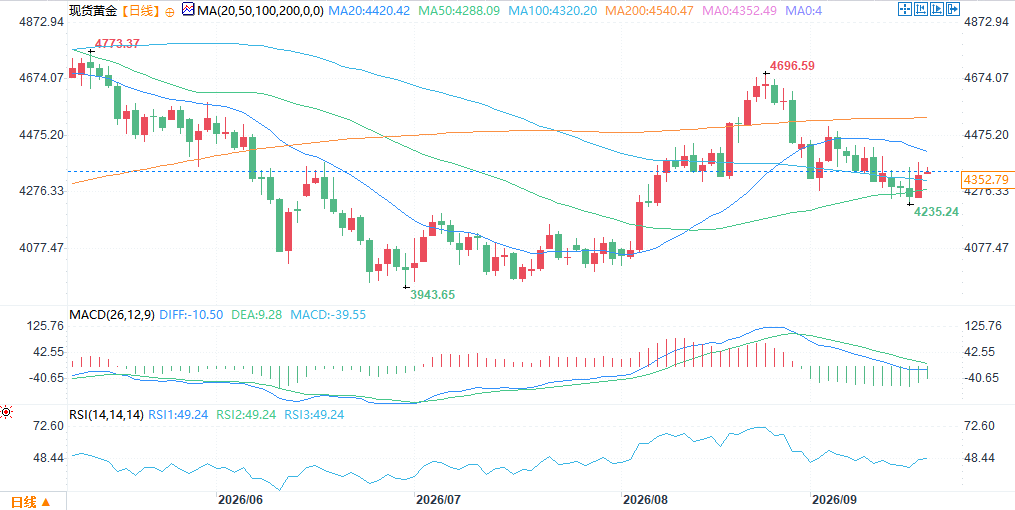 (Spot gold daily chart, source: EasyTrade) At 10:48 Beijing time, spot gold was trading at $4354.53 per ounce.
Goldman Sachs' core assessment: Maintains $5,400 forecast; interest rate hikes will slow, not derail.
Goldman Sachs maintained its year-end 2027 gold price forecast at $5,400 per ounce, despite the Federal Reserve's interest rate hike this week. The bank explicitly stated that a tighter monetary policy environment may slow the pace of gold's rise to some extent, but will not fundamentally deviate it from its long-term upward trajectory. This judgment is made against a backdrop that typically puts significant pressure on gold: higher interest rates increase the attractiveness of interest-bearing assets such as government bonds, potentially suppressing investor demand for non-interest-bearing metals, even though gold is traditionally considered an important inflation hedge. Goldman Sachs believes that the headwinds from the current rate hike cycle are manageable and will not change its core bullish logic. The bank emphasized that the long-term drivers of gold—including continued global central bank gold purchases, geopolitical uncertainty, and concerns about the creditworthiness of currencies in some regions—remain robust enough to offset the short-term pressure from rising interest rates, thus maintaining its original forecast target.Gold's performance on Friday: A weaker dollar and lower oil prices provided support.
Gold rose slightly on Friday, trading around $4,350 an ounce, mainly supported by falling oil prices and a weaker dollar. US crude oil futures were down about 0.6%, while the dollar index retreated from recent highs and remained relatively weak. This combination made dollar-denominated gold relatively cheaper for investors holding other currencies, providing a mild upward tailwind for gold prices. It's worth noting that this move occurred just two days after the Federal Reserve raised interest rates on Wednesday and signaled the possibility of further rate hikes in the coming months; there was no significant safe-haven selling or substantial pressure on interest rate-sensitive assets. Traders generally interpreted the weaker dollar and lower oil prices as short-term positives, allowing gold to rebound slightly in relatively calm trading, demonstrating its resilience in a complex macroeconomic environment.Federal Reserve Signals: 16 Policymakers Expect at Least One More Rate Hike This Year
The Federal Reserve's updated quarterly economic projections summary showed that 16 of the 18 policymakers expect at least one more 25-basis-point rate hike by the end of the year. This clearly hawkish signal quickly refocused market attention on real yields and the dollar's trajectory, becoming the most closely watched variable for gold traders recently. Despite the tightening interest rate outlook, market participants remain highly focused on developments in the Middle East and the diverging monetary policy paths of major central banks globally. Persistent geopolitical risks provide significant offsetting support for gold, even as the interest rate environment is no longer as accommodative as before. Analysts point out that while the hawkish signal exerts short-term pressure on gold prices, it has not completely eliminated safe-haven demand, and gold remains relatively resilient in the interplay between interest rates and risk premiums.Logical Breakdown: Why Goldman Sachs Maintains a Bullish Outlook
Goldman Sachs maintains its long-term bullish forecast, indicating that it views the Federal Reserve's tightening path more as a headwind slowing gold's rise than a decisive factor reversing the overall upward trend. This view contradicts conventional logic to some extent: higher interest rates typically suppress demand for non-interest-bearing gold by increasing the relative attractiveness of interest-bearing assets. However, Goldman Sachs' unwavering long-term objective means that it believes this interest rate pressure is manageable within its broader bullish framework, with core support stemming from continued large-scale gold purchases by global central banks and the ongoing geopolitical risks in the Middle East and elsewhere. Looking at the near-term path, 16 policymakers anticipate one more rate hike this year, and real yields may continue to pose a real headwind in the short term. However, Goldman Sachs judges that these short-term fluctuations are insufficient to shake the long-term allocation logic of gold as a strategic asset, and therefore chooses to maintain its original forecast.Summary: Short-term headwinds coexist with long-term support; the $5400 forecast remains unchanged.
In summary, Goldman Sachs maintains its $5,400 gold forecast, believing that the pace of interest rate hikes is slowing rather than a derailed rally. Gold rose slightly on Friday, supported by a weaker dollar and lower oil prices. The 16 Federal Reserve policymakers expect at least one more rate hike this year, with real yields and the dollar providing recent headwinds. However, continued central bank gold purchases and Middle East geopolitical risks are providing offsetting support. Goldman Sachs' unchanged long-term forecast suggests that the bank believes tightening pressures are manageable within its bullish argument. Going forward, attention should be paid to the timing of the second rate hike this year, the path of real yields and the dollar, the evolution of the Middle East situation, and whether central bank gold purchases can continue to provide structural support for gold. (Spot gold daily chart, source: EasyTrade) At 10:48 Beijing time, spot gold was trading at $4354.53 per ounce.
- Risk Warning and Disclaimer
- The market involves risk, and trading may not be suitable for all investors. This article is for reference only and does not constitute personal investment advice, nor does it take into account certain users’ specific investment objectives, financial situation, or other needs. Any investment decisions made based on this information are at your own risk.