With a 175 basis point interest rate differential between the US and Canada and mutual tariffs imposed, where is the bottom for the Canadian dollar's current decline?
2026-09-18 11:04:10
The USD/CAD pair traded in a narrow range below the psychological level of 1.4000 in Asian trading on Friday (September 18), the highest level since August 7, reached earlier this week. Nevertheless, the spot price is still on track for a second consecutive weekly gain, extending its more than week-long upward trend against a backdrop of supporting fundamentals. The consolidation below 1.4000 suggests that bulls are taking a wait-and-see approach before this key psychological level, but the overall upward trend remains intact. 
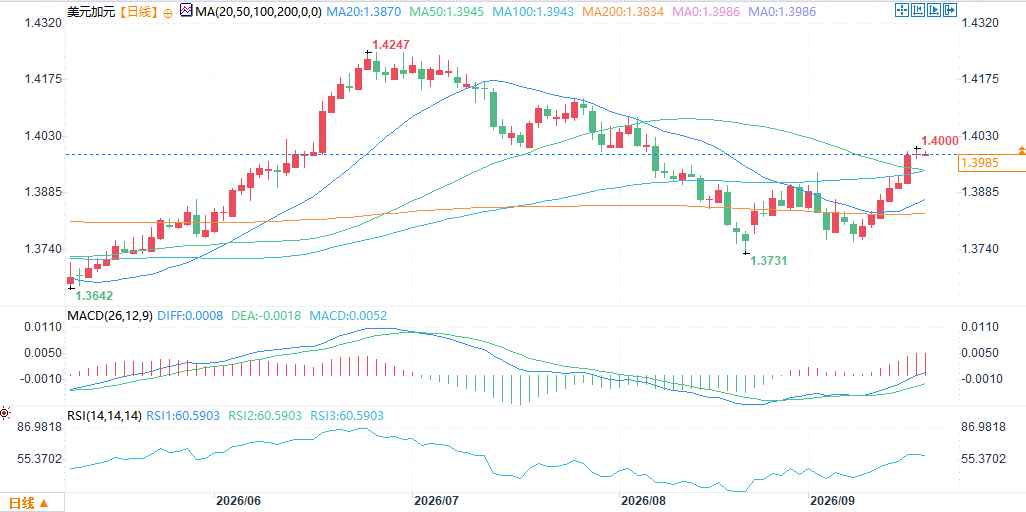 (USD/CAD daily chart, source: EasyForex) At 11:02 Beijing time, USD/CAD was trading at 1.3984/85.
USD/CAD interest rate differential: 175 basis points, the core driver of the Canadian dollar's weakness.
The recent strength of the USD/CAD pair is primarily due to the widening interest rate differential between the US and Canada. Earlier this month, the Bank of Canada decided to keep its policy rate unchanged at 2.25%, while the Federal Reserve raised rates by 25 basis points to 3.75%-4.00% on Wednesday, its first rate hike in over three years. Strategists at prominent institutions point out that the US-Canada policy rate differential has thus widened again to approximately 175 basis points, a level largely consistent with the situation for most of last year. They believe that the significant widening of the front-end interest rate differential has directly weakened the Canadian dollar's attractiveness, becoming a major driver of its weakness and underperformance compared to other currencies. However, since the US-Canada interest rate differential is unlikely to narrow effectively in the short term, the Canadian dollar lacks sufficient interest rate support to drive a meaningful recovery. The market generally expects the Canadian dollar to remain under pressure, and the upside risk for the USD/CAD pair remains dominant.Trade tensions: US and Canada impose tariffs on each other, offsetting support for oil prices.
Trade tensions between the US and Canada have become another significant drag on the Canadian dollar. On August 22, the US imposed a 50% tariff on approximately $20 billion worth of Canadian goods, while Canada retaliated on September 8 with tariffs ranging from 15% to 50% on approximately $20 billion worth of US goods. This tit-for-tat action quickly escalated bilateral tensions. This tariff confrontation directly offset the potential support from the recent surge in oil prices, failing to effectively alleviate bearish sentiment towards the commodity-related Canadian dollar. As a typical commodity currency, the Canadian dollar traditionally benefits from rising oil prices, but current trade tensions have temporarily disrupted this linkage. Investors are reassessing Canada's export prospects and economic growth risks, making it difficult for the Canadian dollar to gain sufficient support from the recovery in energy prices. Instead, it is further pressured by trade uncertainty, leading to increased safe-haven demand for the Canadian dollar.US Dollar and the Federal Reserve: Hawkish outlook supports the dollar, but falling yields limit gains.
Federal Reserve Chairman Warsh's continued focus on inflation has, to some extent, quelled selling pressure in the fixed-income market, pushing US Treasury yields down from multi-year highs. This shift has put the US dollar on the defensive overall, creating a short-term headwind for the USD/CAD exchange rate. However, the Fed's hawkish outlook—expecting at least one more rate hike this year—coupled with ongoing geopolitical uncertainty, continues to provide a significant tailwind for the safe-haven dollar, thus benefiting long positions in USD/CAD. Currently, the dollar faces a tug-of-war between two forces: downward pressure from falling yields and support from hawkish policy expectations and geopolitical risks. This mixed situation has caused USD/CAD to consolidate below the 1.4000 level, with little chance of a unilateral breakout in the short term. Traders need to closely monitor subsequent economic data and central bank communications to determine the direction. (USD/CAD daily chart, source: EasyForex) At 11:02 Beijing time, USD/CAD was trading at 1.3984/85.
- Risk Warning and Disclaimer
- The market involves risk, and trading may not be suitable for all investors. This article is for reference only and does not constitute personal investment advice, nor does it take into account certain users’ specific investment objectives, financial situation, or other needs. Any investment decisions made based on this information are at your own risk.