The dollar rose to 157 against the yen, but leveraged funds bet on a stronger yen.
2026-09-21 08:08:10
On Monday (September 21), the USD/JPY pair continued its upward trend in Asian trading, currently trading around 157. However, while the USD/JPY pair continued its rise, positioning data revealed a potentially alarming contrarian signal. Leveraged funds have turned net long on the yen for the first time since July 2025, holding approximately 250 billion yen in bullish bets, according to CFTC data. This shift occurred prior to interest rate hikes by the Federal Reserve and the Bank of Japan, and before the yen fell by more than 1% to around 158 last Friday. 
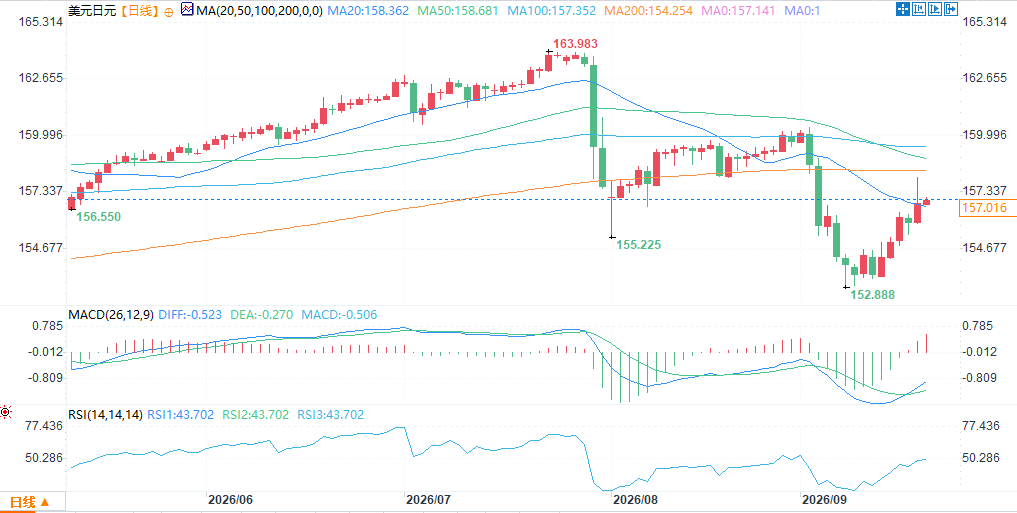 (USD/JPY daily chart, source: EasyForex) At 8:01 Beijing time, USD/JPY was trading at 157.00/01.
Key data: Leveraged funds turned to a net long position of approximately 20,000 contracts, and asset managers increased their positions to approximately 55,000.
Hedge funds have turned bullish on the yen for the first time since July 2025, a shift particularly noteworthy following weeks of market intervention by US and Japanese authorities to support the yen. Leveraged traders completely wiped out their previous bearish bets on the yen in the week ending September 15 and began building bullish positions. These funds currently hold approximately 250 billion yen (about $1.6 billion) in bets on a stronger yen. The shift is substantial: leveraged funds quickly went from a net short of about 53,000 contracts a week ago to a net long of about 20,000 contracts, meaning a net position change of over 73,000 contracts, indicating a sharp reversal in market sentiment. Simultaneously, another important group tracked in the report—asset managers—also significantly increased their yen long positions. They increased their net long positions by about 54,000 contracts, bringing their total net long positions to about 55,000 contracts. This synchronized increase suggests that not only are more speculative leveraged funds adjusting their direction, but relatively conservative asset management institutions are also becoming more optimistic about the yen's prospects. CFTC (Commodity Futures Trading Commission) data provides an important window into how hedge funds and asset managers allocate positions in the currency derivatives market. However, it's important to note that this data is only a weekly snapshot, typically lagging behind actual trading events by several days, thus reflecting market conditions prior to policy announcements. The shifts in leveraged funds are particularly noteworthy, as they tend to be more sensitive to short-term interest rate differentials, policy expectations, and intervention signals. This recent establishment of net long positions may stem from expectations of further tightening by the Bank of Japan or a narrowing of the USD/JPY interest rate differential. Overall, the strength of yen long positions has significantly increased in the derivatives market, laying a crucial foundation for subsequent exchange rate volatility. If subsequent price movements contradict these positions, these newly established positions could amplify market volatility.The timing was awkward: the data was up to September 15th, after which both the Federal Reserve and the Bank of Japan raised interest rates.
This timing is rather awkward for newly established yen long positions. CFTC positioning data is current as of last Tuesday, just before the Federal Reserve and the Bank of Japan announced their interest rate hike decisions last week. The signals given by Japanese policymakers in their decisions disappointed some market participants who hoped to see the central bank continue raising rates and provide clearer forward guidance. The yen fell more than 1% on Friday before paring some losses in late New York trading, eventually hovering around 157. Meanwhile, the dollar recorded its biggest weekly gain in three months last week, further exacerbating the pressure on the yen. The newly established yen long positions were established before a week of unfavorable market conditions. This means that if the yen continues to weaken, these long positions may face a squeeze risk. Leveraged funds quickly reversed from a large net short to a net long position, a significant adjustment in their positions. If prices move against expectations, stop-loss orders or forced liquidations could accelerate the yen's decline. While asset managers also increased their positions considerably, their holding style is typically more long-term, limiting the impact of short-term volatility, but overall market sentiment may still be affected. Furthermore, the strengthening of the US dollar following the Fed's rate hike further widened the USD/JPY interest rate differential, directly contradicting the "narrowing interest rate differential" logic relied upon by yen bulls. Therefore, the actual market performance after the data release made the previously optimistic position adjustments appear ill-timed. Market participants need to closely monitor whether the yen will experience further pullback due to crowded positions, and whether policy communication can revitalize bullish sentiment in the coming weeks. In the current environment, position squeeze has become a significant risk factor in the near term.Warning Signs of Intervention: The Bank of Japan conducted a currency check last Friday.
Reports indicate that the Bank of Japan (BOJ) inquired about exchange rate levels with market participants last Friday, a procedure commonly referred to as a "currency check." Historically, this step has often been seen as a precursor to potential official intervention in the exchange rate. While this report has not yet been officially confirmed by the BOJ, it quickly attracted market attention. A currency check itself is not equivalent to direct intervention, but it conveys the authorities' high sensitivity to the current exchange rate level and their willingness to act if necessary. This signal, coupled with the backdrop of thin market liquidity during the Silver Week holiday, further fueled speculation about intervention. In times of low liquidity, any official action can generate a larger price shock. It is worth noting that the current market structure differs from previous interventions—leveraged funds have just turned net long on the yen. If the authorities intervene to support the yen at this time, it could resonate with existing long positions, amplifying the yen's rebound. Conversely, if some funds delay intervention and the yen continues to weaken, newly established long positions may be forced to adjust. Historically, Japanese authorities have often assessed market reactions after currency checks before deciding whether to actually intervene. This particular check occurred after the BOJ and US Federal Reserve decisions, and at a time when the yen had experienced a significant decline; the timing itself carries policy implications. The market is therefore on high alert: on the one hand, it is watching whether the intervention will actually be implemented, and on the other hand, it is assessing the potential amplifying effect of existing net long positions after the intervention takes effect. Any official action will now fall on a market where positions are already biased towards the yen, which could make the rebound more rapid, while also increasing the uncertainty of subsequent volatility.Japanese Yen Weekly Outlook
The yen is highly likely to experience sharp fluctuations and weaken further in the coming week. Japan is about to have a three-day holiday, which will reduce market liquidity; meanwhile, the Bank of Japan's lack of clear guidance on the pace of future interest rate hikes has disappointed investors. On Monday, the yen stabilized around 157 yen to the dollar, after falling as much as 1.3% on Friday when two Bank of Japan board members opposed a rate hike. Subsequent reports indicated that officials contacted market participants to conduct exchange rate checks, a precursor to potential market intervention and yen buying, but this news only slightly narrowed the yen's decline. Last week, the yen depreciated by more than 2%, marking its largest weekly drop in nearly a year. James Reilly, senior market economist at Capital Economics, wrote in a report that, similar to the recent pattern of the yen's strong rise before central bank meetings, the Bank of Japan has completely curbed its momentum this time; a significant improvement in the yen's performance against the dollar will likely depend on factors in the United States. The news of these exchange rate checks also highlights the possibility that Japanese authorities may intervene again to prevent further yen weakness. Intervention could lead to rapid and sharp exchange rate fluctuations, causing losses for traders. Japan's holiday, which lasts until Wednesday, could lead to insufficient market liquidity. If the government intervenes, the effect of the intervention will be amplified. A similar situation occurred during the Golden Week holiday in late April and early May this year, when Japan intervened in the foreign exchange market after the yen fell below the 160 mark. (USD/JPY daily chart, source: EasyForex) At 8:01 Beijing time, USD/JPY was trading at 157.00/01.
- Risk Warning and Disclaimer
- The market involves risk, and trading may not be suitable for all investors. This article is for reference only and does not constitute personal investment advice, nor does it take into account certain users’ specific investment objectives, financial situation, or other needs. Any investment decisions made based on this information are at your own risk.