With attacks reaching the Saudi capital, will oil prices resume their upward trend?
2026-09-21 08:42:10
Brent crude futures opened slightly higher in Asian trading on Monday (September 21), rising as high as $103.56 per barrel before trading around $103 per barrel, essentially unchanged for the day. Traders weighed the Houthi ballistic missile attack on Riyadh, which was intercepted by Saudi air defenses. 
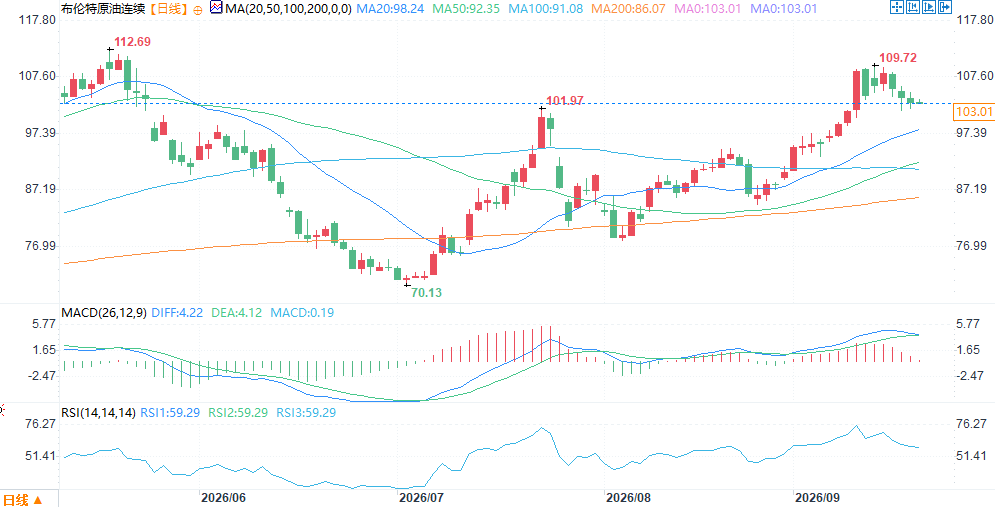 (Brent crude oil futures daily chart, source: EasyTrade) At 8:39 Beijing time, Brent crude oil futures were trading at $102.63 per barrel.
Event: Houthi rebels launch ballistic missile attack on Riyadh; smoke appears near the airport.
Saudi Arabia's Civil Defense issued a nighttime telephone alert on Saturday, warning of potential airstrikes on Riyadh and Al-Kharj, east of the capital. Saudi air defenses intercepted missiles launched towards the capital at dawn, and the Saudi-led coalition later confirmed that rebels attempted to strike the capital with ballistic missiles. Residents reported at least one explosion, and footage showed a plume of black smoke in front of the main terminal at King Khalid International Airport. Flights at the airport were severely disrupted. No casualties or damage were reported, although earlier media reports cited three officials as saying the airstrikes targeted jet fuel facilities at the airport. The Houthis claimed responsibility for the missile and drone attacks on "sensitive" locations in Riyadh and claimed to have also attacked Saudi Aramco facilities in the Red Sea city of Yanbu. Targets in Riyadh were unidentified, and Yanbu stated that it was not confirmed in the reviewed reports. This is the first time Riyadh has been targeted since the latest Saudi-Houthi escalation opened another front in the broader conflict with Iran. The Houthis have been attacking Saudi Arabia since declaring a naval blockade of Riyadh in July. Washington has signaled no intention to join the offensive strikes against the rebels.Market Interpretation: Risk Premium Reconstruction, Yanbu Claims Even Greater Impact if Confirmed
The higher opening price aligns with the market rebuilding its risk premium on Saudi supply following the series of attacks. Even without reported damage, the smoke near the capital's airport altered the perceived boundaries of the conflict. If the Yanbu attack is confirmed, its impact on traffic flow will be greater than the Riyadh incident, as Yanbu points to an alternative route to the Saudi Red Sea exit – the Gulf route. Washington's signal against launching an offensive strike has two sides: it reduces the probability of a broader escalation, but leaves the Houthis' actions against Saudi Arabia unchecked in the short term.Background: Pipeline attack, Hormuz blockade, and six-month high shipment levels
This comes against the backdrop of a drone strike linked to the conflict with Iran that shut down a Saudi pipeline bypassing the Strait of Hormuz, while Iran maintains the strait's closure. Meanwhile, U.S. Central Command stated on Saturday that shipments via Hormuz have reached a six-month high, with Saudi forces intercepting missiles, limiting immediate supply impact. The U.S. military cited mine clearance operations as the reason for the six-month high in Hormuz oil and LNG shipments. This combination creates a tug-of-war between the rebuilding of risk premiums in oil prices and actual improvements in supply.Follow-up attention: Whether the attacks will be repeated, whether Yanbu's claims have been confirmed, and whether Washington's position has changed.
Key signals to watch are: whether attacks on Saudi targets will be repeated, whether Yanbu's claims will be confirmed, and whether Washington's stance on the Houthis has changed. A calm Monday would indicate a decline in the premium, while further attacks near Saudi energy assets would support its continuation. For traders, the key is not whether losses have occurred (no reports have been made yet), but rather the proximity of the attacks: attacks have reached the Saudi capital, and coupled with claims against Saudi Aramco facilities, the market is forced to question whether Saudi energy infrastructure and export routes will become the next targets. (Brent crude oil futures daily chart, source: EasyTrade) At 8:39 Beijing time, Brent crude oil futures were trading at $102.63 per barrel.
- Risk Warning and Disclaimer
- The market involves risk, and trading may not be suitable for all investors. This article is for reference only and does not constitute personal investment advice, nor does it take into account certain users’ specific investment objectives, financial situation, or other needs. Any investment decisions made based on this information are at your own risk.