One chart: Baltic Dry Index rises across the board, with freight rates for all vessel types strengthening in tandem.
2026-09-21 22:52:11
Latest data shows that on September 21, 2026, the Baltic Dry Index (BDI) reached 3399 points, a five-day high, up 0.86% month-on-month (compared to the previous value), marking the third consecutive day of increase (including zero growth). Looking at the short-term charts, the recent 11 BDI data points show: 5 positive increases, 6 negative increases, and 0 zero increases. Specifically, the Panamax Freight Index (BPI) was 2255 points, up 0.18% from the previous value; the Capesize Freight Index (BCI) was 5839 points, up 1.23%; and the Supramax Freight Index (BSI) was 1771 points, up 0.23%. For detailed 720-day and 10-year trend charts of the Baltic Dry Index and its three main sub-indices, please refer to the charts specially created by FX678. 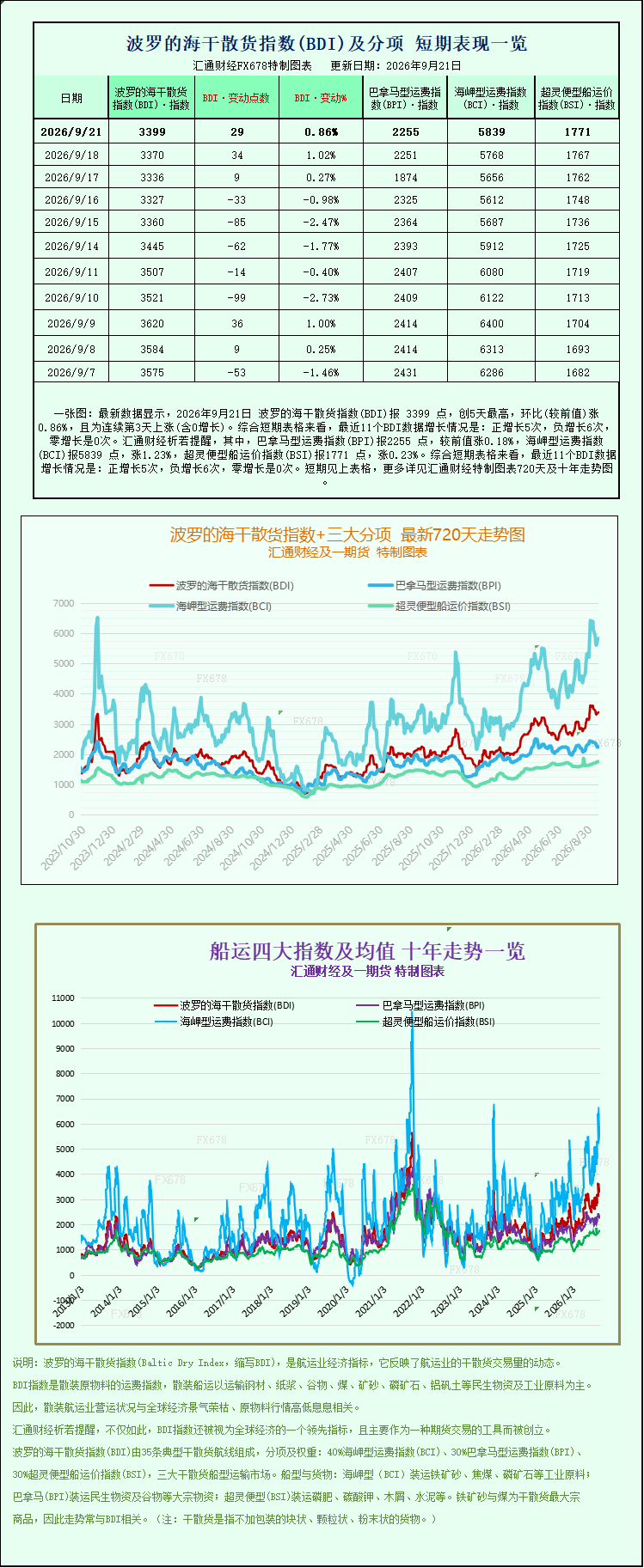 The Baltic Dry Index (BDI) rose on Monday, driven primarily by a simultaneous increase in freight rates across all vessel types, indicating a general improvement in the dry bulk shipping market. The BDI, a core benchmark for the industry, comprehensively tracks spot freight rates for Capesize, Panamax, and Supramax vessels. The index rose 29 points, or 0.8%, to close at 3399 points. This rise signifies a broad-based recovery in spot charter rates across the entire dry bulk shipping sector, moving beyond isolated price movements for a single vessel type and indicating a broad-based improvement in market fundamentals. By vessel type, the Capesize sector, the largest in terms of volume, led the gains. The Capesize freight rate index rose 71 points, or 1.2%, to close at 5839 points. The average daily earnings for Capesize vessels also increased, rising by $638 in a single day to reach $49,450 per day. Cape-class vessels are the largest and most important type of vessel in the dry bulk market, with a typical deadweight of approximately 150,000 tons. They primarily handle the ocean transport of bulk industrial raw materials such as iron ore and coal, serving as a barometer for the global trade in heavy industrial raw materials. The recent recovery in Cape-class vessel freight rates is largely driven by a slight increase in iron ore futures prices. Market traders generally expect that with the approach of the National Day Golden Week holiday, domestic steel companies will stock up in advance, increasing their purchases of raw materials like iron ore to prepare for post-holiday production. This expectation has pushed up iron ore forward contract prices, thereby stimulating demand for ocean-going ore shipping, with charterers locking in Cape-class vessel capacity in advance. However, the potential for further iron ore price increases is limited by high port inventories, meaning that the shipping benefits brought by iron ore are not a strong stimulus but rather a temporary stockpiling-driven phenomenon rather than a long-term reversal of the supply-demand balance. The continuously accumulating ore inventories at ports will restrict steel mills' willingness to make sustained, large-scale purchases. Once the pre-holiday stockpiling window closes, there is a risk of a decline in subsequent ore trading and shipping demand. Panamax vessels also saw a slight increase. The Panamax freight rate index rose 4 points, or 0.18%, to 2255 points. The average daily earnings per Panamax vessel increased by $35, currently standing at $20297. Panamax vessels generally have a deadweight range of 60,000 to 70,000 tons, with core cargoes being coal and grain, and routes covering global grain exporting countries and Asia-Pacific coal trade corridors. Freight rate fluctuations for this vessel type largely follow the pace of global energy trade and agricultural exports. This slight increase benefited from both a recovery in overall dry bulk market sentiment and stable global grain exports, coupled with supportive coal transportation demand from Asia-Pacific thermal power plant restocking, which helped stabilize and slightly raise Panamax vessel charter rates. However, compared to Capesize vessels, the increase in Panamax was weaker, reflecting that the demand surge in grain and coal trade was not as strong as the pre-holiday stockpiling of iron ore. The small vessel sector also maintained an upward trend. The Supramax freight rate index rose slightly by 4 points, or 0.2%, to close at 1771 points. Supramax vessels, with their smaller tonnage and greater route flexibility, are primarily used for short-haul and small-volume bulk cargo transportation, covering commodities such as sand, fertilizer, and small-volume grains. Freight rate fluctuations for this vessel type typically reflect the regional short-haul trade climate. Their simultaneous rise with the broader market indicates not only a recovery in long-distance bulk shipping demand but also an increase in short-haul bulk cargo transportation activities between regions, demonstrating a broader market recovery. From a market structure perspective, the simultaneous rise across all vessel types is the most crucial characteristic of this market trend. Historically, dry bulk market increases have often been driven by a single vessel type: for example, only Capesize vessels saw strong demand due to iron ore, while freight rates for small and medium-sized vessels remained low; or only Panamax and Supramax vessels performed well during the peak grain export season, while large vessels saw no market activity. This time, however, all three vessel types saw gains, representing an overall increase in global dry bulk cargo flow activity, rather than a localized trend driven by a single cargo type. However, it's also important to objectively recognize the significant divergence in price increases among different vessel types. Capesize vessels significantly outperformed Panamax and Supramax vessels in terms of index points, absolute increases, and daily earnings growth. This divergence indicates that the core engine of this market rally remains pre-holiday iron ore stockpiling demand, with other vessel types largely following the market trend and exhibiting weaker endogenous driving forces. On the supply side, the pace of vessel capacity deployment also affects freight rate elasticity. The continuous increase in new ship launches in recent years has significantly boosted the total capacity of the dry bulk fleet, suppressing freight rate ceilings in the long term. In the current environment, even with a short-term recovery in demand, a sustained and substantial surge in freight rates remains difficult. This current rise is more of a phase of correction than a restart of a super shipping bull market. Once domestic steel mills complete their pre-holiday raw material purchases and iron ore ocean shipping orders decline, Capesize vessel freight rates are likely to be the first to come under pressure, subsequently dragging down the entire dry bulk index. On the demand side, two key themes need to be closely monitored. The first is the sustainability of domestic steel industry operations; whether steel mills maintain their raw material purchase pace after the Golden Week holiday will directly determine whether the demand for iron ore ocean shipping can continue. Secondly, the pace of global grain exports and changes in coal import demand in the Asia-Pacific region determine the support for Panamax and Supramax freight rates. In addition, port operational efficiency and weather-related vessel delays can also temporarily alter the effective supply of shipping capacity, causing short-term fluctuations in freight rates. Overall, Monday's rise in the Baltic Dry Index reflects a short-term positive for the dry bulk market. Expectations of pre-holiday raw material stockpiling in China boosted iron ore shipping demand, driving the overall market higher and lifting freight rates across all vessel types. However, medium- to long-term suppressing factors such as inventory and new vessel capacity have not disappeared, limiting the upside potential of this round of increases. Further market movements will require continued monitoring of changes in the fundamentals of the freight and trade sectors.
The Baltic Dry Index (BDI) rose on Monday, driven primarily by a simultaneous increase in freight rates across all vessel types, indicating a general improvement in the dry bulk shipping market. The BDI, a core benchmark for the industry, comprehensively tracks spot freight rates for Capesize, Panamax, and Supramax vessels. The index rose 29 points, or 0.8%, to close at 3399 points. This rise signifies a broad-based recovery in spot charter rates across the entire dry bulk shipping sector, moving beyond isolated price movements for a single vessel type and indicating a broad-based improvement in market fundamentals. By vessel type, the Capesize sector, the largest in terms of volume, led the gains. The Capesize freight rate index rose 71 points, or 1.2%, to close at 5839 points. The average daily earnings for Capesize vessels also increased, rising by $638 in a single day to reach $49,450 per day. Cape-class vessels are the largest and most important type of vessel in the dry bulk market, with a typical deadweight of approximately 150,000 tons. They primarily handle the ocean transport of bulk industrial raw materials such as iron ore and coal, serving as a barometer for the global trade in heavy industrial raw materials. The recent recovery in Cape-class vessel freight rates is largely driven by a slight increase in iron ore futures prices. Market traders generally expect that with the approach of the National Day Golden Week holiday, domestic steel companies will stock up in advance, increasing their purchases of raw materials like iron ore to prepare for post-holiday production. This expectation has pushed up iron ore forward contract prices, thereby stimulating demand for ocean-going ore shipping, with charterers locking in Cape-class vessel capacity in advance. However, the potential for further iron ore price increases is limited by high port inventories, meaning that the shipping benefits brought by iron ore are not a strong stimulus but rather a temporary stockpiling-driven phenomenon rather than a long-term reversal of the supply-demand balance. The continuously accumulating ore inventories at ports will restrict steel mills' willingness to make sustained, large-scale purchases. Once the pre-holiday stockpiling window closes, there is a risk of a decline in subsequent ore trading and shipping demand. Panamax vessels also saw a slight increase. The Panamax freight rate index rose 4 points, or 0.18%, to 2255 points. The average daily earnings per Panamax vessel increased by $35, currently standing at $20297. Panamax vessels generally have a deadweight range of 60,000 to 70,000 tons, with core cargoes being coal and grain, and routes covering global grain exporting countries and Asia-Pacific coal trade corridors. Freight rate fluctuations for this vessel type largely follow the pace of global energy trade and agricultural exports. This slight increase benefited from both a recovery in overall dry bulk market sentiment and stable global grain exports, coupled with supportive coal transportation demand from Asia-Pacific thermal power plant restocking, which helped stabilize and slightly raise Panamax vessel charter rates. However, compared to Capesize vessels, the increase in Panamax was weaker, reflecting that the demand surge in grain and coal trade was not as strong as the pre-holiday stockpiling of iron ore. The small vessel sector also maintained an upward trend. The Supramax freight rate index rose slightly by 4 points, or 0.2%, to close at 1771 points. Supramax vessels, with their smaller tonnage and greater route flexibility, are primarily used for short-haul and small-volume bulk cargo transportation, covering commodities such as sand, fertilizer, and small-volume grains. Freight rate fluctuations for this vessel type typically reflect the regional short-haul trade climate. Their simultaneous rise with the broader market indicates not only a recovery in long-distance bulk shipping demand but also an increase in short-haul bulk cargo transportation activities between regions, demonstrating a broader market recovery. From a market structure perspective, the simultaneous rise across all vessel types is the most crucial characteristic of this market trend. Historically, dry bulk market increases have often been driven by a single vessel type: for example, only Capesize vessels saw strong demand due to iron ore, while freight rates for small and medium-sized vessels remained low; or only Panamax and Supramax vessels performed well during the peak grain export season, while large vessels saw no market activity. This time, however, all three vessel types saw gains, representing an overall increase in global dry bulk cargo flow activity, rather than a localized trend driven by a single cargo type. However, it's also important to objectively recognize the significant divergence in price increases among different vessel types. Capesize vessels significantly outperformed Panamax and Supramax vessels in terms of index points, absolute increases, and daily earnings growth. This divergence indicates that the core engine of this market rally remains pre-holiday iron ore stockpiling demand, with other vessel types largely following the market trend and exhibiting weaker endogenous driving forces. On the supply side, the pace of vessel capacity deployment also affects freight rate elasticity. The continuous increase in new ship launches in recent years has significantly boosted the total capacity of the dry bulk fleet, suppressing freight rate ceilings in the long term. In the current environment, even with a short-term recovery in demand, a sustained and substantial surge in freight rates remains difficult. This current rise is more of a phase of correction than a restart of a super shipping bull market. Once domestic steel mills complete their pre-holiday raw material purchases and iron ore ocean shipping orders decline, Capesize vessel freight rates are likely to be the first to come under pressure, subsequently dragging down the entire dry bulk index. On the demand side, two key themes need to be closely monitored. The first is the sustainability of domestic steel industry operations; whether steel mills maintain their raw material purchase pace after the Golden Week holiday will directly determine whether the demand for iron ore ocean shipping can continue. Secondly, the pace of global grain exports and changes in coal import demand in the Asia-Pacific region determine the support for Panamax and Supramax freight rates. In addition, port operational efficiency and weather-related vessel delays can also temporarily alter the effective supply of shipping capacity, causing short-term fluctuations in freight rates. Overall, Monday's rise in the Baltic Dry Index reflects a short-term positive for the dry bulk market. Expectations of pre-holiday raw material stockpiling in China boosted iron ore shipping demand, driving the overall market higher and lifting freight rates across all vessel types. However, medium- to long-term suppressing factors such as inventory and new vessel capacity have not disappeared, limiting the upside potential of this round of increases. Further market movements will require continued monitoring of changes in the fundamentals of the freight and trade sectors.
- Risk Warning and Disclaimer
- The market involves risk, and trading may not be suitable for all investors. This article is for reference only and does not constitute personal investment advice, nor does it take into account certain users’ specific investment objectives, financial situation, or other needs. Any investment decisions made based on this information are at your own risk.