Energy shocks, if kept under control, will lead to stability; if out of control, they will cause change. Who holds the fate of the euro against the dollar?
2026-09-22 08:34:16
On Tuesday (September 22) during Asian trading hours, the euro fluctuated slightly higher against the US dollar, currently trading around 1.1465, still hovering near its lowest level since the end of July. Amid this weakness, the latest statements from European Central Bank (ECB) officials have become a crucial clue for the market's assessment of the euro's future direction. ECB Executive Board member and Chief Economist Philip Lane stated that as long as the current energy shock does not worsen further, the eurozone economy should be able to maintain a steady but moderate growth pace. He also pointed out that the second round of energy price increases will first push up inflation, after which inflation will only begin to fall back towards the central bank's target from mid-2027. This statement outlines a two-stage inflation path of "rising first and then falling," suggesting that the ECB may need to tolerate higher inflation for a longer period and is unlikely to shift to a dovish stance in the short term. 
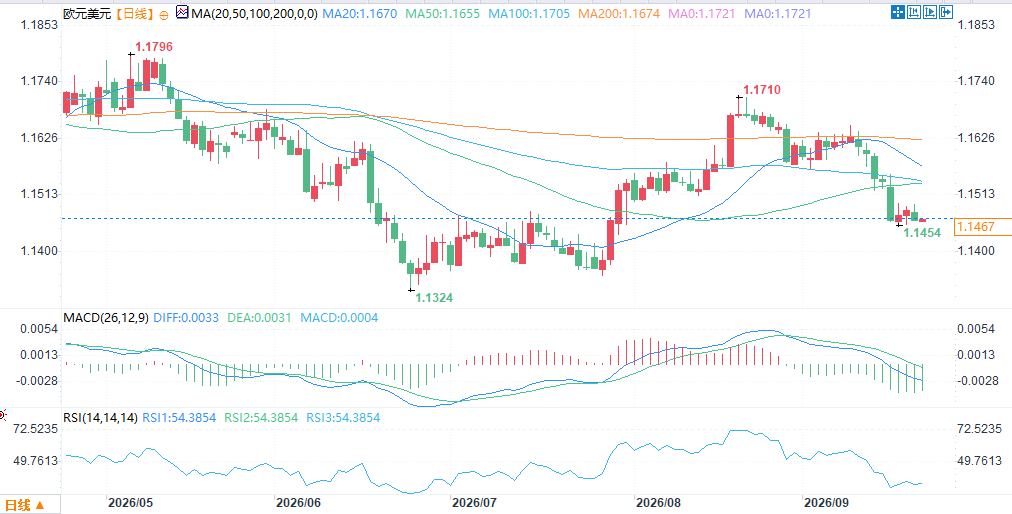 (Euro/USD daily chart, source: FX678) At 8:26 Beijing time, the euro was trading at 1.1466/67 against the US dollar.
Growth Outlook: Conditionally Remaining Robust
In a media interview, Ryan clearly stated that the Eurozone economy currently has the foundation to continue expanding at a robust but moderate pace, with domestic demand gradually recovering, the resilience of the service sector, and the continued support of the job market; overall momentum has not clearly stalled. However, he also attached a clear condition—the energy shock must not escalate further. Media reports indicate that this "conditional" statement means that the Eurozone's outlook is highly tied to oil and gas price movements, rather than locked into a fixed policy path. If escalating geopolitical conflicts in the Middle East and elsewhere lead to another sharp rise in energy prices, business costs and household real income will be under pressure, consumption and investment may slow, and central banks still have room to shift their tone on the growth outlook, and may even need to reassess their policy stance.Inflation Path: A second round of increases will occur first, before prices fall back to the target level by mid-2027.
Ryan pointed out that the second round of energy price increases will push up overall inflation through production costs, transportation expenses, and wage negotiations, and price pressures will persist for some time in the near term. Inflation will then gradually decline towards the ECB's 2% medium-term target starting in mid-2027. This timeline suggests that any meaningful slowdown in inflation will be delayed until after next year. This assessment is consistent with Ryan's public statements this year. He has repeatedly described the eurozone's energy-driven inflationary pressures as "manageable," provided that these pressures remain within a limited range and do not spread into a wider second-round effect. He has also previously clearly distinguished between one-off shocks that central banks can "see through" and persistent shocks that require a stronger policy response.Policy implications: Higher inflation needs to be tolerated for a longer period.
Ryan's comments point to a clear two-stage inflation path: a recent surge due to a second round of energy price increases, followed by a decline towards the target starting in mid-2027. If this timeline holds, the ECB may need to "see through" the high inflation over a longer period, maintaining its current policy stance and avoiding a premature shift to easing. This stance, if it reinforces market expectations of a stable policy from the central bank, could provide some support for the euro exchange rate. Meanwhile, more hawkish voices remain within the ECB. Previously, committee member Stournaras stated that a rate hike in October could be considered if energy costs or inflation surge. This indicates that disagreements remain within the Governing Council regarding the strength and timing of the response to energy shocks, and that room for policy discussion still exists.The euro's trajectory against the dollar depends on the interplay between the dollar and oil prices.
Ryan's remarks have a slightly neutral to slightly positive impact on the euro against the dollar, primarily due to the stability of policy expectations. He explicitly stated that inflation will not fall back to the target until mid-2027, implying that the ECB will not turn to interest rate cuts in the short term and even retains the possibility of further tightening. This contrasts with market expectations regarding the Fed's interest rate cut path. If expectations of a narrowing interest rate differential between the US and Europe intensify, the euro will receive support from the yield side. Furthermore, Ryan's conditional statement linking growth prospects to energy shocks effectively sets a key variable for the euro: as long as the situation in the Middle East does not deteriorate further and oil prices remain under control, Eurozone growth and policy resolve can be maintained, limiting the euro's downside potential. However, the euro's upside against the dollar also faces significant constraints. First, on the dollar side, the Fed's rate hike last week signaled a possible further tightening this year, leading to a stronger dollar index that directly suppresses the euro. Second, on the energy side, if the Middle East conflict escalates and pushes up oil prices, the Eurozone, as a net energy importer, will be far more impacted than the US, and deteriorating terms of trade will drag down the euro. This is why Ryan repeatedly emphasized the premise of "no escalation of the energy shock."Market Focus
The market will closely watch subsequent statements from ECB officials, the latest Eurozone inflation and growth data, and the actual movement of oil and gas prices to determine whether the timeline for "inflation falling back to target by mid-2027" can withstand the test of reality. Lane's conditional statement implies that the central bank's policy path will be flexibly adjusted according to changes in energy prices, rather than a pre-set fixed route. Any signal of escalating energy shocks could quickly alter market pricing in either interest rate hikes or continued interest rates.Summarize
Ryan's statement continues the core tone established since 2026: as long as the energy shock is contained, the Eurozone economy can maintain steady and moderate growth, but inflation will initially rise due to a second round of energy price increases, only falling back to the target level by mid-2027. This "rise first, then fall" path means the ECB is unlikely to shift to easing in the short term, which may provide some support for the euro. However, since both the growth and inflation outlook are predicated on the energy shock not escalating, the central bank's tone could quickly turn hawkish if oil and gas prices surge again. The market needs to continue to monitor the evolution of energy prices and Eurozone data. (Euro/USD daily chart, source: FX678) At 8:26 Beijing time, the euro was trading at 1.1466/67 against the US dollar.- Risk Warning and Disclaimer
- The market involves risk, and trading may not be suitable for all investors. This article is for reference only and does not constitute personal investment advice, nor does it take into account certain users’ specific investment objectives, financial situation, or other needs. Any investment decisions made based on this information are at your own risk.