The Reserve Bank of Australia (RBA) has officially stated that inflation risks are tilted to the upside, and the option of raising interest rates remains on the table.
2026-09-22 08:16:11
The Australian dollar traded in a narrow range against the US dollar during Asian trading hours on Tuesday (September 22), currently hovering around 0.7120. The market is closely watching the Australian dollar's future movement, influenced by the latest hawkish comments from Reserve Bank of Australia (RBA) officials. RBA Chief Economist Sarah Hunter stated that given the Middle East situation pushing up oil prices and domestic demand exceeding supply, the central bank may need to raise interest rates for the fourth time this year. The market has already priced in a 95% probability of a rate hike to 4.60% at the September 29 meeting and expects rates to peak at 4.85% early next year. Hunter's comments further reinforced the market's hawkish expectations rather than posing a challenge to them. 
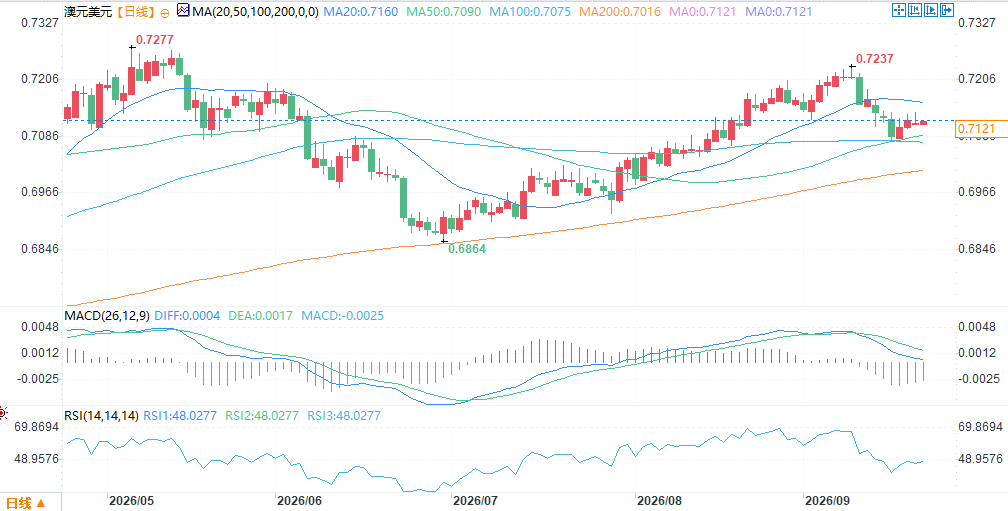 (Australian dollar against US dollar daily chart, source: EasyForex) At 8:12 Beijing time, the Australian dollar was trading at 0.7120/21 against the US dollar.
Reasons for raising interest rates: Inflation risks are tilted to the upside.
In a podcast, Hunt explicitly stated that the Reserve Bank of Australia's (RBA) board is most concerned about inflation persisting at excessively high levels for too long, potentially embedding itself into the price and wage-setting behavior of businesses and households, creating a self-reinforcing spiral. She specifically emphasized two major upside risks: first, the ongoing conflict in the Middle East continues to push up global energy prices, with rising crude oil prices directly impacting domestic gasoline retail prices and indirectly increasing logistics and transportation costs for goods such as food and building materials, further driving up overall prices; second, capacity constraints remain significant in some domestic regions, with strong demand for skilled workers in cities like Brisbane, Perth, and Adelaide, leading to localized labor market tensions and strong corporate bargaining power, which could easily push up service prices. Media reports indicate that since February, the RBA has cumulatively raised interest rates by 75 basis points, pushing the cash rate to a post-pandemic high of 4.35%, but core inflation remains at 3.6%, significantly higher than the central bank's 2%–3% target range. Market pricing indicates a 95% probability of a 25 basis point rate hike to 4.60% at the September 29 meeting, with interest rates expected to peak at around 4.85% early next year.Policy transmission mechanism: Interest rates respond to inflation, rather than trigger it.
In the interview, Hunt systematically clarified common misconceptions about monetary policy. She emphasized that interest rates are a tool to combat inflation, not the root cause of it: external shocks (such as rising oil prices) first push up prices, and the central bank then uses interest rate hikes to curb demand and anchor expectations; the relationship between the two is essentially one-way. The impact of interest rate hikes extends far beyond mortgage holders—although only about one-third of Australians hold home loans, rising interest rates reduce import costs through an appreciation of the Australian dollar, curb consumption by increasing savings returns, and adjust asset prices and the wealth effect through the broader real estate market, thus comprehensively impacting economic activity. Rent and interest rates are not simply correlated one-to-one. Recent rent increases are mainly due to labor shortages in the construction industry, rising material costs, and a long-term shortage of housing supply; these fundamental supply and demand factors have a far greater impact than interest rates themselves.Financial stability: No systemic mortgage pressure observed.
Hunt stated that there are currently no signs of a systemic mortgage crisis in the Australian financial system. The proportion of households with negative equity remains lower than pre-pandemic levels, with the significant house price increases of previous years providing borrowers with ample buffer space. More importantly, over 40% of mortgage-backed households have prepaid their mortgages for two years or more, effectively accumulating a substantial repayment buffer that can withstand pressure from short-term income shocks or rising interest rates. Banks maintain prudent loan approval standards, and the overall default rate remains low, indicating that household balance sheets are generally sound and financial stability risks are manageable.Australian Dollar vs. US Dollar Outlook
Hunt's hawkish remarks directly benefited the Australian dollar against the US dollar, primarily in terms of interest rate differential expectations. The market has priced in a 95% probability of the Reserve Bank of Australia (RBA) raising interest rates to 4.60% on September 29th. Given that the current cash rate for the Australian dollar is already higher than the Federal Reserve's target range, if the RBA raises rates as expected, the interest rate differential between Australia and the US dollar will narrow further, enhancing the attractiveness of the Australian dollar's yield. However, the actual movement of the Australian dollar against the US dollar is not solely determined by the RBA. Recently, the pair has also been suppressed by hawkish expectations from the Federal Reserve—the Fed's rate hike last week signaled a possible further tightening this year, and a stronger US dollar has limited the Australian dollar's upside potential. Furthermore, the Australian dollar is more sensitive to global risk sentiment and changes in US interest rates than the interest rate differential itself. If the situation in the Middle East escalates and triggers a safe-haven inflow into the US dollar, the Australian dollar's interest rate advantage is often offset. Therefore, Hunt's comments provided a floor for the Australian dollar, but whether it can break through the current trading range of 0.7100 to 0.7200 still depends on the direction of the US dollar and the evolution of risk appetite.Summarize
Hunt's comments indicate that the Reserve Bank of Australia (RBA) remains highly vigilant about upside risks to inflation, and that the option of raising interest rates remains on the table. The market has fully priced in a rate hike to 4.60% on September 29th, with the peak rate expected to reach 4.85% early next year. The Australian dollar and interest rate-sensitive assets are expected to closely watch RBA Governor Bullock's remarks at the post-policy press conference for confirmation of this hawkish tone. The RBA's forecasts assume inflation will ease over the next few years, but Hunt warned that further rate hikes are still possible if current upside risks materialize, with the next board opportunity to act being the September 29th meeting. (Australian dollar against US dollar daily chart, source: EasyForex) At 8:12 Beijing time, the Australian dollar was trading at 0.7120/21 against the US dollar.
- Risk Warning and Disclaimer
- The market involves risk, and trading may not be suitable for all investors. This article is for reference only and does not constitute personal investment advice, nor does it take into account certain users’ specific investment objectives, financial situation, or other needs. Any investment decisions made based on this information are at your own risk.