With Saudi Arabia under attack and the Houthis still active, the downside for oil prices is limited. What will the Indian rupee do next?
2026-09-22 15:54:16
On Tuesday (September 22), the US dollar traded around 95.80 against the Indian rupee during the European session, almost unchanged on the day, awaiting a meeting between US and Gulf leaders regarding Middle East energy supplies. Market experts believe that oil prices have limited downside potential amid ongoing tensions between Saudi Arabia and the Iranian-backed Houthi rebels. The US dollar outperformed other currencies due to strong expectations of a hawkish Federal Reserve. 
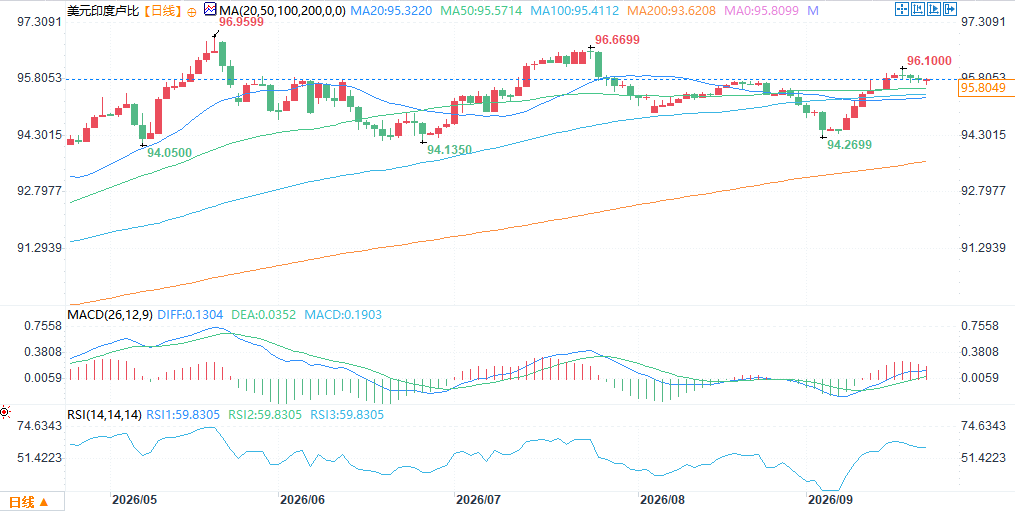 (USD/INR daily chart, source: FX678) At 15:48 Beijing time, the USD/INR exchange rate was 95.81/82.
Multilateral meetings during the UN General Assembly become the focus
Later Tuesday, Gulf leaders and the United States are likely to meet on the sidelines of the UN General Assembly in New York, where they are expected to discuss potential ways to increase Middle Eastern oil supplies. Whether US President Trump will meet with Iranian President Pezechzian is a key focus. Positive outcomes from these meetings would be detrimental to oil prices, thereby easing concerns about high global inflation expectations. For India, lower oil prices are beneficial to its currency, as India heavily relies on oil imports to meet its energy needs. The Indian rupee has been supported by the continued decline in oil prices in recent days.The attack on Saudi Arabia limited the downside potential for oil prices.
According to Al-Masirah TV, controlled by the Houthi rebels in Yemen, Saudi Arabian warplanes launched an airstrike on the Red Sea port city of Muha in Taiz province in southwestern Yemen early that morning, killing six people and injuring eight. The report stated that Saudi warplanes carried out three airstrikes on a residential house in Muha that day. Among the six dead were two children and one woman. Al-Masirah TV also broadcast footage of the dead and injured. Saudi Arabia has not yet responded to the report. Oil prices were pressured by optimism, with the market anticipating improved Saudi energy supplies and the country's commitment to exploring alternatives to increase oil shipments. However, financial market experts warned that the recent decline in oil prices may be limited due to ongoing tensions between Saudi Arabia and the Iranian-backed Houthi rebels. Analysts at OCBC Bank believe that crude oil prices may find "some new support" after a new round of attacks on Saudi Arabia last weekend, with the Houthis claiming to have launched missile and drone attacks on Saudi Aramco facilities in Riyadh and Yanbu. They noted that Saudi authorities reported that attacks in Yanbu and several other locations had been "thwarted, and no new damage was caused to oil infrastructure." Even so, OCBC believes that "the weekend's attacks on Saudi Arabia mean that supply/geopolitical risks remain, which may limit the downside for oil prices in the near term." Unless Saudi flows normalize and the attacks on energy infrastructure subside, further declines in oil prices may be limited.The Fed's hawkish expectations need to be verified by data.
A number of market experts have clearly stated that the recent strength of the US dollar is supported by expectations of a Federal Reserve rate hike. Last week, the Fed raised interest rates by 25 basis points to 3.75%-4.00% and hinted at at least one more rate hike this year. Experts believe that the firmly hawkish Fed expectations need to be validated by subsequent US data. HSBC analysts pointed out that the dollar "strengthened" after the decision. They emphasized that "the mid-range dot plot for 2026 suggests one more rate hike before the end of the year," and that "a significant portion of participants still expect further rate hikes in 2027." HSBC believes that "this path is more hawkish than 'one-time' but still below current market pricing," meaning they "do not expect a significant repricing of interest rate expectations or the dollar." Instead, the bank expects "market attention may focus on whether upcoming data validates expectations of the final rate hike this year," suggesting that further dollar appreciation will depend on how the data aligns with the Fed's expected path.Summarize
The Indian rupee's current movement is driven by both oil prices and the US dollar. The meeting between the US and Gulf states during the UN General Assembly, and the potential meeting between Trump and Peskov, are key events determining the direction of oil prices. A positive outcome from the meetings would benefit the rupee, as lower oil prices would support prices. However, the ongoing tensions between Saudi Arabia and the Houthis limit the downside potential of oil prices, potentially limiting the rupee's support. On the dollar side, the Fed's hawkish expectations have already been partially priced in, and further gains require confirmation from US data. Going forward, attention should be paid to the outcomes of UN General Assembly meetings, developments in the Middle East, US economic data, and oil price movements, as these factors will collectively determine the short-term direction of the USD/IRR exchange rate. (USD/INR daily chart, source: FX678) At 15:48 Beijing time, the USD/INR exchange rate was 95.81/82.
- Risk Warning and Disclaimer
- The market involves risk, and trading may not be suitable for all investors. This article is for reference only and does not constitute personal investment advice, nor does it take into account certain users’ specific investment objectives, financial situation, or other needs. Any investment decisions made based on this information are at your own risk.