Gold Trading Alert: The $4300 mark has been regained! Trump threatens to "destroy Iran," can the UN General Assembly bring a turning point?
2026-09-23 07:54:11
On Tuesday (September 22), the gold market witnessed a dramatic rebound after hitting a low. Spot gold fell by more than 1% intraday, breaking below the $4,300 per ounce mark, but recovered strongly in the late session, ultimately closing slightly higher. This movement reflects the core contradiction in the current market: on one hand, the rising expectations of a Federal Reserve rate hike and high real interest rates are putting downward pressure on gold; on the other hand, the ongoing conflict in the Middle East continues to disrupt energy prices and safe-haven demand. On Wednesday (September 23) in early Asian trading, spot gold fluctuated narrowly, currently trading at $4,358.80 per ounce. Gold is at a crucial crossroads—after falling more than 22% from its record high in January, will it continue to face pressure, or will it prepare for a new round of rebound? 
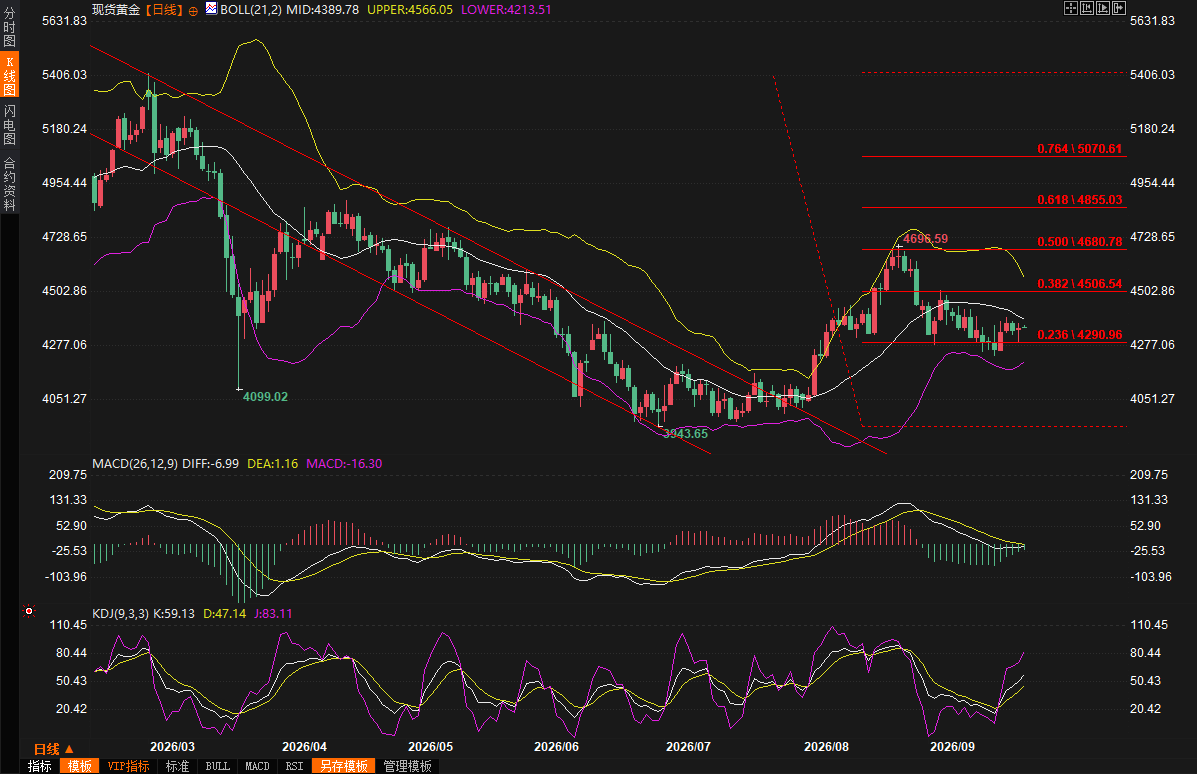 (Spot gold daily chart, source: EasyTrade) At 07:50 Beijing time, spot gold is currently trading at $4358.43 per ounce.
The direct drivers of gold price volatility: the dual pressure from interest rate expectations and the dollar's performance.
On Tuesday, spot gold touched a low of $4,291.46 per ounce, a daily drop of 1.15%, before gradually recovering to close at $4,358.30, a gain of approximately 0.34%. U.S. gold futures closed slightly lower by 0.2%, settling at $4,376.40. Bart Melek, global head of commodities strategy at TD Securities, offers a representative view: despite the decline in oil prices, the market is still heavily pricing in expectations of further interest rate hikes by the Federal Reserve, and the slight strengthening of the dollar in recent days has put direct pressure on gold. The market's pricing in monetary policy is already quite aggressive. According to the CME FedWatch tool, traders believe there is a 90% chance of a Fed rate hike in December. St. Louis Fed President Musalaim and Chicago Fed President Goolsby both hinted that it is necessary to continue tightening policy to address the inflation risks from strong demand and rising energy prices. The Fed just completed its first rate hike since 2023 last week, and Chairman Warsh has more clearly signaled possible further action in the coming months. Against this backdrop, rising real interest rates directly increase the opportunity cost of holding gold, naturally reducing its attractiveness as a non-interest-bearing asset. Meanwhile, the US dollar index rose amid fluctuations, briefly touching a two-month high. A strong dollar typically has a negative correlation with gold prices, further amplifying short-term downward pressure. Since hitting a record high of $5,594.82 per ounce in January, gold has fallen by more than 22%, fully demonstrating the profound impact of shifting interest rate expectations on precious metal pricing.The ripple effects of the Middle East conflict: a tug-of-war between energy prices, inflation concerns, and safe-haven demand.
What truly complicates the gold price trend is the ongoing situation in the Middle East. Since the outbreak of the US-Israel military action against Iran at the end of February, energy prices have risen sharply, global inflationary pressures have resurfaced, and many central banks have been forced to adopt restrictive policy stances. This chain reaction ultimately transmitted to the gold market, creating a significant suppressive effect. Tuesday's oil price performance provided another perspective. Brent crude futures closed down more than 1% at $99.25 per barrel, and US crude futures fell to $94.99, both hitting two-week lows. The driving factor was the improvement on the supply side: the Saudi East-West oil pipeline resumed operation, exports from Yanbu port are expected to restart, and ship traffic in the Strait of Hormuz increased. Iran even hinted that if the US eases military pressure and lifts the port blockade, the Strait could be reopened within seven days. These signals gave the market hope for a supply recovery, and the decline in oil prices temporarily eased some inflation concerns. The US Treasury market reacted quickly. The two-year Treasury yield fell from its intraday high, and the 10-year yield also declined slightly, reflecting the easing of inflation expectations due to the drop in oil prices. This attracted bargain hunters, providing support for gold prices. However, expectations of further interest rate hikes by the Federal Reserve limited the downside for yields, thus limiting gold's gains. The market's probability of an October rate hike remains around 55%, indicating that the policy path is far from clear. Notably, Trump's remarks at the UN General Assembly added new uncertainty to the situation. On the one hand, he warned that if a peace agreement could not be reached, he might "completely destroy" Iran; on the other hand, he stated that he expected an agreement with Iran to be reached only after the November midterm elections and revealed that US officials had held productive talks with mediators. This "fighting while negotiating, threatening while engaging in diplomacy" stance has caused the market's assessment of when the conflict will end to fluctuate repeatedly. If the conflict prolongs, energy prices may surge again, inflationary pressures may return, and central banks' hawkish stances may be reinforced, putting sustained downward pressure on gold. If diplomatic progress accelerates, safe-haven demand may decline temporarily, but interest rate expectations may also adjust accordingly.In-depth observation of market structure and sentiment: repricing after the pullback from record highs
The sharp decline in gold prices from historical highs is essentially a repricing of the market's expectation of "high interest rates lasting longer." In the early stages of the war, safe-haven demand and inflation concerns pushed gold prices to extreme highs, but as central bank policy responses materialized, rising real interest rates gradually took over. The current fluctuation of gold prices between $4300 and $4400 reflects a temporary balance between bullish and bearish forces: bears are betting on a steeper interest rate path, while bulls are focusing on geopolitical risk premiums and long-term allocation needs. From a broader perspective, the Middle East conflict has profoundly altered the linkage between global commodities and monetary policy. The risk of energy supply disruptions is no longer a short-term shock, but a long-term variable that may continuously affect inflation expectations and central bank response functions. As a traditional inflation hedge and safe-haven asset, gold's pricing model has seen a significant increase in geopolitical weight, but its interest rate sensitivity is equally undeniable. This tug-of-war between the two determines that gold prices are unlikely to move in one direction. Every combination of the dollar's performance, oil price fluctuations, and speeches by Federal Reserve officials can trigger short-term volatility in gold prices. Investors should be wary that the market has largely priced in a high probability of a December rate hike. If subsequent data or official statements show signs of easing, gold may have room for a phase of recovery; conversely, if the conflict escalates or inflation data deteriorates again, gold prices may test lower support levels.A crossroads: rebalancing short-term pressure with long-term logic
In summary, the rebound in gold prices is driven by a complex situation shaped by both a high-interest-rate environment and uncertainty in the Middle East. The Federal Reserve's policy path remains the dominant short-term variable, while geopolitics provides a catalyst for volatility and potential safe-haven support. Gold has significantly corrected from its extremely optimistic pricing, and current levels reflect interest rate realities rather than completely negating its long-term investment value. In the coming months, the market will closely watch subsequent statements from Federal Reserve officials, diplomatic developments before and after the midterm elections, and the actual recovery of energy supplies. If a peace agreement is achieved after the election, as Trump has stated, oil prices and inflation expectations may decline further, and the interest rate path may adjust, potentially providing gold with clearer directional guidance. Until then, gold prices may continue to test the waters between bottoming out and rebounding, testing investors' patience and risk assessment. (Spot gold daily chart, source: EasyTrade) At 07:50 Beijing time, spot gold is currently trading at $4358.43 per ounce.
- Risk Warning and Disclaimer
- The market involves risk, and trading may not be suitable for all investors. This article is for reference only and does not constitute personal investment advice, nor does it take into account certain users’ specific investment objectives, financial situation, or other needs. Any investment decisions made based on this information are at your own risk.