With demand falling and prices rising, will the Reserve Bank of Australia raise interest rates next week?
2026-09-23 08:20:13
Preliminary survey data released by S&P Global on Wednesday (September 23) showed that Australia's private sector growth slowed to its weakest level in the third quarter in September, with manufacturing falling back into contraction and companies laying off workers for the first time since May. The Flash Composite Output Index fell to 50.8 in September from 52.7 in August, marking the fourth consecutive month above the 50-point threshold separating expansion from contraction, but showing only slight growth. Services activity slowed to 51.4, and the manufacturing PMI fell to 49.3, the first time it has fallen below 50 since March, with factory output declining at its fastest pace in 21 months. 
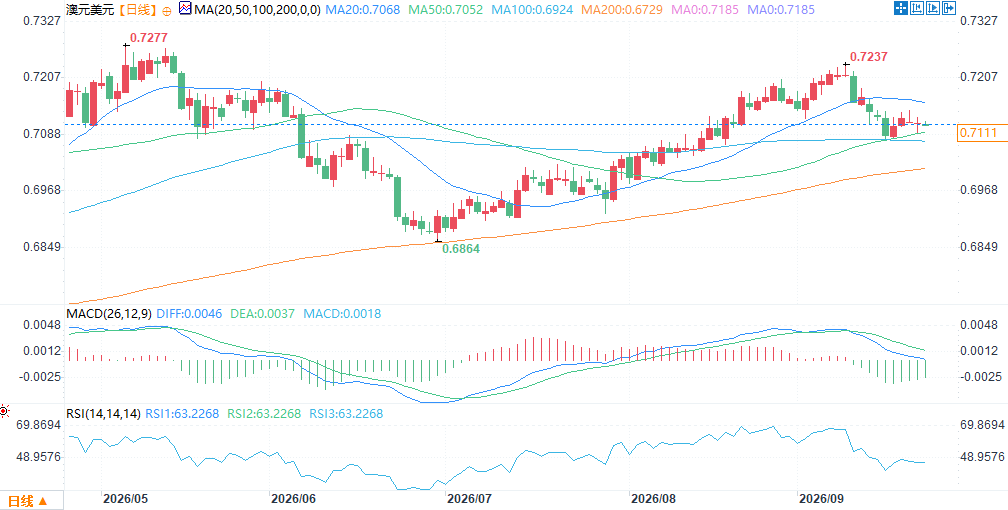 (AUD/USD daily chart, source: FX678)
Growth momentum weakens, with manufacturing becoming the main drag.
The Flash Composite Output Index fell to 50.8 in September, a significant drop from 52.7 in August, marking the lowest level in the third quarter. Although it remained above the 50-point mark for the fourth consecutive month, growth momentum has weakened considerably, showing only a slight expansion. The service sector continued to be the main driver of growth, with the index falling from 53.2 to 51.4, slowing for the second consecutive month, indicating that demand for consumer and business services is gradually cooling. Manufacturing became the biggest drag, with the PMI falling from 52.0 to 49.3, the first time it has fallen below 50 since March. Factory output contracted at its fastest pace in 21 months, and new orders declined again. Weakening demand was the core reason: while total new business grew for the third consecutive month, the growth rate was the slowest in this round of expansion; new export orders declined for the fifth time in six months, mainly dragged down by weak commodity producers. The contraction in the order book and the accelerated decline in output reinforced each other, indicating that the manufacturing supply chain and end-user demand are under pressure simultaneously, and the overall private sector is shifting from moderate expansion to near stagnation.The employment market signals warrant attention, with companies laying off employees for the first time in four months.
Private sector employment fell for the first time in four months, albeit at a moderate pace, but the largest drop since October 2020. Layoffs were widespread across multiple sub-sectors of manufacturing and services, reflecting proactive adjustments to workforce allocation by companies amid slowing demand. Backlogs remained slightly higher, indicating that some companies have not yet fully absorbed existing orders, but confidence has clearly weakened. Business confidence fell to a three-month low and further below the long-term average, with respondents generally expressing concerns about rising costs, demand uncertainty, and difficulty in customer retention. Economists at S&P Global Market Intelligence noted that the economy ended the quarter on a weaker foundation, but overall growth was maintained, outperforming the slump of the second quarter. The simultaneous slowdown in employment and output suggests that the labor market may be entering a cautious adjustment phase. If demand remains weak in the future, the scope of layoffs may expand further, placing additional constraints on household consumption and overall economic momentum.Price pressures are moving in the opposite direction to activity, with Middle Eastern energy costs being the main driver.
Price pressures contrast sharply with the slowdown in activity. Input cost inflation rose to a three-month high, with respondents frequently citing the Middle East conflict and its impact on energy and fuel costs as the main driver. Output prices rose at a robust pace, faster than in August, indicating that businesses still have some capacity to pass on costs. S&P Global emphasizes that current inflation remains well below second-quarter levels. Cost pressures are primarily concentrated in the service sector, with some easing in manufacturers' input inflation, but longer delivery times for suppliers reflect ongoing logistics and supply chain frictions. This combination of "cooling activity and rising prices" sends mixed signals to the Reserve Bank of Australia: weak demand and job losses support a cautious wait-and-see approach, while accelerating sales prices maintain the rationale for raising interest rates to combat inflation. Energy costs, as a key transmission channel, will directly determine inflation stickiness and the policy path.Impact on the Reserve Bank of Australia and the Australian dollar
The data was released just before the Reserve Bank of Australia's (RBA) policy meeting on September 29, and the market widely expects a rate hike. Slowing demand and declining employment point to a cooling economy, but stronger selling prices will keep the policy focus on inflation risks. Since the market has already largely priced in a rate hike this week, this data will have limited impact on next week's decision, but is more likely to influence expectations for November and beyond. Energy remains a key variable, with Middle Eastern fuel costs explicitly listed as a major factor putting pressure on input prices; oil price fluctuations will directly influence Australia's inflation outlook. For the Australian dollar, weakening growth momentum presents a mild headwind, but expectations of interest rate differentials may still dominate short-term movements. Currently, the four major Australian banks unanimously predict that the RBA will raise interest rates to 4.60% on September 29. If subsequent employment and demand data weaken further, and inflation does not decline significantly, the policy path may see more divergence and volatility. (AUD/USD daily chart, source: FX678)Summarize
Australia's preliminary September PMI readings revealed a mix of slowing growth and price pressures: the composite index fell to a third-quarter low, manufacturing contracted, and companies laid off workers for the first time in four months. However, input cost inflation rose to a three-month high, and output prices accelerated, primarily driven by Middle Eastern energy costs. This mixed signal presents a dilemma for the Reserve Bank of Australia's (RBA) decision on September 29th, but the market has already largely priced in a rate hike, and the data is likely to have a greater impact on November expectations. For the Australian dollar, weakening growth momentum presents a mild headwind, but interest rate differentials remain the dominant factor. Going forward, attention should be paid to the RBA's decision on September 29th, the final manufacturing PMI reading on October 1st, the final services and composite PMI readings on October 5th, and the continued impact of oil price movements on Australia's inflation outlook. At 8:17 AM Beijing time, the Australian dollar was trading at 0.7111/12 against the US dollar.- Risk Warning and Disclaimer
- The market involves risk, and trading may not be suitable for all investors. This article is for reference only and does not constitute personal investment advice, nor does it take into account certain users’ specific investment objectives, financial situation, or other needs. Any investment decisions made based on this information are at your own risk.